
Tucson winters are mild, but they still catch homes off guard. Normal overnight lows sit around 40 degrees Fahrenheit in December and January, and most winters bring roughly 10 freezing nights, enough to crack an exposed backflow preventer, reveal a heater that has not run since spring, or trigger a sewer smell from drains that dried out over the summer. This winter home maintenance checklist covers what actually matters in the desert: waking up your heating system, protecting outdoor plumbing before a freeze warning, keeping your home safe while the heat runs, and a quick section for seasonal residents arriving from out of state.
Key Takeaways
- Tucson averages about 10 freezing nights per winter. Exposed outdoor pipes, irrigation lines, and backflow preventers carry the most risk.
- Test your heating system before the first cold night, not on it.
- Carbon monoxide detectors are essential in any home with a gas furnace, water heater, or attached garage.
- Seasonal residents arriving for winter should run every drain and test heat before the first cold snap.
- Small leaks and drips are easier and less expensive to fix in fall than after a freeze.
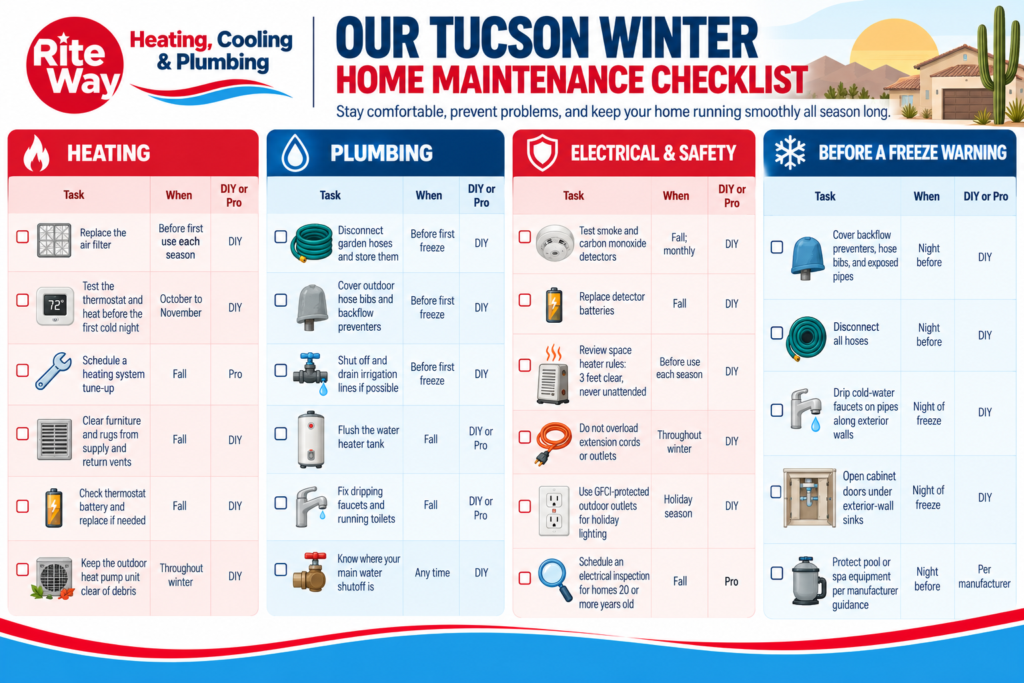
How Cold Does It Get in Tucson?
According to the NWS, Tucson’s average December and January overnight lows hover around 39 to 41 degrees Fahrenheit at the airport station. A typical winter brings roughly 10 nights at or below freezing. Sierra Vista and higher-elevation communities in Southern Arizona see colder conditions, with average January lows around 34 degrees Fahrenheit and more consistent overnight freezes through the season.
This is not a freeze-all-week scenario like northern climates, but it is enough to split an unprotected hose bib or crack irrigation lines before sunrise. The pipes and equipment at risk in a Tucson home are specific: outdoor and garage-mounted plumbing, backflow preventers, irrigation systems, and pipes running along exterior walls.
Get Your Heating System Ready
Most Tucson heating systems sit idle from April through October. Dust collects in the filter, debris settles around the outdoor heat pump unit, and small issues that developed at the end of last season go unnoticed until the heat goes on for the first time.
Replace the air filter before the first run of the season. Monsoon season fills filters with dust and particulates that build up over the summer even without the heat running. A fresh filter at the start of winter costs a few dollars and protects both efficiency and air quality.
Test the heat before the first cold night. Turn the thermostat to heat mode and set it a few degrees above room temperature. A brief dust smell on the first run is normal as residue burns off the heat exchanger. If the system blows cold air, trips a breaker, or makes unfamiliar sounds, something needs attention before the weather drops. For more on what causes a heater to blow cold air, Rite Way’s post on HVAC not blowing warm air covers the most common causes in Tucson and Phoenix homes.
A professional heating system tune-up before winter is the most effective way to catch what a visual check cannot. If your home uses a heat pump, heat pump maintenance keeps the reversing valve and defrost system ready for the cold months. For ceiling fans, switching to clockwise on low during the heating season helps distribute warm air more evenly; our ceiling fan direction guide explains when to switch in Arizona.
How to Keep Pipes From Freezing in Tucson
Unlike northern climates, most Tucson homes do not have basement pipes or crawlspaces to worry about. The freeze risk is specific: hose bibs, backflow preventers, irrigation valves and lines, water softener and RO lines in garages, pool and spa equipment, and pipes running along exterior walls.
Before the first freeze warning of the season:
- Disconnect and store all garden hoses
- Cover outdoor hose bibs and backflow preventers with insulated covers
- Shut off irrigation at the controller and drain lines if possible
- Wrap exposed pipes on exterior walls with foam pipe insulation
On a night a freeze is forecast: drip cold-water faucets fed by pipes along exterior walls and open the cabinet doors beneath those sinks to let warm interior air circulate around the pipes.
Heat tape can protect specific exposed sections when insulation alone is not enough. Use only products rated for the application, follow the manufacturer’s installation instructions, and do not overlap the tape on itself.
If a pipe freezes, open the faucet and apply gentle heat with a hair dryer, working from the faucet toward the frozen section. Never use an open flame. If a pipe bursts, shut off the main water valve immediately and call Rite Way for 24/7 emergency plumbing. If you are not sure where the main shutoff is, find it before freeze season starts.
Water Heater and Leak Checks
Fall is a good time to flush sediment from the water heater tank. In Tucson’s hard water supply, mineral buildup accumulates faster than in most cities and reduces efficiency over time. Rite Way’s water heater maintenance guide walks through the full process step by step.
Check around the base of the water heater, under sinks, and at supply line connections for drips or moisture. A small drip caught in fall is a straightforward repair. The same leak ignored through winter can become a bigger problem. Rite Way’s Smart Water Valve detects unusual water usage and shuts off the supply automatically, which is particularly useful for seasonal residents or anyone whose water heater sits in a garage that does not get checked regularly.
Electrical and Carbon Monoxide Safety
Test every smoke detector and carbon monoxide detector in the home before the heating season. Replace batteries at the same time so you are not chasing a low-battery chirp in the middle of the night.
Carbon monoxide is odorless and colorless, and the heating season is when the risk increases. Any home with a gas furnace, gas water heater, or attached garage should have CO detectors installed near sleeping areas. If a CO alarm sounds, leave the home immediately and call 911. For gas appliances, if you smell gas at any time, leave and call 911 and Southwest Gas from outside.
Space heaters cause a significant share of home fires each winter. Keep them at least three feet from anything flammable, never leave them unattended, and turn them off before sleeping.
If your home is 20 or more years old and has not had an electrical review in some time, an electrical inspection before winter is worthwhile. Older homes can have wiring that predates modern safety standards, and holiday lighting and space heaters add load to the system through the season. Rite Way also handles panel repair and installation if an inspection finds anything that needs attention.
Arriving for the Winter? A Quick Checklist for Seasonal Homes
Many Southern Arizona communities, including Green Valley, Saddlebrooke, and Sierra Vista, welcome a large number of seasonal residents each fall. If the home has been sitting empty since spring, a few quick checks before the first cold night make a real difference.
Run every faucet, shower, and floor drain for a minute. Drains that sit unused through the hot, dry summer months lose the water in their P-traps, which is what normally blocks sewer gas from entering the home. A sewer smell throughout the house after returning is almost always dry traps. Running each drain for thirty seconds resolves it. If the smell persists, Rite Way’s post on drain smells like rotten eggs explains the other common causes.
Test the water heater, run the heat for a few minutes before the first cold night, and check all smoke and CO detectors. If you plan to leave again in spring, consider the Smart Water Valve to protect the home while it sits empty.
Ready for Winter? Rite Way Is.
Rite Way’s licensed technicians handle heating tune-ups, heat pump maintenance, plumbing repairs, water heater service, and electrical inspections across Tucson, Sierra Vista, and Southern Arizona. If something on your checklist needs a pro, we give you honest options and upfront pricing before any work begins. We have been serving Arizona homeowners since 1959 and answer phones 24/7.
