A little water heater maintenance goes a long way, and in Tucson and Phoenix, it goes further than most homeowners realize. Arizona’s hard water carries dissolved minerals that settle as sediment inside the tank faster than in most parts of the country. Add the fact that water heaters here typically sit in garages that reach extreme temperatures in summer, and you have conditions that put more stress on a unit than national averages suggest. Generic maintenance schedules like flushing once a year or testing the valve every few years are often the minimum, not the ideal, for an Arizona home.
Below is a simple checklist, step-by-step instructions for the most common tasks, guidance for tankless owners, and a clear breakdown of what you can do yourself versus what is better left to a licensed plumber.
Key Takeaways
- Arizona’s hard water accelerates sediment buildup and anode rod wear. Most Tucson and Phoenix homeowners should flush more often than once-a-year national guidelines suggest.
- The T&P relief valve discharges hot water when tested, not air. Stand clear and have a bucket ready.
- Never restore power to an electric water heater until the tank is completely full after flushing.
- Tankless water heaters still need maintenance. Descaling is especially important in hard water markets like Tucson and Phoenix.
- A T&P valve that drips constantly may be a pressure issue, not just a bad valve.
Water Heater Maintenance Checklist
Use this as a quick reference. Because Tucson and Phoenix have hard water, lean toward the more frequent end of each range.
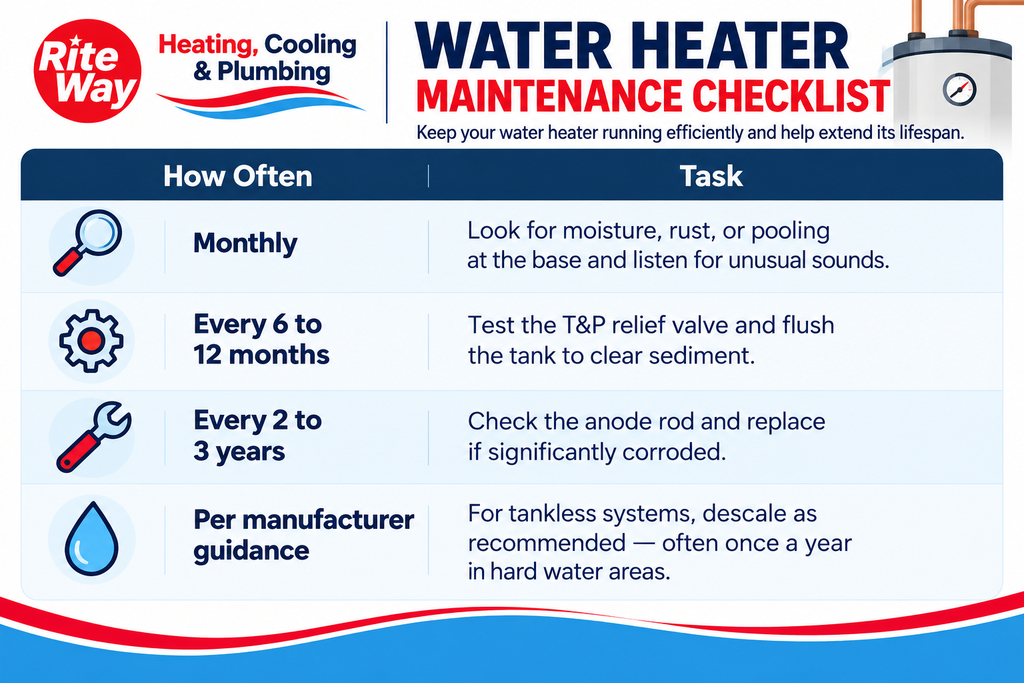
Some manufacturers note that regular maintenance may be required to keep a warranty valid. Check your documentation for the specifics that apply to your unit.
Check for Leaks, Rust, and Moisture
Once a month, take a quick look around the water heater. In Arizona, units typically sit in garages, utility closets, or on slab floors, out of the way and easy to overlook. A monthly check takes two minutes and can catch a small drip before it becomes a flood.
Look for:
- Moisture or pooling water at the base of the tank
- Rust-colored stains on the tank body or connections
- Corrosion at the inlet and outlet fittings
- Dripping or staining around the T&P valve discharge pipe
A small drip at a fitting may be a simple fix. Water pooling beneath the tank often points to internal corrosion and a failing unit. If you notice active leaking, shut off the water supply and power first, then contact Rite Way for water heater repair.
Rite Way also offers a Smart Water Valve that detects unusual water usage and shuts off the supply automatically, which is a useful option for a unit in a garage or utility room that isn’t checked regularly.
How to Test the Temperature and Pressure Relief Valve
The T&P valve releases pressure if the tank overheats or internal pressure climbs too high. Test it every six to twelve months.
Before you begin: The valve discharges hot water through the discharge pipe, not air. Make sure the pipe routes to a floor drain or safe area and is not directed toward anyone nearby.
- Place a bucket near the discharge pipe or confirm it routes to a safe drain.
- Lift the lever briefly, just a second or two, then release.
- Hot water should flow while open and stop completely when released.
- If the valve will not open, won’t stop dripping, or drips on its own, it needs to be replaced.
Constant dripping is not always a bad valve. High pressure or thermal expansion can cause it to release as a safety response. Tucson Water’s 2025 Annual Water Quality Report recommends a pressure-regulating valve when home pressure exceeds 80 psi. A plumber can test your pressure and determine whether a PRV or expansion tank is the real fix.
How to Flush a Water Heater
Flushing removes sediment from the bottom of the tank. In Tucson and Phoenix, where the water supply is largely Colorado River sourced and carries dissolved minerals, sediment builds up faster than in softer-water markets. At least once a year is the baseline, and more often if you hear popping or rumbling.
Safety note: Tank water is hot. Let the system sit unused for an hour before draining to lower the temperature. Never restore power to an electric water heater until the tank is completely full.
- Turn off power at the breaker (electric) or set the gas valve to pilot or off per the label (gas).
- Shut off the cold water inlet valve at the top of the tank.
- Open a hot water faucet anywhere in the house to relieve pressure.
- Connect a garden hose to the drain valve near the base and route it outside or to a floor drain.
- Open the drain valve and allow the tank to drain fully.
- Briefly open the cold inlet to stir remaining sediment and flush until water runs clear.
- Close the drain valve, remove the hose, and open the cold inlet fully to refill.
- Keep the hot faucet open until water flows steadily, which confirms the tank is full.
- Restore power at the breaker or relight the pilot per the label instructions.
If the drain valve drips after you close it, or if you see significant rust in the drained water, contact a plumber.
Check the Anode Rod
The anode rod corrodes slowly over time so the tank walls do not. When it is spent, the tank begins to rust from the inside out. Most manufacturers recommend checking it every two to three years, but Arizona’s hard water accelerates wear, so earlier checks are worthwhile.
Checking involves shutting off the water supply, depressurizing the tank, and removing the rod from the top of the unit. If the rod is less than half an inch thick or heavily coated with calcium, replace it. Many homeowners choose to have a plumber handle this as part of a broader service visit. Contact Rite Way for water heater service.
Set the Right Water Temperature
The commonly recommended setting is 120 degrees Fahrenheit, which is generally considered safe and energy-efficient for most households. Check your manufacturer’s documentation for model-specific guidance. You can verify the current temperature with a kitchen thermometer at a hot tap after running water for two minutes.
Maintaining a Tankless Water Heater
Tankless water heaters last longer than tank units. Rite Way puts the range at 15 to 20 years for tankless versus 8 to 12 for a tank, but they are not maintenance-free in a hard-water market like Tucson or Phoenix.
The primary task is descaling the heat exchanger. Minerals from Arizona’s water supply build up on the heating coils, reducing efficiency over time. Annual descaling is common in hard-water areas and typically involves circulating a descaling solution through the unit’s service valves. Most homeowners choose to have this done professionally. Cleaning the inlet filter screen periodically is also worthwhile.
For tankless water heater repair or descaling, Rite Way can help. If you are weighing whether a tankless unit makes sense for your home, that post breaks down the differences for an Arizona homeowner.
Hard Water and Your Water Heater
Tucson’s supply is approximately 78% recharged Colorado River water per the 2025 Tucson Water Annual Quality Report, and Phoenix’s supply comes from similar sources. The dissolved minerals settle inside tanks, coat heat exchangers, and wear down anode rods faster than in softer-water markets.
A whole-home water softener reduces mineral buildup throughout the entire plumbing system, not just the water heater. Rite Way also offers water quality testing if you want to understand your specific supply before deciding.
When to Leave It to a Pro
Some tasks are reasonable DIY projects for a confident homeowner. Others are better left to a licensed plumber:
- Anode rod replacement: requires the right tools and rod type for your tank
- Tankless descaling: if you are not familiar with the service valve procedure on your unit
- Gas components: if you smell gas, leave immediately and call 911 and Southwest Gas from outside; do not flip switches or use the phone indoors
- A T&P valve that will not stop dripping: pressure, thermal expansion, or a failing valve may each require a different fix
- Any active leak at the tank body: often signals internal corrosion and a unit that needs replacement
- Rumbling or popping after a flush: may indicate scale on the heating elements or a larger issue
When any of the above applies, Rite Way’s licensed plumbers are ready to help. Give us a call or book online and we will take it from there.
