The easiest way to test water quality at home is to start with your water utility’s annual report, then test at your tap using test strips, a meter, a certified lab kit, or a professional in-home test. Which method you choose depends on what you want to know and how precise you need the results to be. In Tucson, where the water supply runs from hard to very hard and most homes have decades-old plumbing, knowing your numbers before choosing a treatment system can save you guesswork and money. Here is how each option works, what to test for based on your situation, how to collect a sample correctly, and how to make sense of the results or you can have a Rite Way specialist handle water quality testing at your home and walk you through everything on the spot.
Key Takeaways
- Start with your utility’s annual water quality report. It is free, covers the whole system, and is the fastest way to understand your baseline.
- Test strips and TDS meters are useful for quick checks, but they cannot tell you whether water is safe to drink.
- For lead, bacteria, or other health-related concerns, use a certified lab.
- Private well owners are responsible for their own testing and should test at least once a year.
- In Tucson, hardness is the most common issue at the tap and the most practical thing to test for first.
Start With Your Water Source
Whether you get your water from a city utility or a private well determines who is responsible for testing and what you should be looking for.
City water: Public water systems must test regularly and report results to customers. Your utility publishes an annual water quality report that covers what was found, at what levels, and how those levels compare to federal and state standards. For Tucson residents, the 2025 Tucson Water Annual Water Quality Report is the starting point. That said, your home’s plumbing can affect what comes out of your specific tap, which is where at-home testing adds value beyond the citywide picture.
Private well: The EPA does not regulate private wells. According to the EPA, well owners are responsible for testing at least once a year for total coliform bacteria, nitrates, total dissolved solids, and pH. Private wells are common in outlying parts of Rite Way’s service area, including Marana, Vail, and communities south of Tucson. For more on what shapes water quality from the source through your plumbing, see our post on what affects water quality.
6 Ways to Test Water Quality at Home
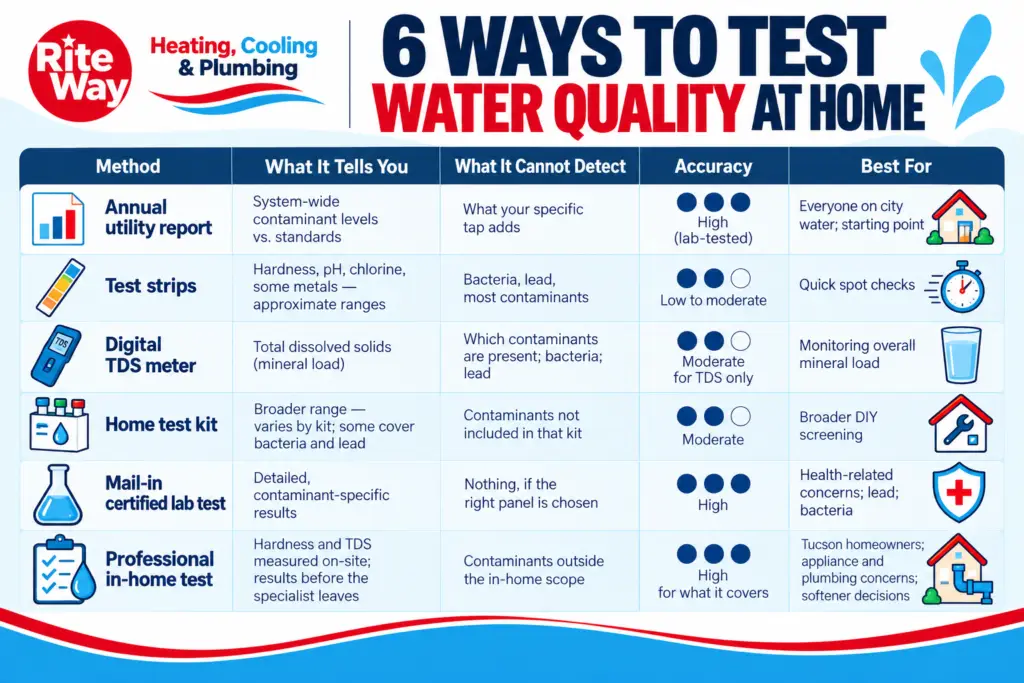
Your Utility’s Annual Report
Download or request your annual report before buying any test. It shows system-level results for over 90 regulated contaminants and is free. In Tucson, it is published every year on the Tucson Water website.
Test Strips
Strips give approximate ranges for hardness, pH, chlorine, and some metals. They are inexpensive and fast, but they are not precise and cannot detect bacteria, lead, or most contaminants that affect health.
Digital TDS Meter
A TDS meter measures total dissolved solids, which is the combined mineral load in the water. It is a useful general indicator but does not identify which minerals or contaminants are present. A high TDS reading in a Tucson home typically reflects hardness minerals, but it does not tell you whether the water is safe.
Home Test Kit
Packaged kits cover a broader range than strips, and some can detect bacteria or lead. Results vary by kit. Read the included contaminant list carefully to confirm it tests for what you are actually concerned about.
Mail-In Certified Lab Test
For health-related concerns, a certified lab gives you reliable, specific results. You collect a sample at home, ship it to the lab, and receive detailed numbers. Only use labs certified for drinking water testing. Your local health department may be able to recommend one.
Professional In-Home Test
A Rite Way water specialist comes to your home, tests your water on-site for hardness and total dissolved solids, and explains the results before leaving. Extended testing is also available for a fuller picture. For Tucson homeowners deciding between a softener, filter, or reverse osmosis system, this is the most practical first step so you know your numbers before you spend anything.
Rite Way’s water specialists handle the entire process: no sample collection, no shipping, no waiting. You get your results and a plain-language explanation at the same visit, with no obligation to purchase anything.
What Should You Test For?
The right tests depend on your situation.
City water in an older Tucson home: Hardness and TDS are the most practical starting point. Tucson’s water is classified as hard to very hard, and hardness is the leading driver of scale buildup, appliance wear, and water heater sediment in this market. If your home was built before 1986, you may also want to test for lead. The EPA banned lead from new plumbing pipes and solder in 1986, but homes built before that date may have lead solder at pipe joints. A certified lab test is the only reliable way to check. Rite Way’s in-home test covers hardness and TDS; ask about extended testing if you want a broader screen.
Private well: The EPA recommends testing at least annually for total coliform bacteria, nitrates, TDS, and pH. Depending on your area and well history, you may also want to test arsenic, fluoride, and uranium every few years. Ask your local health department or county extension office for guidance on what is most relevant in your specific area of Southern Arizona.
Other situations that warrant testing:
- A new baby in the home, particularly if preparing formula with tap water
- Changes in the water’s taste, odor, or color
- After plumbing work or a well repair
- Before choosing a water softener, filter, or reverse osmosis system
How to Collect a Water Sample
How you collect the sample directly affects the accuracy of the results. Follow the instructions included with your kit or lab exactly. General steps for most tests:
- Use the kitchen cold-water tap as your sample point unless instructed otherwise.
- For a lead test, labs typically want a first-draw sample, water that has been sitting in the pipes for at least six hours, usually collected first thing in the morning before any water is used.
- For a bacteria test, use the sterile collection bottle provided, do not touch the inside of the cap or bottle, and get the sample to the lab within the required window, often 24 to 48 hours.
- Some labs ask you to remove the aerator from the faucet before sampling to avoid debris from the screen.
- Label the sample with the date, time, and collection point.
Incorrect sampling is one of the most common reasons home test results are misleading. If you would rather not deal with collection and shipping, a Rite Way specialist handles the entire process at your tap with results before they leave your home.
How to Read Your Water Test Results
Lab tests and meters use units that are easy to misread. Here is what the most common ones mean.
Units:
- ppm and mg/L mean the same thing (milligrams per liter or parts per million).
- ppb and µg/L also mean the same thing (micrograms per liter or parts per billion) and are used for very low concentrations.
- Hardness is often reported in grains per gallon (gpg). One gpg is approximately 17.1 mg/L.
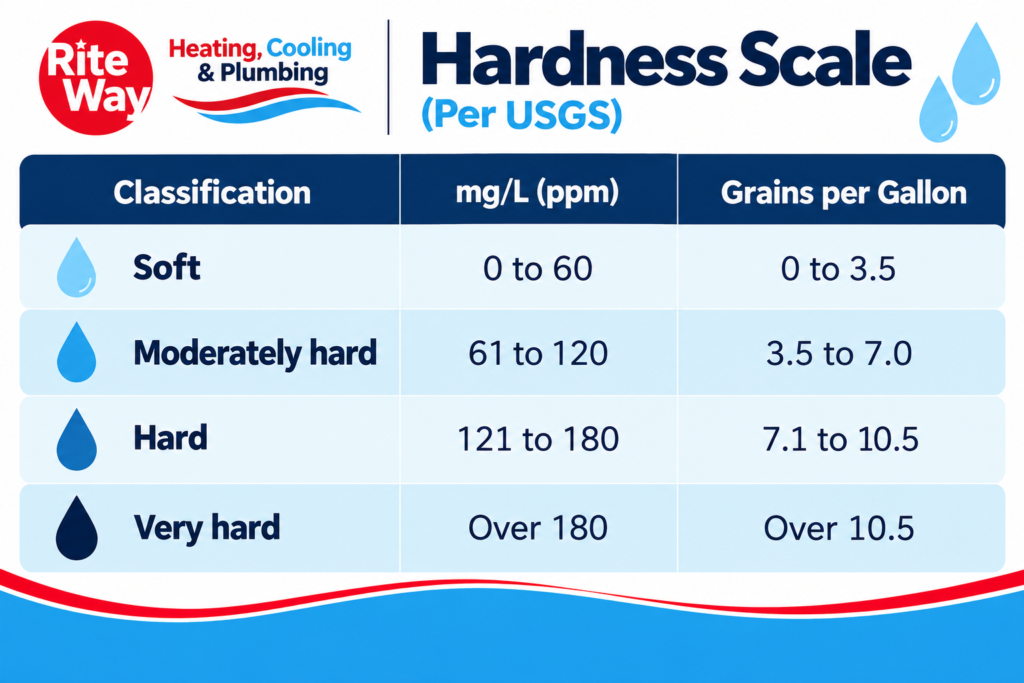
Most Tucson homes fall solidly in the hard to very hard range, which is why scale buildup on faucets, showerheads, and water heaters is so common here.
Health-based limits vs. aesthetic guidelines: The EPA sets Maximum Contaminant Levels (MCLs) for health-related contaminants and these are the legal limits your utility must meet. For things like TDS, hardness, and chloride, the EPA has Secondary Standards that are non-health-based and relate to taste and appearance. The secondary standard for TDS is 500 mg/L.
Reading a utility report: Each contaminant will show the level detected, the EPA legal limit, and often the typical source. If a result exceeds the MCL, the utility is required to notify you and take corrective action.
Testing Water in Tucson: What to Know
Tucson’s water is a blend of groundwater and recharged Colorado River water, and hardness is classified as hard to very hard, meaning most Tucson homes deal with significant mineral content at the tap every day. Because the blend and water source can vary by neighborhood, your utility’s system-wide average may not reflect exactly what is coming out of your specific tap on the east side versus the northwest side versus a home near the central wellfield. An at-home test gives you numbers for your address. For a full breakdown of what is in Tucson’s water supply, visit Rite Way’s water quality testing page, which covers the local picture in detail.
What to Do After You Test
If results look normal: For city water, Rite Way recommends retesting every one to two years or when something changes such as a new smell, a change in taste, plumbing work, or a new treatment system installed in the home.
If hardness or TDS is high: A whole-home water softener or salt-free conditioner addresses scale throughout the home. A reverse osmosis system handles drinking and cooking water at the point of use. Rite Way’s specialists can walk you through the options based on your specific test results and household needs.
If a health-related contaminant is above the legal limit: Stop using the water for drinking or cooking, follow the guidance from the lab or your local health department, and contact a professional for next steps. For concerns about aging pipes in an older Tucson home, repiping removes the source of the problem rather than filtering around it. Additional water filtration options are also available depending on what the results show.
Ready to Know What’s in Your Water?
Rite Way’s licensed water specialists serve Tucson, Marana, Oro Valley, Vail, Sahuarita, and communities throughout Pima County. A specialist comes to your home, tests your water on-site, and explains your hardness and TDS numbers before leaving with no obligation to purchase anything. Extended testing is also available if you want a fuller picture. We’ve served Arizona homeowners since 1959 and answer phones 24/7.