Closing air vents in rooms you do not use seems like an easy way to save on energy bills, but it usually does the opposite. Your heating and cooling system is designed to move a set amount of air through the whole house. Close off vents, and that air does not disappear. It builds up pressure in your ducts, leaks out through gaps, and forces your system to work harder to move the same air through fewer openings.
In Tucson and Phoenix, where AC systems run roughly 8 to 10 months a year, that added strain accumulates in a way it simply would not in a market with a shorter cooling season. Many homes here also have ductwork running through attics that reach extreme temperatures in summer, which means any extra pressure in the ducts is pushing cooled air into one of the hottest spaces in the house rather than into the rooms you are trying to cool. Add in Tucson’s monsoon season, when humidity makes restricted airflow even more uncomfortable, and the case against closing vents gets stronger. Here is what really happens, why closing bedroom doors can cause the same problem, and what actually works instead.
Key Takeaways
- Closing vents does not reduce how much air the blower moves. It raises duct pressure and pushes that air through leaks instead of registers.
- In most Tucson homes, ducts run through the attic. More pressure means more air lost to extreme heat rather than delivered to the living space.
- Closing bedroom doors causes the same pressure imbalance as closing vents, for the same reason.
- One partially closed vent in one room is unlikely to cause problems. Closing several rooms is where real damage risk begins.
- Ceiling fans, regular tune-ups, and ductless options are better solutions for rooms that are always too hot or cold.
How Your Air Vents Work
Your HVAC system has two types of registers: supply vents, which push conditioned air into the room, and return grilles, which pull air back to the system to be filtered and reconditioned. The system is sized and designed to move a specific volume of air through the whole home. Supply and return registers work together to keep air moving evenly. When that balance is disrupted by closing vents, blocking returns, or closing doors, the system has to compensate, and it usually does so inefficiently.
Does Closing Air Vents in Unused Rooms Save Energy?
No. Closing vents does not reduce how hard your system works. The blower motor runs at the same speed regardless of how many vents are open, pushing the same volume of air through a now-restricted system. The result is higher pressure in the ducts, more air escaping through leaks, and a system that runs longer to reach the set temperature. Most homeowners who close vents to save money end up spending more, not less.
What Happens When You Close Vents
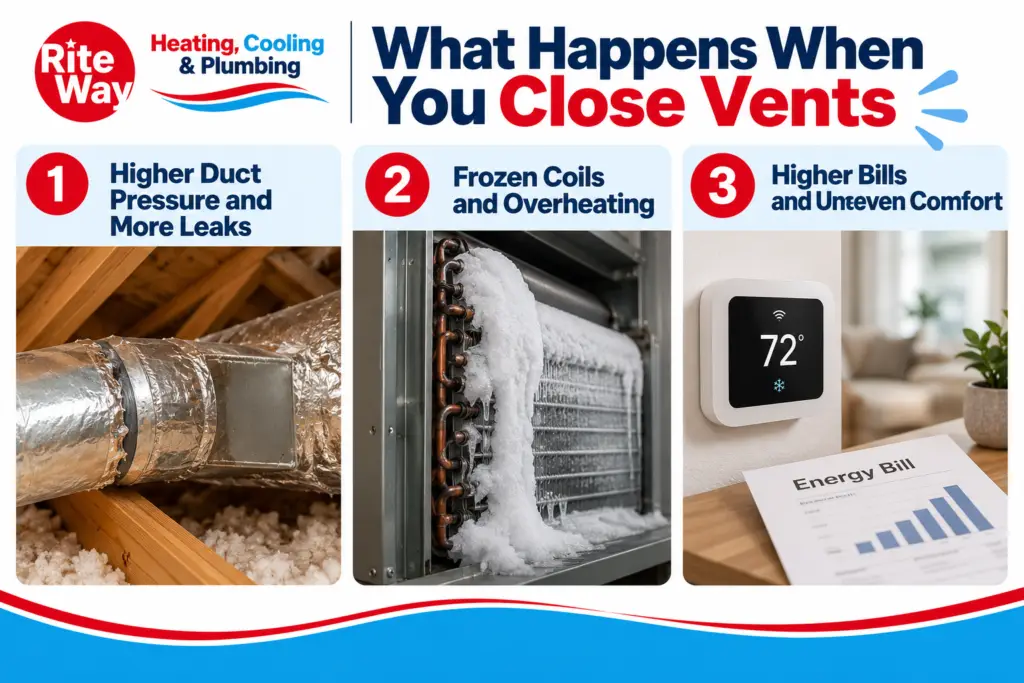
Higher Duct Pressure and More Leaks
Every forced-air system has some degree of duct leakage. When vents are closed, pressure inside the ducts rises and pushes more conditioned air through those gaps. In Tucson, where most ductwork runs through attics that reach extreme summer temperatures, that leakage means cooled air is escaping into one of the hottest spaces in the house rather than reaching the rooms you are trying to cool. Sealing those leaks is the right fix.
Frozen Coils and Overheating
Your AC’s indoor coil needs consistent airflow to function correctly. When vents are closed and airflow drops, the coil can get too cold and ice over. A frozen evaporator coil shuts down cooling and can damage the system if it continues to run in that state. On the heating side, restricted airflow can cause a furnace to overheat and trip its internal limit switch, resulting in a system that blows cold air or shuts off unexpectedly. Our post on HVAC not blowing warm air covers what that looks like and what to do.
Higher Bills and Uneven Comfort
Your system has no sensors that detect closed vents and reduce its workload accordingly. It keeps running until the thermostat is satisfied, which takes longer when airflow is restricted. The rooms with closed vents get no conditioned air, and the rooms that remain open may get too much. The result is higher energy bills alongside more uneven temperatures throughout the house, which is exactly the opposite of what closing vents was supposed to achieve.
What About Closing Doors?
Closing interior doors creates the same pressure problem as closing vents. Most homes have one or two central return grilles rather than a return in every room. When a bedroom door is closed, supply air continues to push into that room but has no path back to the return. The room pressurizes, and the system pulls replacement air from wherever it can find an opening, including gaps around windows, under exterior doors, or through wall cavities. In homes with gas appliances, pressure imbalances are one of the factors a technician checks when evaluating heating system performance. The simplest fix is keeping interior doors open when the system is running. For rooms that must stay closed, ask a technician to evaluate airflow options for that space.
Why It Matters More in Arizona Homes
In Tucson and Phoenix, AC systems run roughly 8 to 10 months a year. That extended runtime means anything that increases wear on the blower motor, elevates duct pressure, or reduces coil airflow has more opportunities to cause problems than it would in a market with a shorter cooling season. Tucson’s monsoon season adds a second consideration: reduced airflow across the indoor coil also reduces the system’s ability to remove humidity from the air on muggy days, making the home feel less comfortable even when the thermostat reads correctly.
Is It Ever OK to Close a Vent?
Partially closing one vent in a single room is unlikely to cause significant problems. The concern starts when multiple vents are closed or several rooms are shut off at once, which raises duct pressure enough to affect the equipment and the rest of the system. If one room is consistently too hot or too cold, that is usually an airflow or duct issue worth having a technician evaluate rather than a problem to manage by adjusting vents.
Better Ways to Save Energy and Balance Comfort
These alternatives actually address the problem rather than creating new ones:
- Use ceiling fans correctly. A fan set counterclockwise in summer creates a wind-chill effect that lets you raise the thermostat a few degrees comfortably. Our ceiling fan direction guide covers when to switch and how in Arizona’s climate.
- Schedule an AC tune-up. A properly maintained system runs more efficiently and handles Tucson’s long cooling season with less wear. Rite Way offers AC tune-ups for Tucson-area homeowners.
- Address duct leaks. If your ducts are losing conditioned air to the attic, sealing them fixes the root cause. Rite Way offers Aeroseal ductwork sealing and duct cleaning in Tucson.
- Look into a ductless mini split. For a room where the existing duct system never serves well, a ductless mini split delivers conditioned air directly without affecting the rest of the system.
- Get a TEP energy efficiency audit. Rite Way is a participating contractor for TEP energy efficiency audits, which can identify where your home is losing energy and the most cost-effective fixes.
- Consider replacing an aging system. If your AC is past its useful life, it will run inefficiently regardless of how you manage the vents. Our guide on when to replace your air conditioner covers how to tell when it is time.
Not Getting the Comfort You Expect? Rite Way Can Help.
If adjusting vents and registers has not solved your comfort problems, the issue is likely inside the system or ductwork itself. Rite Way’s licensed technicians serve Tucson and communities across Southern Arizona. We can evaluate airflow, check for duct leaks, and give you honest options before any work begins. We have been answering phones 24/7 and serving Arizona homeowners since 1959.