
If you own a home in Tucson, Phoenix, or anywhere across Southern Arizona, a weak shower is one of those problems that tends to sneak up on you. One day the pressure feels a little off. A few months later it is noticeably worse. In a market where hard water from the Central Arizona Project is constantly working against your fixtures, showerhead nozzles clog, flow restrictors scale up, and valve cartridges wear out faster than they would almost anywhere else in the country.
The good news is that when low water pressure is isolated to one shower and not your whole home, the cause is almost always at the fixture level, and several of the fixes are things you can handle yourself. This guide walks through five shower-specific solutions in order from easiest to most involved, so you can start with the simplest check and work your way toward a plumber only if you need one.
Key Takeaways:
- If pressure is low only in one shower, the problem is at the fixture level, not your home’s overall supply.
- A clogged showerhead is the most common cause and the easiest fix. In Tucson and Phoenix, it needs cleaning more often than standard advice suggests.
- Flow restrictors limit water volume by design. Removing or adjusting one is a legitimate DIY fix for shower-specific low pressure.
- A worn or scaled shower valve cartridge is the most common plumber-level fix for single-shower pressure loss.
- If none of the DIY fixes work, the issue is almost certainly inside the shower valve itself: cartridge wear, an anti-scald device set too conservatively, or a thermostatic mixing valve that needs recalibration.
Water Pressure vs. Water Flow: What Is the Difference?
These two terms are related but not the same, and mixing them up leads to the wrong fix.
Water pressure (measured in PSI, or pounds per square inch) is the force behind your water supply. Water flow (measured in GPM, or gallons per minute) is the volume of water that reaches your showerhead. You can have adequate pressure but low flow if something is restricting the volume before it exits the nozzle, which is exactly what a clogged showerhead, a blocked flow restrictor, or a worn cartridge creates. Most shower-specific pressure complaints in Tucson and Phoenix are actually flow problems, not pressure problems. The fixes in this guide address both.
Why Tucson and Phoenix Showers Need More Attention
Before getting into the fixes, it is worth understanding why shower pressure problems come up more frequently for Tucson and Phoenix homeowners than in most parts of the country.
Both cities draw from the Central Arizona Project, which carries significant mineral hardness. That hardness deposits calcium and magnesium on showerhead nozzles, flow restrictors, and valve cartridges faster than in soft-water markets. A showerhead that might need cleaning once a year in Denver or Portland may need attention every 2 to 3 months in a Tucson or Phoenix home without a whole-home water softener in place. The same hard water that scales up your showerhead is also quietly working on your valve cartridge and flow restrictor at the same time, which is why pressure problems in our market tend to compound faster than homeowners expect.
Every fix on this list works faster and lasts longer in a home with a water softener installed.
Why Your Shower Pressure Changes at Different Times
If your shower pressure is inconsistent rather than consistently weak, timing is a useful clue. Pressure that drops only during Tucson or Phoenix summer mornings, when irrigation systems, evaporative coolers, and household demand all overlap across entire neighborhoods, may reflect municipal supply fluctuation rather than a fixture problem. Pressure that is consistently weak at any time of day, or that has gradually worsened over months, points to one of the five causes below.
5 Fixes for Low Water Pressure in Your Shower
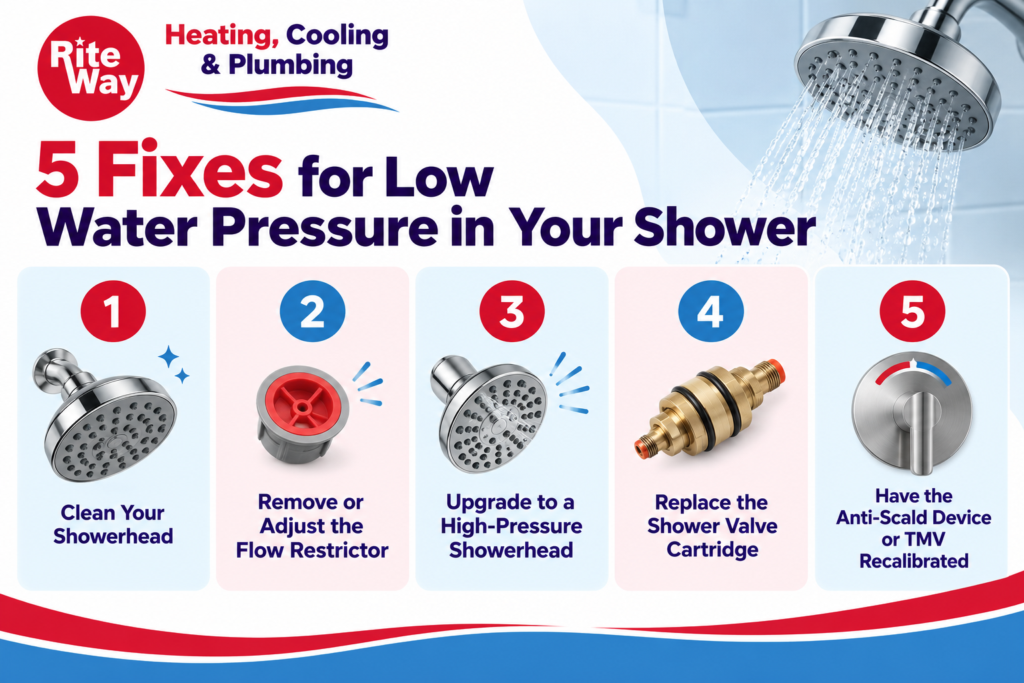
Fix 1: Clean Your Showerhead
A clogged showerhead is the most common cause of shower-specific low water pressure and the easiest fix. Mineral deposits from hard water build up inside the showerhead nozzles over time, gradually blocking the spray holes and reducing flow. In Tucson and Phoenix, this happens significantly faster than in soft-water cities, and homes in established neighborhoods like Sam Hughes, Arcadia, Ahwatukee, or midtown Tucson that have never had their showerheads cleaned or replaced are often dealing with years of accumulated scale.
How to do it:
- Unscrew the showerhead from the arm.
- Soak it in white vinegar for several hours or overnight. For the heavier scale buildup common in our market, a longer soak works better than a quick rinse.
- Use an old toothbrush to scrub the nozzle openings.
- Reinstall and test.
If your showerhead is more than 5 to 7 years old and has never been cleaned or replaced, the buildup may be too extensive to fully clear. Replacement at that point is often more practical than cleaning.
In Tucson and Phoenix, plan to clean your showerhead every 2 to 3 months without a water softener. A whole-home softener reduces this to once or twice a year.
Fix 2: Remove or Adjust the Flow Restrictor
Every showerhead sold in the U.S. after 1992 is required to meet a maximum flow rate of 2.5 gallons per minute under the Energy Policy Act of 1992. Manufacturers achieve this through a small plastic flow restrictor disc inside the showerhead inlet. Many newer models restrict flow further to 1.5 or 1.8 GPM. If your shower feels weak even after a thorough cleaning, the restrictor is the next thing to check.
How to do it:
- Unscrew the showerhead from the arm.
- Look inside the inlet for a small plastic disc, often pink, red, or white, with a center hole. It is typically held in place by an O-ring.
- Remove it carefully with a flat-head screwdriver or needle-nose pliers.
- Reinstall the showerhead and test.
In Tucson and Phoenix, flow restrictors are also prone to calcium buildup that clogs the center opening and reduces flow even further than intended. If yours looks scaled when you remove it, that scale alone may explain the pressure drop, and cleaning the restrictor rather than removing it entirely may be enough to restore normal flow.
There is no Tucson Water or Phoenix ordinance prohibiting flow restrictor removal in existing residential shower fixtures. Check your showerhead’s manual for the specific location and removal steps for your model.
Fix 3: Upgrade to a High-Pressure Showerhead
If your showerhead is old or low-performance, upgrading to a model designed for low-pressure conditions is a straightforward improvement that does not require a plumber. High-pressure showerheads use a narrower spray pattern and optimized nozzle geometry to create stronger perceived flow even at lower GPM.
When shopping, look for models rated at 2.0 to 2.5 GPM. Below 1.5 GPM, even a well-designed showerhead will feel weak in most household setups. In Tucson and Phoenix, look specifically for showerheads with rubber nozzles rather than fixed plastic holes. Rubber nozzles resist calcium buildup and can be wiped clean without soaking, which extends the time between deep cleanings in our hard-water environment considerably.
Fix 4: Replace the Shower Valve Cartridge
If cleaning the showerhead and checking the flow restrictor do not restore pressure, the next most likely cause is a worn or scaled shower valve cartridge. The cartridge is the internal component inside your shower valve that controls water flow and temperature. Over time it wears down mechanically or accumulates scale that stiffens the internal passages, reducing how much water can flow through the valve regardless of what the showerhead looks like.
Signs of a worn cartridge include consistently weak flow even with the handle fully open, difficulty finding a comfortable temperature without the pressure changing, or a shower that has gradually gotten weaker over months or years.
Cartridge replacement is a plumber repair in most cases. The process requires shutting off the water supply to the shower, disassembling the valve trim, removing the cartridge, and installing a manufacturer-matched replacement. Cartridge design varies significantly by valve brand, and installing the wrong one or reassembling incorrectly can cause leaks or temperature control problems.
In Tucson and Phoenix, cartridges scale and stiffen faster than in soft-water markets. If your home has had the same shower valve for 8 or more years and has never had cartridge service, this is one of the most common plumber-level fixes we perform on single-shower pressure calls across our service area.
Fix 5: Have the Anti-Scald Device or TMV Recalibrated
Most showers installed or renovated in the past 20 to 30 years have either a pressure-balancing valve with an anti-scald limiter or a thermostatic mixing valve (TMV). Both are safety devices designed to prevent scalding, and both can reduce shower flow if they are set more conservatively than your household needs.
The anti-scald limiter is a plastic stop inside the valve handle that limits how far the handle can turn toward heat. If set too conservatively, it prevents the valve from opening to full flow even when the handle is turned as far as it will go. A TMV mixes hot and cold water to a target temperature and may restrict flow if it is out of calibration or if your home’s hot water supply temperature has shifted.
Adjusting an anti-scald stop is sometimes a homeowner fix: the handle trim typically needs to be removed to access the stop, which can then be repositioned to allow wider handle travel. TMV recalibration and any adjustment that requires going inside the valve body should be handled by a licensed plumber to avoid voiding the valve warranty or creating a burn risk.
Do Shower Filters Affect Water Pressure?
Yes, if the filter cartridge is clogged. Inline shower filters attach between the shower arm and the showerhead and use a replaceable cartridge to reduce chlorine, scale, and other contaminants. When the cartridge becomes clogged with sediment or mineral buildup, it restricts flow noticeably. In Tucson and Phoenix, shower filter cartridges tend to load up faster than the manufacturer’s standard replacement schedule accounts for. If you have a filter installed and pressure has dropped, replacing the cartridge is the first thing to check before assuming the problem is deeper in the plumbing.
When DIY Fixes Do Not Work: What a Rite Way Plumber Actually Checks
If you have cleaned the showerhead, checked the flow restrictor, and pressure is still weak, the problem is inside the valve. When Rite Way responds to a single-shower pressure call in Tucson or Phoenix, our licensed plumbers assess:
- Cartridge condition: Whether the cartridge shows wear, internal restriction, or scale buildup that cleaning cannot address.
- Anti-scald device setting: Whether the limiter stop is set too conservatively for the household’s actual needs.
- TMV calibration: Whether a thermostatic mixing valve is out of range and restricting flow as a result.
- Supply line pressure at the valve: Whether the angle stops or supply lines feeding the shower valve are delivering adequate pressure or acting as a restriction point themselves.
- Pipe diameter: In older Tucson and Phoenix homes, particularly those built before 1980 across midtown Tucson, central Phoenix, and established Scottsdale neighborhoods, supply lines feeding the shower may be original small-diameter pipe that limits flow regardless of what the fixture itself looks like.
Rite Way Can Restore Your Shower Pressure in Tucson and Phoenix
If the DIY fixes have not worked, or you would rather have a licensed plumber assess the valve directly, Rite Way is ready to help. We service showers throughout Tucson, Phoenix, Marana, Oro Valley, Green Valley, Sierra Vista, and the wider Southern Arizona area and will tell you exactly what we find before any work begins.
Low Water Pressure in Shower FAQs
When pressure is weak in one shower but fine everywhere else, the problem is almost always at the fixture level: a clogged showerhead, a blocked flow restrictor, or a worn valve cartridge.
Every 2 to 3 months without a water softener. Tucson and Phoenix’s hard water builds mineral scale on showerhead nozzles significantly faster than in soft-water cities.
Yes, flow restrictors are small plastic discs inside the showerhead inlet that limit water volume by design, and there is no municipal ordinance in Tucson or Phoenix prohibiting removal in existing residential fixtures.
The cartridge is the internal component inside your shower valve that controls flow and temperature. Signs it needs replacing include gradually weakening pressure, difficulty finding a comfortable temperature, or a shower that has gotten worse over months.
Yes, if the filter cartridge is clogged. In Tucson and Phoenix’s hard-water environment, shower filter cartridges may need replacement more frequently than the manufacturer recommends.
It is a safety stop inside the shower valve that limits how far the handle can turn toward hot. If set too conservatively, it prevents the valve from opening to full flow even when the handle is all the way open.
Call a plumber if cleaning the showerhead and checking the flow restrictor did not help. At that point the issue is inside the valve itself: cartridge wear, an anti-scald device, or a thermostatic mixing valve that needs professional attention.