Tankless water heaters are known for providing endless hot water, but many Tucson homeowners still wonder if that is really true. It is a fair question, especially in a market where hard water puts extra wear on these systems and where peak demand in a busy household can push any unit to its limits.
The short answer: you cannot run out of hot water with a tankless unit the way you would with a tank. But limits still exist and are worth understanding. At Rite Way, we install and service tankless water heaters throughout Tucson, Phoenix, and the surrounding communities, and helping homeowners understand exactly what these systems can and cannot do is a big part of what we do every day.
Key Takeaways:
- Tankless water heaters do not run out of hot water in the traditional sense since they heat water on demand rather than storing it.
- You can still experience reduced or inconsistent hot water if your system’s flow rate is exceeded by running multiple fixtures at the same time.
- Most performance issues come down to improper sizing, not the system itself, making correct installation critical.
- Hard water and mineral buildup can reduce efficiency over time, so regular maintenance is essential, especially in Southern Arizona.
- If you notice temperature fluctuations, low pressure, or inconsistent performance, it may point to a repair issue or a system that no longer meets your household’s demand.
When You Might Run Out of Hot Water
Even though tankless systems provide continuous hot water, there are situations where it can feel like you are running out.
The most common reason is exceeding the system’s flow rate. Tankless units can only heat a certain amount of water at once, measured in gallons per minute (GPM). If multiple fixtures are running at the same time, such as showers, laundry, and sinks, the demand may exceed what the unit can handle. In larger Tucson homes or households with multiple bathrooms, this is one of the more common calls we receive.
When this happens, you may notice:
- Reduced water temperature
- Fluctuating heat levels
- Inconsistent performance across fixtures
This is not a failure of the system. It simply means the unit is undersized or being pushed beyond its capacity.
One other thing worth knowing: the cold water sandwich effect.
This is a brief burst of cool water that can occur between two separate hot water draws. Here is what happens: the unit shuts off after the first use, the hot water sitting in the pipes cools slightly, and when the next draw starts, that cooled water reaches the tap before the unit fully fires up again. It usually lasts just a few seconds and is more noticeable in homes with longer pipe runs between the unit and the fixture. It is a quirk of how on-demand systems work, not a defect. Homes with a recirculation pump system can eliminate it entirely.
The Role of Proper Tankless Water Heater Installation
One of the biggest factors in performance is proper installation. If a unit is too small for your household, it will struggle to keep up with demand. This is something we see regularly across Tucson, Marana, Oro Valley, and the wider Southern Arizona metro, particularly in larger homes or properties with multiple bathrooms.
Professional installation ensures:
- The correct system size for your usage and peak demand
- Proper configuration for your existing plumbing
- Reliable performance across all fixtures
It starts with evaluating your home’s actual water usage and recommending the right unit for long-term performance, not just day-one output.
Making Sure Your Tankless Water Heater Is Running Correctly
Even a properly sized system needs regular maintenance to perform at its best. Mineral buildup is a particularly common issue in Southern Arizona. Tucson’s water supply, a blend of Colorado River water and local groundwater, carries a high mineral load that builds scale on the heat exchanger over time, reducing heating efficiency and restricting flow.
In Southern Arizona, where municipal water typically runs hard, we recommend flushing your tankless unit every six months rather than the standard annual interval. Hard water scale builds up faster here than in most parts of the country. A whole-home water softener reduces that frequency and extends the life of the unit significantly.
Routine maintenance helps:
- Remove mineral deposits from the heat exchanger
- Maintain heating efficiency
- Extend the life of the unit
- Prevent unexpected breakdowns
When It May Be Time for Water Heater Replacement
If your current water heater is not meeting your needs, it may be time to consider a replacement. This is especially true if:
- Your system cannot keep up with your household’s demand
- Repairs are becoming more frequent
- Your unit is nearing the end of its lifespan
- You want to improve energy efficiency and lower monthly costs
Upgrading to a properly sized tankless system can provide more consistent performance and long-term savings.
Ready for Reliable Hot Water? Rite Way Can Help.
Whether you are experiencing inconsistent hot water, due for maintenance, or considering an upgrade, Rite Way’s team is here to help. We install, repair, and service tankless water heaters throughout Tucson, Marana, Oro Valley, Green Valley, Sierra Vista, and the wider Southern Arizona area.
Running Out of Hot Water FAQs
Not the way a tank can: a tank runs out when stored water is depleted; a tankless unit heats continuously on demand. Should demand exceed the unit’s flow rate, you may notice cooler or inconsistent water, which is a sizing issue, not a system failure.
It is a brief burst of cool water between two separate hot water draws, usually just a few seconds. It happens when the unit shuts off, the water in the pipes cools slightly, and the unit has not fully fired up for the next draw.
Every six months, because southern Arizona’s hard water accelerates mineral scale buildup on the heat exchanger faster than most parts of the country, so the standard annual flush is not enough here. A whole-home water softener reduces that frequency and extends the life of the unit.
The unit struggles to heat water fast enough when multiple fixtures run at the same time. You will notice temperature drops, fluctuating heat, or inconsistent performance across showers and faucets.
It does not cause immediate damage, but it shortens the lifespan of the heat exchanger over time. Scale buildup forces the unit to work harder and reduces efficiency.
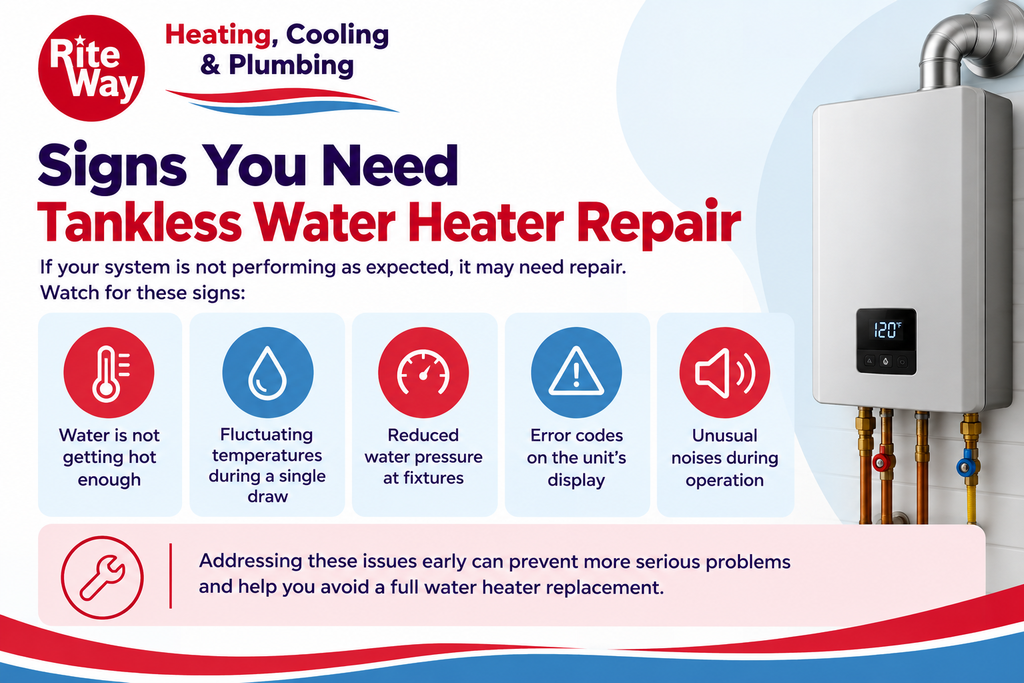
Watch for water that is not getting hot enough, temperatures that fluctuate mid-draw, reduced pressure at fixtures, error codes on the display, or unusual noises when the unit fires. Catching these early almost always means a simpler, less expensive fix.
Yes, if the unit is properly sized for your household’s peak demand. A tankless unit that was sized for average usage may struggle when demand spikes.
With proper maintenance, a tankless water heater can last 20 or more years. In Tucson’s hard water environment, that lifespan is heavily dependent on how consistently the unit is descaled and whether a water softener is in place to reduce mineral load.