If you’ve been looking into HVAC maintenance, you’ve probably come across both duct cleaning and duct sealing – and wondered whether you need one, the other, or both. It’s a fair question, and the answer isn’t always obvious. These two services are often mentioned together, but they solve very different problems.
Here in Southern Arizona, duct maintenance carries some extra weight. Between Tucson’s notorious dust levels, Phoenix’s urban air quality, and the allergens that monsoon season kicks up across the region, your ductwork works hard year-round. Understanding what each service does, and when you need it, can help you protect both your indoor air quality and your energy bills.
At Rite Way Heating, Cooling & Plumbing, we help homeowners across Tucson, Phoenix, and Sierra Vista make smart decisions about their HVAC systems every day. Here’s what you need to know.
Key Takeaways
- Duct cleaning removes built-up dust, debris, and contaminants from inside your duct system to improve indoor air quality and airflow.
- Duct sealing closes gaps, cracks, and leaks in your ductwork to prevent conditioned air from escaping and energy from being wasted.
- If your home needs both services, cleaning should always come first. Sealants need a clean surface to bond properly.
- In Southern Arizona’s dusty climate, duct cleaning is typically recommended every 3-5 years, while duct sealing is a longer-term solution that can last a decade or more.
- A professional inspection is the best way to determine which service your system needs right now.
What Is Duct Cleaning?
Think of your air ducts as the lungs of your home. Over time, dust, pet dander, pollen, mold spores, and other contaminants collect on the interior walls of your duct system. Every time your HVAC system cycles on, it pushes some of that buildup into your living spaces.
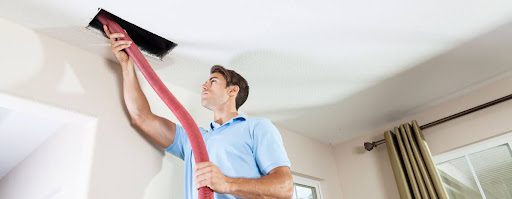
Duct cleaning uses specialized equipment, including high-powered vacuums and agitation tools like motorized brushes, to physically remove that accumulated debris from your supply and return ducts, registers, grilles, and other components of the duct system. The goal is cleaner air circulation and a system that doesn’t have to work as hard to move air through.
Signs You May Need Duct Cleaning
- Visible dust or debris buildup around your vent covers
- Increased allergy or respiratory symptoms indoors
- Musty or stale odors when the HVAC system runs
- Visible mold growth inside ducts or on vent covers
- A recent home renovation that generated significant dust
- You’ve never had your ducts cleaned and the system is more than a few years old
In Tucson and Phoenix especially, where dust and desert particulates are a constant presence, duct cleaning tends to be more of a regular maintenance item than a one-time fix.
What Is Duct Sealing?
Duct sealing addresses a different problem entirely, not what’s inside your ducts, but the structural integrity of the duct system itself. Gaps, cracks, disconnected joints, and small holes in ductwork allow conditioned air to escape into unconditioned spaces like attics, crawl spaces, and wall cavities before it ever reaches your living areas.
According to ENERGY STAR, leaky ducts in a typical home can waste 20-30% of conditioned air. That means your HVAC system is working significantly harder, and costing you more, than it should be.
Duct sealing closes those leaks using methods like mastic sealant, metal foil tape, or Aeroseal technology. Aeroseal is particularly effective because it works from the inside out. Pressurized adhesive particles are injected into the duct system and naturally seek out leaks, building up along the edges to plug gaps that would be impossible to reach manually.
Signs You May Need Duct Sealing
- Unusually high energy bills that don’t match your usage
- Uneven heating or cooling throughout your home such as some rooms are comfortable while others aren’t
- Rooms that never seem to reach the temperature set on the thermostat
- Visible cracks, gaps, or disconnected sections in accessible ductwork
- Your home is older and the ductwork has never been inspected or sealed
For older homes in established Tucson neighborhoods or parts of the Phoenix metro, duct sealing can make a significant and immediate difference in both comfort and monthly utility costs.
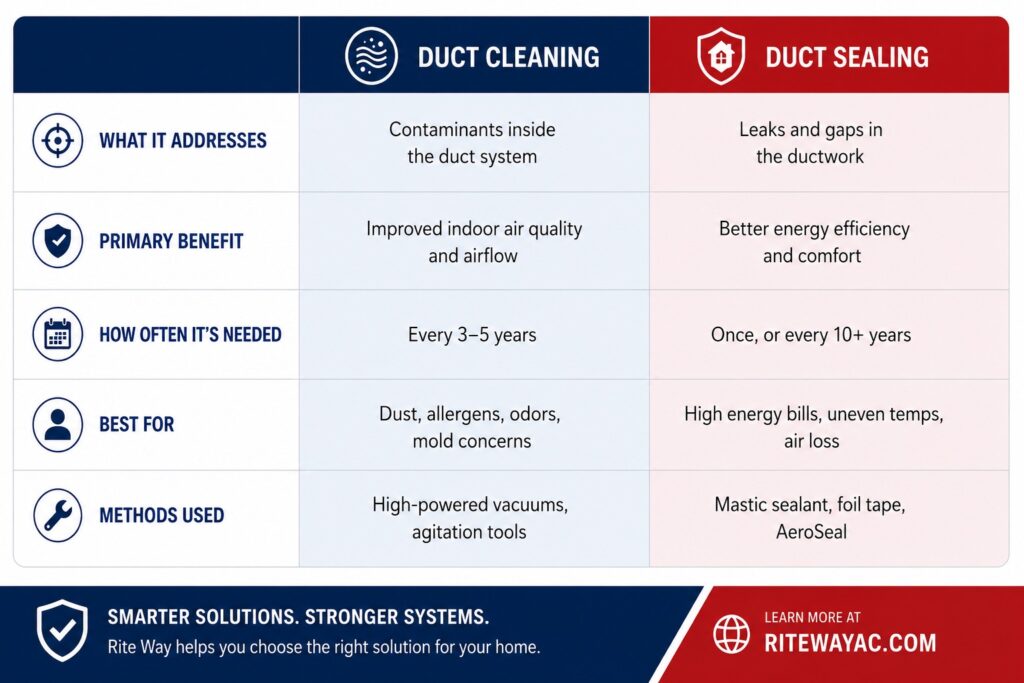
Duct Cleaning vs. Duct Sealing: A Quick Comparison
Which Comes First: Cleaning or Sealing?
This is one of the most important questions homeowners don’t think to ask and the answer matters. If your home needs both services, duct cleaning should always be done before duct sealing.
The reason is straightforward: sealants need a clean surface to bond properly. If the interior of your ducts is coated in dust and debris when the sealant is applied, it may bond to the buildup rather than the duct wall itself, leading to a seal that fails sooner than it should. Cleaning first ensures the sealant makes solid, lasting contact with the duct surface.
It also means you won’t be sealing existing contaminants permanently inside your system, which is something no homeowner wants.
How Southern Arizona’s Climate Affects Your Ductwork
Living in Southern Arizona means dealing with conditions that most parts of the country don’t face in the same way. A few things worth knowing:
- Desert dust is relentless. Tucson and Phoenix consistently rank among the dustiest metros in the country. That fine particulate matter doesn’t just settle on your furniture, it works its way into your duct system and accumulates faster than it would in a more temperate climate. If you haven’t had your ducts cleaned in several years, there’s a good chance it’s overdue.
- Monsoon season adds allergens. The summer monsoon brings mold spores, pollen, and moisture into the air. If your duct system has any leaks pulling air in from unconditioned spaces, those allergens can end up circulating through your home all season long.
- Older homes are especially vulnerable. A large portion of the housing stock in Tucson and Phoenix was built in the 1960s through 1980s. Ductwork from that era is more likely to have deteriorated seals, disconnected joints, and years of accumulated debris. Both cleaning and sealing are often warranted in these homes.
Ready to Schedule a Duct Service?
Whether you need duct cleaning, duct sealing, or a full HVAC inspection to figure out where to start, the team at Rite Way Heating, Cooling & Plumbing is here to help. We serve homeowners throughout Tucson, Phoenix, Sierra Vista, and across Southern Arizona with honest assessments and quality HVAC services you can count on.
Contact Rite Way today to schedule your duct service and take the first step toward a cleaner, more efficient home.
Duct Cleaning vs. Duct Sealing FAQs
Duct cleaning removes dust and contaminants from inside your duct system, while duct sealing closes gaps and leaks in the ductwork that allow conditioned air to escape. They solve different problems and are often both recommended for older homes.
Most homes benefit from professional duct cleaning every 3-5 years. In Southern Arizona’s dusty climate, or in homes with pets, allergies, or recent renovations, every 2-3 years may be more appropriate.
Yes – significantly. Leaky ductwork can waste 20-30% of your conditioned air, meaning your HVAC system runs longer and harder than necessary. Duct sealing is one of the most cost-effective improvements you can make to reduce monthly utility costs.
It can, particularly in homes where dust, pet dander, mold spores, or other allergens have built up inside the duct system. Cleaning removes those contaminants so they’re no longer being circulated through your living spaces every time the system runs.
Aeroseal is particularly effective for sealing small, hard-to-reach leaks throughout a duct system because it works from the inside. For larger visible gaps, mastic sealant or foil tape may be used in combination. A professional inspection will determine which approach is right for your system.
Always clean first. Sealants bond directly to the duct surface, and if that surface is coated in dust or debris, the seal won’t hold as well. Cleaning first ensures the best possible result from any sealing work that follows.