If you own a home in Tucson or the Phoenix area, your water heater works harder than you might think. Between the desert heat, the mineral-heavy water coming out of your tap, and the year-round demand that comes with no real off-season, these systems take a beating. So when it is finally time to replace yours, the decision between tankless and traditional carries a little more weight here than it might somewhere else.
Both systems work well. The right one depends on your household size, your budget, how long you plan to stay in the home, and what your current setup can actually support. This guide walks through the real differences so you can make a confident call before you commit to anything.
Key Takeaways:
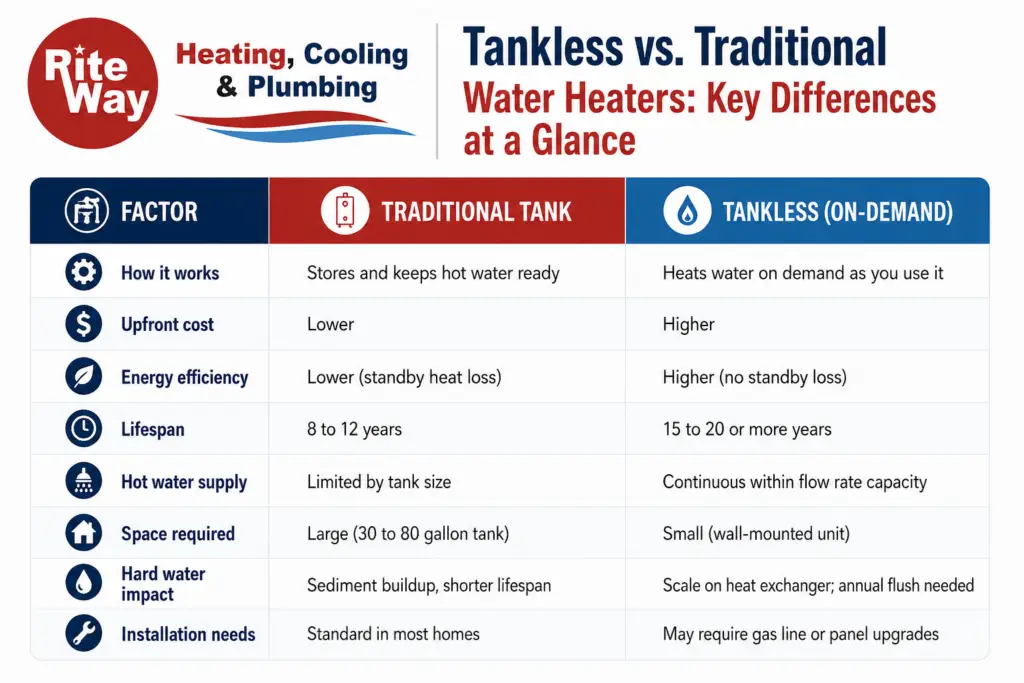
- Tankless water heaters cost more upfront but last 20 or more years compared to 8 to 12 years for a traditional tank.
- Tucson’s hard water affects both systems. Traditional tanks accumulate sediment; tankless units collect scale on the heat exchanger. Maintenance is not optional in this market.
- Tankless units eliminate standby heat loss, but continuous hot water is only as reliable as the unit’s flow rate capacity. Sizing matters.
- The right system depends on your budget, household size, home infrastructure, and how long you plan to stay.
- A whole-home water softener extends the life of either system and protects your plumbing throughout the home.
Upfront Cost and What Goes Into Installation
Traditional tank water heaters are the lower-cost option to start. In most homes, replacing an existing tank is straightforward because the infrastructure is already in place. Your gas line, electrical connections, and venting are typically compatible with the new unit, which keeps the overall cost manageable.
This is especially relevant in Tucson, where much of the housing stock was built in the 1970s and 1980s. Many of those homes have had one or two tank replacements already and are set up for exactly this kind of straightforward swap.
Tankless installation is more involved, and the total cost reflects everything that has to happen before the unit even goes on the wall.
Gas-powered tankless heaters draw a large volume of gas in short, high-demand bursts rather than the slow, steady draw of a storage tank. Most homes have gas lines that are not sized for that demand, which means upsizing the line before installation. Electric tankless units are high-demand appliances that often require a panel upgrade to support them safely. Both types may also need modified venting depending on placement.
For homeowners on a tight timeline or budget, a traditional tank is the simpler, faster path. For those planning to stay long-term, the higher upfront investment in a tankless system is often offset through lower energy bills and a longer window before the next replacement.
Energy Efficiency: Which One Costs Less to Run?
Tankless water heaters are more energy efficient. Because there is no tank to keep hot around the clock, they eliminate standby heat loss completely. Traditional units cycle on and off throughout the day to maintain tank temperature, using gas or electricity even when no one is drawing hot water.
According to U.S. Department of Energy Building America research, tankless gas water heaters can save approximately 33 percent on hot water heating costs compared to a conventional storage water heater, though actual savings vary based on your household’s daily usage and individual draw volume.
That matters here. Tucson Electric Power and APS rates have climbed steadily, and running a traditional tank around the clock adds up on a monthly basis in a way that homeowners in milder climates might not feel as acutely. Over the years compared side by side, the energy savings from a properly maintained tankless system can offset a meaningful portion of that higher upfront cost.
Lifespan: How Long Does Each System Last?
This is one of the clearest advantages on the tankless side. Here is how the two systems compare:
- A properly maintained tankless water heater can last 20 or more years.
- Traditional storage tank water heaters typically need replacement after 8 to 12 years, as sediment buildup, corrosion, and wear reduce performance and eventually cause leaks or failure.
- Over a 20-year period, a homeowner with a traditional tank may replace the unit once or twice, paying equipment and installation costs each time. One properly maintained tankless unit can cover that same window.
That said, lifespan is not automatic. In our market, where the water is very hard and systems run year-round without a break, maintenance is what separates a system that reaches its full potential from one that fails ahead of schedule.
“Continuous Hot Water” Does Not Mean Unlimited: Why Sizing Matters
The standout claim for tankless water heaters is continuous hot water, and it is accurate. A tankless unit heats water on demand rather than drawing from a stored supply, so you never actually run out the way you would with a tank.
But here is the nuance that rarely gets explained before purchase: that continuous supply is only continuous within the unit’s flow rate capacity, measured in gallons per minute (GPM). Every tankless unit has a limit.
If your household is running two showers, a dishwasher, and a washing machine at the same time, an undersized unit can struggle more than a traditional tank would.
The second variable is temperature rise: the difference between your incoming cold water temperature and your desired output. This is actually one area where Arizona homeowners have an advantage. Because our groundwater and incoming supply temperatures run warmer than in colder states, a tankless unit does not have to work as hard to hit your target temperature, which improves real-world performance. Even so, sizing still determines what a unit can realistically handle at peak demand.
A properly sized tankless unit delivers exactly what it promises. An undersized one does not. This is why professional sizing and installation matter just as much as which brand or model you choose.
Maintenance: What Each System Needs to Last
Both systems need routine care to reach their full lifespan.
Traditional tank water heaters benefit from:
- Annual flushing to remove sediment from the bottom of the tank.
- Anode rod inspection to protect against internal corrosion.
- Thermostat and pressure relief valve checks.
Tankless water heaters require:
- Annual descaling to flush mineral deposits from the heat exchanger.
- Inlet filter cleaning.
- Annual professional inspection.
In Tucson and Phoenix, descaling is not optional for tankless owners. It is the single most important maintenance step in our area. Skipping it allows mineral scale to build up on the heat exchanger, forcing the unit to work harder and cutting years off what should be a long-lived system.
Tucson’s Hard Water and Your Water Heater
Tucson’s water comes from a blend of Colorado River water delivered through the Central Arizona Project and local groundwater pulled from aquifers beneath the Sonoran Desert. As that water moves through limestone and caliche-heavy desert geology, it picks up calcium and magnesium along the way. The result is water that is consistently classified as hard throughout the Tucson metro, and that hardness affects your water heater differently depending on which system you have.
In a traditional tank, minerals settle and accumulate at the bottom over time. That layer of sediment acts as insulation between the burner and the water, making the heater work harder, use more energy, and potentially fail earlier than its rated lifespan. A popping or rumbling sound from an older tank is often sediment at work.
In a tankless unit, minerals deposit directly on the heat exchanger. Because the heat exchanger is what actually heats the water, scale buildup has a direct impact on efficiency and output. In our market, annual descaling is standard care, not extra.
One option worth considering alongside either system is a whole-home water softener. Conditioning Tucson’s hard water before it reaches your water heater extends the life of both tank and tankless systems, reduces how often maintenance is needed, and protects your plumbing fixtures throughout the home.
Which Water Heater Is Right for Your Home?
There is no single right answer. The best system depends on your situation. Here is a straightforward way to think through it.
A traditional tank water heater may be the better fit if:
- You need the lowest possible upfront cost.
- You need a quick replacement without room for infrastructure upgrades.
- Your household is small with modest hot water demand.
- You manage a rental property, which is a common situation across a lot of Tucson’s older neighborhoods.
A tankless water heater may be the better fit if:
- You want continuous hot water and are done waiting for the tank to recover.
- You plan to stay in your home for 10 or more years.
- Lower monthly energy costs matter to your budget.
- You want to reclaim space in your garage, closet, or utility room.
- Your household has high or unpredictable hot water demand.
- You are already planning other upgrades like gas lines or electrical work.
A licensed plumber can assess your home’s existing setup and recommend the right size and fuel type before you commit to either system.
Signs It’s Time to Replace Your Water Heater
Do not wait for a complete failure. A leaking tank can cause significant water damage, and a unit on its way out typically loses efficiency well before it stops working entirely. In a home that runs its water heater 365 days a year with no seasonal break, the wear adds up faster than most people expect.
Watch for these warning signs whether you have a tank or tankless unit:
- Hot water runs out faster than it used to, or the temperature is inconsistent.
- Rust or discoloration appears in your hot water.
- Water is pooling around the base of the tank.
- You hear popping, rumbling, or banging sounds from the unit.
- Energy bills are climbing without a change in usage.
- Your tank water heater is 10 years old or approaching that mark.
- Your tankless unit has not been serviced in several years.
Ready to Choose? Rite Way Can Help.
If you have worked through this guide and still have questions about which system makes sense for your home, that is exactly what our team is here for. Rite Way’s plumbing crew has been installing, servicing, and replacing water heaters in Tucson for decades. We know what our water does to these systems, what older homes in this area typically need before a tankless installation can happen, and how to make sure you get the right setup the first time.
Tankless vs Traditional Water Heater FAQs
A traditional water heater stores hot water in a tank and keeps it warm around the clock, while a tankless unit heats water on demand only when you need it, with no tank and no standby heat loss.
Yes, within its rated flow rate capacity. A properly sized tankless unit delivers continuous hot water, but an undersized unit can struggle when multiple fixtures run at the same time.
For homeowners planning to stay long-term, yes. Tankless units are more energy efficient and last significantly longer, though Tucson’s hard water makes annual descaling essential to protect that investment.
Depending on your existing setup, you may need a larger-diameter gas line, an electrical panel upgrade for electric models, or modified venting. A licensed plumber can assess what is required before you commit to anything.
At least once a year. Tucson’s water comes primarily from the Central Arizona Project and carries high mineral content, which accelerates buildup inside the heat exchanger. Annual descaling is not optional here.
Yes, both are available. Gas models are generally more popular in Tucson and Phoenix due to lower operating costs, but the right fuel type depends on your home’s existing connections and what upgrades, if any, are needed.
Yes, and it is worth considering in Tucson. Softening your water before it reaches your water heater reduces mineral buildup in both tank and tankless systems, which means less sediment accumulation, less frequent descaling, and less strain on the unit overall.
It depends on your home’s existing setup. Some homes can make the switch with minimal changes, but many require gas line upsizing, electrical panel upgrades, or venting modifications before a tankless unit can be installed safely.