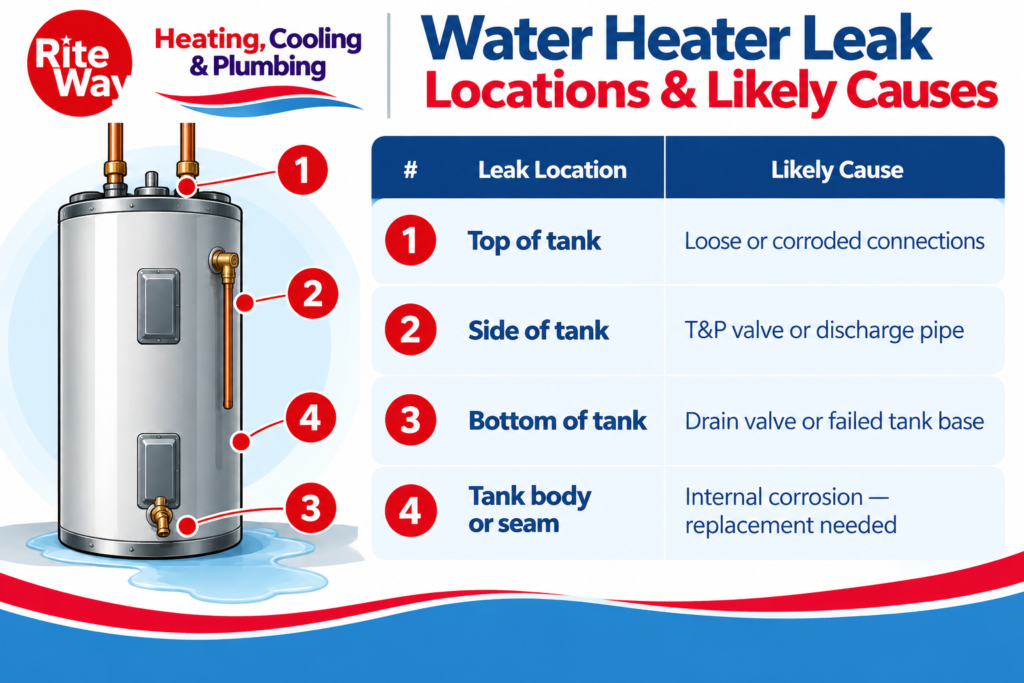
Most water heater leaks come from one of a few places: a loose or corroded connection at the top, the temperature and pressure relief valve on the side, the drain valve near the bottom, or the tank itself wearing out from the inside. Where the water shows up usually tells you which one.
Before you start looking, turn off the cold water supply valve and shut off the power or gas. In Tucson and Phoenix, where water heaters typically sit in garages, laundry rooms, and interior closets built on slab foundations, a small drip can spread across the floor and into drywall fast. Move quickly. Below are the eight most common causes, what you can safely check yourself, and when to call a plumber. Rite Way’s licensed plumbers have served Arizona homeowners since 1959 and take calls 24/7.
Key Takeaways
- Most leaks come from connections, the T&P valve, the drain valve, or a worn-out tank. Where the water appears tells you which.
- Shut off the cold water supply and the power or gas before you investigate. Do not touch the tank or valves while it is hot.
- A tank leaking from the body or base cannot be repaired. It needs to be replaced.
- Hard water and high water pressure are two of the biggest reasons Arizona water heaters fail before their time.
- Smell gas near a gas water heater? Leave immediately. From a safe place, call 911 and Southwest Gas.
First Steps: What to Do When You Find a Leak
- Protect yourself first. Stay clear of standing water near electrical outlets. Hot water and electricity are both present.
- Turn off the cold water supply valve. It sits on the pipe above the tank. Turn it clockwise to close.
- Shut off the power or gas. For electric units, flip the breaker labeled for the water heater. For gas units, turn the dial to OFF or PILOT following the label on the unit.
- If water keeps coming, shut off the home’s main water valve. Tucson Water’s 2025 Annual Water Quality Report notes that homeowners own and maintain the service line from the meter to the house. Know where your main shutoff is before a leak happens.
- Move towels toward the living space. Slab floors spread water sideways rather than draining it away. Push it away from baseboards and drywall.
- Take photos before you clean up. Your homeowner’s insurance may ask for documentation.
- Call a plumber. Only drain the tank yourself if you are comfortable doing so and the water has had time to cool.
Make Sure It Is Actually Your Water Heater
Dry the area around the unit completely, then watch where water reappears. Condensation on a cold tank or burner after heavy use is normal and not a leak.
In Arizona garages and utility closets, a few things can look exactly like a water heater drip:
- AC air handlers and condensate drain lines, which often share the same space as the water heater
- Water softener or reverse osmosis systems, which have their own supply lines and drain connections
- Washer supply hoses or loose fittings on nearby plumbing
If you can trace the water directly to the tank, connections, or valves, keep reading. If the source is unclear, Rite Way’s leak detection service can locate hidden sources without guesswork.
Where Is the Leak? A Quick Guide to What Each Spot Means
Start at the top of the unit and work down. Water drips downward, so pooling at the base may have started higher up. A dry paper towel run slowly along each section helps confirm the source.
8 Common Reasons Your Water Heater Is Leaking
1. Loose or Corroded Connections at the Top
DIY Check: Partial
The cold inlet and hot outlet connections at the top of the tank can loosen over time or corrode where dissimilar metals meet. A loose fitting may be snugged with a wrench. Corroded or cracked fittings, dielectric nipples, or flexible supply lines need a plumber.
2. A Leaking Temperature and Pressure Relief Valve
DIY Check: No
The T&P valve is a life-safety device. It opens to release water when pressure or temperature inside the tank gets too high. A drip means either the valve is responding to a real problem inside the tank, or the valve itself has worn out. Either way, a licensed plumber needs to test and address it.
Never cap or plug the discharge pipe. Never attempt to replace the T&P valve yourself. It involves working near scalding water and a pressurized system. This is where Rite Way’s advice parts ways from what you may find elsewhere.
3. High Water Pressure or Thermal Expansion
DIY Check: No
When incoming water pressure exceeds 80 psi, it stresses the tank, fittings, and T&P valve. According to Tucson Water’s 2025 Annual Water Quality Report, pressure-regulating valves are recommended when home pressure exceeds 80 psi, and Pima County has required PRVs on all newly constructed homes since 2005. Many older Tucson homes may not have one. For Phoenix readers, high or fluctuating pressure is equally common. Setting the thermostat to 120 degrees Fahrenheit is also recommended, as higher temperatures accelerate pressure buildup when water expands during heating. A plumber can test your pressure and advise on next steps.
4. A Loose or Worn Drain Valve
DIY Check: Partial
The drain valve at the base of the tank is a common source of bottom leaks. Confirm it is fully closed. If it still drips when closed, the valve seat is worn and a plumber needs to replace it.
5. Sediment Buildup From Hard Water
DIY Check: No (for the repair)
Tucson and Phoenix both have hard water. According to Tucson Water’s 2025 Annual Water Quality Report, roughly 78% of the main system’s annual water delivery comes from Colorado River water recharged through the Central Arizona Project. Minerals from that supply settle as sediment at the bottom of the tank, causing the water nearest the tank floor to overheat and eventually corrode through. Annual flushing slows this process significantly. A whole-home water softener or Rite Way’s water quality testing can help you understand your home’s specific situation. Your utility’s annual water quality report also lists hardness levels for your service area.
6. A Worn-Out Anode Rod
DIY Check: No
The anode rod inside the tank is designed to corrode in place of the steel tank walls. Once it is depleted, the tank itself starts to rust from the inside out. A worn rod does not cause a direct leak, but it sets up the conditions for cause 7. Rods should be inspected every few years, and more often in hard-water markets like Tucson and Phoenix.
7. A Corroded or Cracked Tank
DIY Check: No
Water seeping from the tank body, the bottom seam, or beneath the insulation jacket means the tank has failed internally. This cannot be repaired. The unit needs to be replaced. Rite Way’s plumbers can assess whether a separate component repair makes sense first, or whether replacement is the right call. See our water heater installation page for more.
8. An Aging Water Heater
DIY Check: Yes (check the label)
Tank water heaters typically last 8 to 12 years. Tankless units last 15 to 20. The manufacture date is usually encoded in the serial number on the unit’s label. A unit near or past that range showing warning signs, such as rusty water, rumbling or popping sounds, reduced hot water output, or rising energy bills, is often a better candidate for replacement than another repair. Rite Way’s plumbers give honest assessments based on what they find.
Why Water Heaters Leak Early in Tucson and Phoenix
A few things specific to Arizona put water heaters under more stress than in most of the country.
Hard water: Tucson Water’s supply draws heavily on Colorado River water recharged through the Central Arizona Project, and both Tucson and Phoenix have hard water year-round. There is no off-season. Minerals settle as sediment constantly, which makes annual flushing and anode rod inspections more important here than in most markets. Your utility’s annual water quality report lists hardness levels for your service area, or Rite Way can test your water directly.
Water pressure: Many Tucson homes built before 2005 may not have a pressure-regulating valve, and pressure varies by neighborhood based on elevation relative to the nearest reservoir or booster station. High or fluctuating pressure is a leading reason T&P valves drip and tanks fail before their time. Have a plumber test your pressure if you are unsure.
Where heaters live: Most desert homes sit on slab foundations with no basement. Water heaters in garages and closed utility closets can develop slow leaks that go unnoticed for weeks. Periodically check the base of the unit and the bottom of nearby walls, especially in summer when garages get little foot traffic.
Why a Tankless Water Heater Leaks
Tankless units do not store water, so the leak points differ from tank heaters. Common sources include:
- Water connections: Inlet and outlet fittings can loosen or corrode, especially in hard-water markets.
- Pressure relief valve: Tankless units have their own relief valves, which can fail the same way a tank unit’s valve does.
- Heat exchanger: Scale from hard water builds inside the heat exchanger over time. Rite Way’s site notes that tankless units in mineral-heavy markets may need periodic descaling.
- Condensate line: On condensing tankless models, a clogged or cracked condensate drain can produce a slow drip.
For tankless water heater repair, contact Rite Way. These units have more internal components than tank heaters and generally require a technician to diagnose correctly.
Next Steps: Repair or Replace?
Not every leak means a new water heater.
Fittings, drain valves, and T&P valves can often be repaired at a fraction of replacement cost. If the unit is under 10 years old and the problem is a minor fitting or valve issue, repair usually makes sense.
Replace when:
- Water is coming from the tank body or bottom seam.
- There is rust in the water or visible corrosion on the exterior of the unit.
- The unit is at or past its expected lifespan (8 to 12 years for tank units, 15 to 20 for tankless).
- Breakdowns are happening repeatedly and close together.
Rite Way’s plumbers provide upfront pricing and honest recommendations before any work begins. See water heater repair in Tucson or water heater services in Phoenix for more.
How to Prevent the Next Water Heater Leak
- Flush the tank annually to clear sediment. In Tucson and Phoenix, this matters more than in most of the country.
- Have the anode rod inspected every few years and replaced before it is fully depleted.
- Test the T&P valve annually per the manufacturer’s instructions. Have a plumber do it if you are unsure.
- Have your water pressure checked, especially if your home was built before 2005 and may not have a PRV.
- Consider a whole-home water softener to reduce mineral buildup throughout the house.
- Install a Smart Water Valve + Meter that monitors your home’s water use and can shut off automatically when a leak is detected, along with water sensors placed near the heater and other high-risk spots.
When to Call a Plumber
Call Rite Way or another licensed plumber right away if:
- Water is coming from the tank body or base, not from a fitting or valve.
- The T&P valve is discharging steadily.
- You see rusty or discolored water from the hot tap.
- You smell gas near the unit. Leave the home immediately and, from a safe place, call 911 and Southwest Gas at 877-860-6020.
- Water is near electrical outlets or appliances.
- You cannot locate the source of the leak.
Rite Way serves Tucson, Marana, Oro Valley, Vail, Sahuarita, and Green Valley, as well as Phoenix, Scottsdale, Mesa, Chandler, Gilbert, and Tempe. We handle gas, electric, tank, and tankless water heaters. Every visit starts with a full diagnosis and upfront pricing, and our fully stocked vehicles allow us to complete most repairs on the first visit. All work is performed by ROC-licensed plumbers. We have been answering phones 24/7 since 1959.
Water Heater Leaking FAQs
It depends on where the water is coming from. A slow drip from a loose fitting may allow time for a next-day appointment, but water from the tank body, a steadily discharging T&P valve, or any gas smell should be treated as urgent.
Not safely. Even a small leak can signal internal pressure problems or corrosion, and it will worsen over time. Shut off the supply and the power or gas, then call a plumber.
The T&P valve opens when pressure or temperature inside the tank is too high, or when the valve itself has failed. PRVs are recommended when home pressure exceeds 80 psi, and many homes built before 2005 may not have one. Have a licensed plumber test the pressure and the valve. Never cap or plug the discharge pipe.
It depends on the source. A worn drain valve can be replaced by a plumber. Water from the tank body or bottom seam means the tank has failed internally and needs to be replaced.
Tank units typically last 8 to 12 years, and tankless units 15 to 20. Hard water and high water pressure in Tucson and Phoenix can push units toward the shorter end of those ranges, which is why regular maintenance matters more here than in softer-water markets.
Yes, it is one of the biggest contributors in Arizona. Minerals settle as sediment at the bottom of the tank, causing overheating and corrosion over time, and they wear out the anode rod that protects the tank from rusting. Your utility’s annual water quality report lists hardness levels for your area, or ask Rite Way about water quality testing.
Tankless units most commonly leak at the water connections, the pressure relief valve, or due to scale buildup on the heat exchanger from hard water. Contact Rite Way for tankless water heater service.
Turn off the cold water supply valve if you can reach it safely, keep water away from electrical outlets, and contact your landlord or property manager right away. Take photos of the leak and any water damage. Do not attempt repairs on equipment you do not own.