
An arc fault breaker, also called an arc detector breaker, an AFCI (arc fault circuit interrupter), or arc fault circuit breaker, is a circuit breaker that watches for dangerous electrical arcing in your home’s wiring and cuts power before it can start a fire. Standard breakers only respond to overloads and short circuits. They can miss the smaller, erratic arcs caused by damaged wires, loose connections, or a staple accidentally driven through a cable inside a wall. AFCIs have been required in more and more rooms of new homes since the late 1990s, which means most Tucson and Phoenix homes built before then do not have them. Here is how they work, where they are required, what to do when one keeps tripping, and when to call a licensed electrician. Rite Way has served Arizona homeowners since 1959.
Key Takeaways
- An arc fault breaker (AFCI) helps prevent electrical fires by detecting dangerous arcing that a standard breaker can miss.
- AFCIs protect against fire. GFCIs (ground fault circuit interrupters) protect people from shock. Surge protectors guard against voltage spikes. They are not interchangeable and are not the same device.
- Most Tucson and Phoenix homes were built before AFCIs were required, so they may not have this protection.
- Remodels, added circuits, and panel replacements can trigger AFCI requirements under current code.
- A breaker that trips repeatedly is telling you something. Reset it once. If it trips again, call an electrician.
What Is an Arc Fault Breaker (Sometimes Called an Arc Detector Breaker)?
An electrical arc is an unintended current discharge that jumps between conductors or through damaged insulation. Some arcs are brief and harmless, such as the small spark when you plug something in. Others are sustained and dangerous, generating intense localized heat capable of igniting wood framing, insulation, or anything nearby that is flammable.
A standard circuit breaker trips when current flow is too high. But a dangerous arc can occur at current levels that never trigger a standard breaker. An arc fault breaker, or arc detector breaker, adds a second layer of protection: it continuously analyzes the current waveform on the circuit and shuts power off when it detects the specific electrical signature of a dangerous arc. The terms arc fault breaker, arc detector breaker, and AFCI all refer to the same technology.
How an Arc Fault Breaker Works
The electronics inside an AFCI breaker constantly monitor the circuit. Normal arcs, such as those from motor brushes in vacuums, or the brief spark when a switch clicks, have a predictable signature. Dangerous arcs, such as those from a cord pinched under furniture, a wire damaged behind a wall, or a loose terminal at an outlet, produce a different pattern: an erratic, high-frequency signal that the AFCI recognizes and responds to by tripping the circuit.
Both the hot wire and the neutral wire connect to an AFCI breaker, which allows it to detect arcing in either conductor. Every AFCI has a TEST button. Pressing it simulates a fault condition and should cause the breaker to trip. If it does not, the breaker itself may need to be replaced.
Arc Fault Breaker vs. GFCI vs. Standard Breaker vs. Surge Protector
These four devices protect against different hazards and are not substitutes for each other.
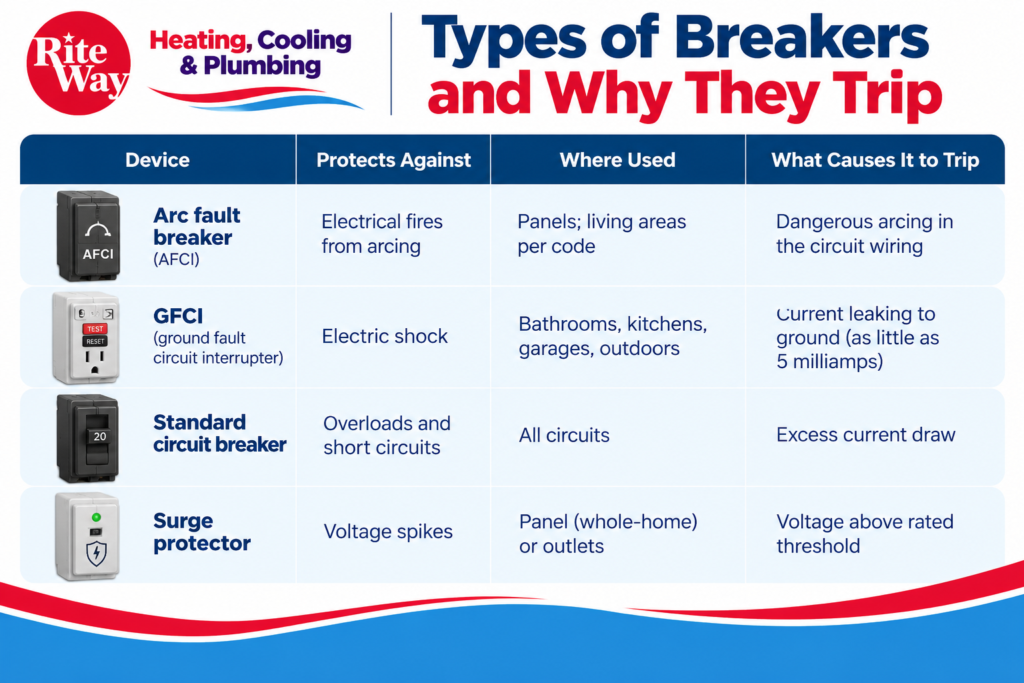
The distinction between AFCIs and surge protectors matters in Arizona. Monsoon season brings storms, outages, and the kind of voltage spikes that can damage appliances and electronics. An arc fault breaker does not stop a surge, and a surge protector does not detect arcing. Rite Way installs whole-home surge protection as part of electrical panel work in Tucson, which is the most effective way to protect against both.
Types of Arc Fault Protection
Combination AFCI breaker: The standard for new construction. Installed at the electrical panel, it protects against both parallel arcs (between conductors) and series arcs (within a single conductor at a loose or damaged point). This is the most complete protection available.
Outlet branch-circuit (OBC) AFCI receptacle: An AFCI device that looks like an outlet and installs at the first receptacle on a branch circuit. It protects the wiring downstream from that point. The NEC allows this type as a compliant option for remodels and modifications where running a new cable to the panel would be impractical.
Dual-function AFCI/GFCI device: A single breaker or receptacle that provides both arc fault protection and ground fault protection. Useful in areas like laundry rooms that require both types of protection.
Where Arc Fault Breakers Are Required in Arizona Homes
The NEC (National Electrical Code) section 210.12 governs AFCI requirements. Under the current edition, AFCI protection is required for branch circuits that supply outlets in most living areas of new homes, including kitchens, family rooms, dining rooms, living rooms, parlors, libraries, dens, bedrooms, sunrooms, recreation rooms, closets, hallways, and laundry areas. Bathrooms and garages are not typically in the AFCI list under current code, but they do require GFCI protection.
For Phoenix, the City of Phoenix adopted the 2024 Building Construction Code, which includes the 2023 NEC, with an effective date of August 1, 2025. The Tucson area has also adopted recent NEC editions. Your local building department sets the exact requirements for your jurisdiction.
One important rule that affects existing homeowners: the NEC generally requires AFCI protection when branch-circuit wiring in a required area is modified, replaced, or extended. If you are remodeling a bedroom, adding outlets to a living room, or upgrading your panel, current code may require AFCI protection for that work. A licensed electrician familiar with local permitting can tell you exactly what applies to your project.
Does Your Tucson or Phoenix Home Have Arc Fault Protection?
AFCI breakers first became required in bedroom circuits under the 1999 edition of the NEC. Requirements expanded to most living areas in 2008 and to kitchens and laundry areas in later editions. Homes built before those requirements took effect were not required to retrofit, and most still have not.
This matters in Arizona. According to University of Arizona housing data, the largest share of Tucson homes was built in the 1970s, well before any AFCI requirement. NAHB analysis of 2024 Census ACS data puts the Phoenix city median year built at 1984, also before AFCI requirements arrived. That means the majority of homeowners in both markets are likely living without this protection unless their panel or circuits have been updated since the home was built.
To check your own panel: AFCI breakers have a TEST button and are typically labeled “AFCI” or “Combination AF.” Outlet-type AFCIs look like GFCI outlets but are labeled AFCI. If you are not sure what you have, Rite Way’s electrical inspections include a review of wiring, breakers, and code compliance. Older homes, particularly those from the 1960s and 1970s that may have aluminum branch wiring, are worth having inspected. Aluminum wiring connections can loosen over time and are a known source of heat and arcing at connection points.
Why Does My Arc Fault Breaker Keep Tripping?
Nuisance tripping is one of the most common complaints about AFCIs, and it is worth understanding what is and is not normal.
Tripping that is usually normal:
- Older or cheaper vacuum cleaners and some power tools with brush motors produce arc-like signals that can occasionally trip an AFCI.
- Some older electronics and dimmers may trigger occasional trips.
Tripping that is a warning sign:
- A damaged, frayed, or pinched power cord on a lamp or appliance.
- A loose wire connection at an outlet, switch, or fixture in that circuit.
- Wiring problems such as a shared neutral between two circuits, which is a common issue in older homes.
- In desert-edge neighborhoods, pack rats and other rodents sometimes chew through wiring in attics and garages. Chewed insulation creates exactly the kind of arcing an AFCI is designed to detect.
Safe reset sequence:
- Unplug everything connected to that circuit.
- Reset the breaker once by pushing it fully to the OFF position, then back to ON.
- Plug items back in one at a time. If it trips when you add a specific item, that item has a problem and should be removed from service.
- If the breaker trips with nothing plugged in, or trips again promptly after reset, stop resetting it and call an electrician.
- If you notice a burning smell or a warm outlet cover on that circuit, turn the breaker off and call for service. Rite Way provides emergency electrical service in Tucson for exactly this situation.
How to Test Your Arc Fault Breakers
Press the TEST button on each AFCI breaker. The breaker should trip immediately. Reset it by pushing it to OFF and then back to ON. Most manufacturers recommend testing monthly, though many homeowners do this once or twice a year at minimum. If the breaker does not trip when tested, it may have failed and should be replaced by a licensed electrician.
Adding Arc Fault Protection to an Older Home
If your home does not have AFCI protection and you want to add it, a licensed electrician has a few options depending on your panel and wiring:
- AFCI breakers at the panel: Replacing standard breakers with combination AFCI breakers is the most complete solution, but the replacement breaker must be compatible with your specific panel model.
- OBC AFCI receptacles: In cases where the panel does not support AFCI breakers or where a full panel replacement is not planned, outlet branch-circuit AFCI receptacles installed at the first outlet on a circuit can provide a code-compliant path.
- Panel replacement: If your panel is outdated or lacks capacity, an electrical panel replacement in Tucson or a panel upgrade in Phoenix is the opportunity to bring AFCI protection throughout the home at the same time.
Any of this work should be permitted and inspected through your local building department. Rite Way’s electricians are familiar with local permitting requirements and handle the coordination. Phoenix-area residents can also visit our Phoenix electrical services page.
Electrical fires are serious. AFCI protection addresses the wiring side of fire risk, but working smoke alarms are equally important. If yours are chirping or you are not sure they are functioning, see our post on why smoke detectors beep.
Serving Southern Arizona Since 1959
Rite Way’s licensed electricians serve Tucson and communities across Southern Arizona and the Greater Phoenix Valley. Whether you need an electrical inspection, a panel upgrade, or help tracking down a breaker that keeps tripping, we give you a plain-language explanation of what we find and upfront pricing before any work begins. All work is performed by ROC-licensed electricians. We have been serving Arizona homeowners since 1959 and answer phones 24/7.
Arc Fault Breaker FAQs
Yes. Arc detector breaker is a plain-language way to describe an arc fault circuit interrupter, or AFCI. Whatever you call it, it is a breaker designed to detect dangerous arcing in your wiring and cut power before it can cause a fire.
Existing homes generally are not required to add them unless circuits are being modified, extended, or the panel is being replaced. That said, most homes in both markets were built before AFCI requirements existed, so they lack this protection. A licensed electrician can inspect your system and explain your options.
An AFCI detects dangerous arcing in the wiring and protects against electrical fires. A GFCI (ground fault circuit interrupter) detects current leaking to ground and protects people from electric shock. Both are safety devices, but they respond to different hazards. Some areas of the home require one, some require the other, and some require both.
Older vacuum motors use brushes that produce arc-like electrical signatures. This can occasionally trigger an AFCI. If the trip happens every time with the same appliance, try the vacuum on a different circuit. If it trips every circuit or your AFCI trips with nothing plugged in, call an electrician.
This work requires opening the electrical panel, where exposed bus bars carry potentially lethal voltage even with the main breaker off. AFCI breakers must also be matched to the specific panel brand and model. This is a licensed electrician job, and in most jurisdictions, it requires a permit.
No. An arc fault breaker responds to arcing inside your home’s wiring. Voltage spikes from storms, outages, or utility switching are handled by surge protection, such as a whole-home surge protector installed at the panel. An AFCI and a surge protector address completely different problems, and many homes benefit from both.
Most manufacturers recommend monthly testing. Press the TEST button on each AFCI breaker and confirm it trips. If it does not trip, the breaker may have failed and should be replaced by a licensed electrician.
