The right ceiling fan direction is counterclockwise in summer and clockwise on low speed in winter. Counterclockwise pushes air down to create a cooling breeze. Clockwise on low gently pulls warm air from the ceiling back into the room without a draft.
In Tucson and Phoenix, where summers arrive early, stretch well into fall, and push temperatures above 100 degrees for weeks at a time, getting ceiling fan direction right is one of the simplest ways to stay comfortable and reduce the load on your cooling system. But the heating side matters too. On cool desert mornings in November and December, when your furnace or heat pump kicks on and warm air rises straight to the ceiling, a fan set correctly can make the whole room feel more evenly heated without touching the thermostat.
Here is how to tell which way your fan is spinning, how to switch it, and how to get the most out of your fans in both seasons.
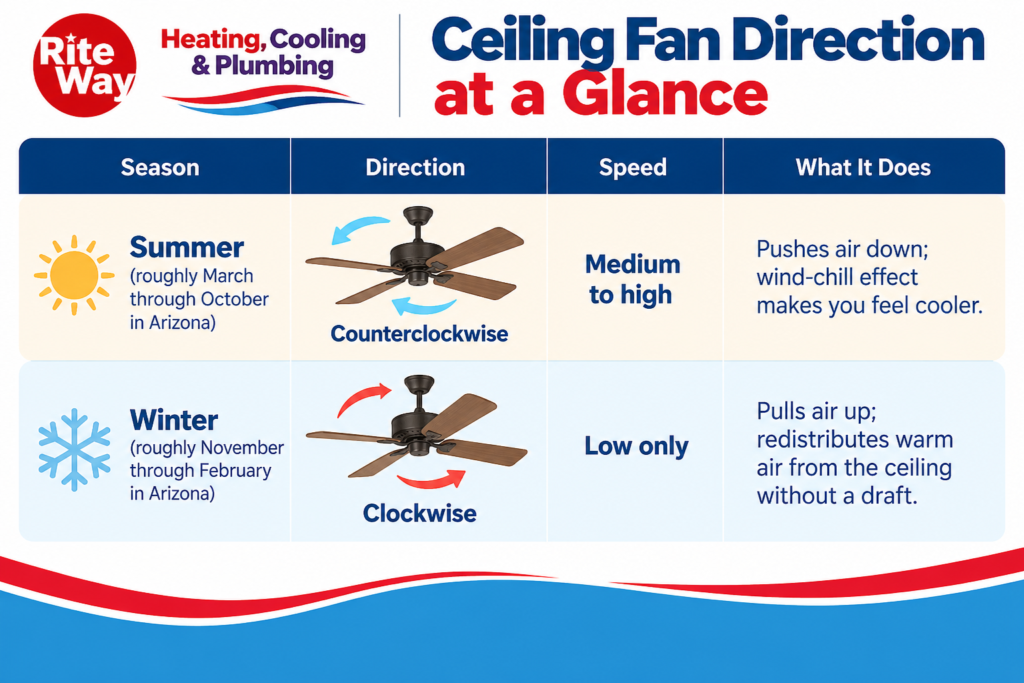
Summer Ceiling Fan Direction: Counterclockwise
In summer, set your ceiling fan to spin counterclockwise. The blades push air straight down, creating a wind-chill effect on your skin that makes you feel cooler without changing the room temperature.
According to the U.S. Department of Energy, using a ceiling fan in the correct direction lets you raise your thermostat about 4 degrees Fahrenheit with no reduction in comfort. In Tucson and Phoenix, where AC systems run for the better part of eight months and extreme heat days are routine, that adds up significantly over a season.
Fans cool people, not rooms. Turn them off when you leave. Running a fan in an empty room does not lower the temperature — it just uses electricity.
Winter Ceiling Fan Direction: Clockwise on Low
In winter, reverse the fan to clockwise and drop it to the lowest speed setting. The blades pull cool air upward, pushing the warm air that collects near the ceiling back down along the walls. At low speed you should not feel a draft, just more even warmth throughout the room.
Arizona winters are short, but the cool stretch from roughly November through February is real — especially in Tucson, where overnight lows regularly dip into the 30s and 40s, and in higher-elevation communities like Sierra Vista and Marana. On cold mornings when the heat is running, clockwise on low is a simple way to get more out of the energy you are already spending.
When to Switch Your Ceiling Fan in Tucson and Phoenix
Generic guides say to switch in spring and fall. In Arizona, the calendar works differently.
According to the NWS, Tucson’s average highs are in the mid-70s by March, above 80 by April, and still around 86 degrees in October. Phoenix runs warmer still. True cool weather does not arrive until November or December and is gone again by late February.
A simple evergreen rule: switch to counterclockwise when you first turn the AC on for the season. Switch to clockwise on low when you first turn the heat on. You will rarely need to touch the direction switch more than twice a year, and in some Phoenix homes the winter switch barely applies at all.
How to Tell Which Way Your Ceiling Fan Is Spinning
Breeze test: Stand under the fan at medium or high speed. If you feel a noticeable breeze pushing down at you, the fan is in counterclockwise summer mode. If you feel almost nothing, it is likely in clockwise winter mode.
Visual test: Watch the blades from below. Counterclockwise means the blades travel from right to left as they pass in front of you.
Some fans and remotes label the settings as “summer” and “winter” or “forward” and “reverse” rather than specifying a direction. Check the label on the motor housing or your remote if you are unsure.
How to Change Ceiling Fan Direction
- Turn the fan off and wait for the blades to stop completely. Never adjust the direction while the fan is moving.
- Find the direction switch on the motor housing (a small slide switch), or use the reverse button on the remote, wall control, or app.
- Flip the switch or press the button.
- Turn the fan back on and run the breeze test to confirm.
Use a sturdy step ladder to reach the motor housing safely. If the fan wobbles, makes noise, or will not reverse, stop and have an electrician take a look. Rite Way’s Tucson electricians can help with wiring and motor concerns.
Use Ceiling Fans to Help Your AC in Arizona Heat
With a ceiling fan running counterclockwise, you can raise the thermostat a few degrees and still feel comfortable, which reduces the load on your AC throughout a long Arizona summer. On the hottest days in Tucson and Phoenix, when even a well-maintained system can reach the upper edge of what it is rated to handle, a ceiling fan can make a real difference in how the house feels without adding to the system’s workload.
Fans are not a substitute for a functioning AC. If your system is struggling to keep up regardless of the fans, AC repair or an AC tune-up may be what it actually needs. Tucson homeowners can also look into Rite Way’s energy efficiency audits through TEP to find other ways to reduce cooling load before the heat arrives.
Use Ceiling Fans to Help Your Heating System in Winter
The same logic works in reverse. In winter, warm air from your furnace or heat pump rises and collects near the ceiling while the space where you actually sit, sleep, and move around stays cooler. A ceiling fan on clockwise low mixes that air back down without creating a draft, making the room feel more consistently warm without turning the thermostat up.
This matters especially in Arizona homes with heat pumps, which are increasingly common in both Tucson and Phoenix. Heat pump supply air runs naturally cooler than furnace air at the vent and can feel lukewarm even when the system is working exactly as it should. A fan set to clockwise low helps distribute that air more evenly throughout the room. For more on heat pump comfort, see our post on HVAC not blowing warm air.
Special Cases: Patios, High Ceilings, and Sizing
Covered patios: Outdoor living is a big part of life in Tucson and Phoenix, and covered patios with ceiling fans are common. Use a damp-rated or wet-rated fan for any outdoor installation. Keep it counterclockwise year-round in most Arizona settings.
High or vaulted ceilings: Use a downrod to bring the fan closer to the living space. The DOE recommends blades sit 7 to 9 feet above the floor and 10 to 12 inches below the ceiling for best airflow.
Fan size: A 36 to 44-inch fan works well in rooms up to 225 square feet. For larger rooms, go with 52 inches or more. A fan that is too small will not move enough air to make a difference on a hot Arizona afternoon.
Serving Southern Arizona Since 1959
Rite Way’s licensed technicians serve Tucson and communities across Southern Arizona and the Greater Phoenix Valley. Whether you need an AC tune-up before summer, a heat pump check before the cool months, or help with an electrical concern, we provide upfront pricing and a plain-language explanation before any work begins. We have been serving Arizona homeowners since 1959 and answer phones 24/7.
Ceiling Fan Direction FAQs
Counterclockwise. This creates a downdraft that produces a wind-chill effect and makes you feel cooler without lowering the room temperature.
Clockwise on low speed only. This draws air upward and pushes the warm air that collects near the ceiling back down into the room without creating a draft.
Yes. The U.S. Department of Energy states that using a ceiling fan correctly lets you raise your thermostat about 4 degrees Fahrenheit with no reduction in comfort, which makes a meaningful difference over a long Arizona cooling season.
No. Fans cool people, not rooms. They create a wind-chill effect on your skin but do not lower air temperature. Turn fans off when you leave to avoid wasting electricity.
It is optional, but helpful. Tucson and Phoenix winters are short, but on cold mornings when the heat is running, clockwise on low helps distribute warm air more evenly. Most of the year — roughly March through October — keep the fan on counterclockwise.
Check the remote, wall control, or app first. Many newer DC-motor fans reverse through a button rather than a switch on the motor housing. If there is no reverse function anywhere, the fan may not have a reversible motor.
Yes. In summer, run your fan on medium to high to maximize the wind-chill effect. In winter, low speed is essential — any faster and the clockwise rotation creates a downdraft that makes the room feel cooler instead of helping distribute warm air.
Yes, and it is one of the most effective ways to stay comfortable during an Arizona summer. The fan does not lower the room temperature, but the wind-chill effect it creates means you can raise the thermostat a few degrees without noticing a difference in comfort, which reduces the workload on your AC system.