It is usually time to replace your air conditioner when it is more than 10 to 15 years old and needs frequent or expensive repairs, your energy bills keep climbing, or it cannot keep your home comfortable on ordinary summer days. In Tucson and Phoenix, where AC systems run most of the year and summer temperatures regularly push past 100 degrees, units reach that point sooner than the national averages you will find online. The extreme heat, near-constant runtime, and monsoon dust that desert systems endure simply do not exist in most of the country. But not every breakdown means a new system. Here are the eight signs that point to replacement, when repair still makes sense, and how to plan so you are not shopping for a new AC in the middle of July.
Key Takeaways
- In Arizona, central ACs typically last 10 to 15 years — shorter than many national estimates because systems run most of the year under sustained extreme heat.
- Age alone is not the deciding factor. Age combined with frequent repairs, rising bills, or a major refrigerant leak usually is.
- Many breakdowns — a failed capacitor, a clogged condensate line — are routine repairs on an otherwise healthy system.
- R-22 systems are strong replacement candidates. R-410A systems can still be serviced.
- Plan a replacement in the cooler months if your system is aging. Do not wait for a July emergency.
How Long Does an Air Conditioner Last in Arizona?
In most of the country, a central AC can last 15 to 20 years. In Tucson and Phoenix, that timeline is shorter. Central air conditioning systems in Arizona’s desert climate typically last 10 to 15 years because the cooling season runs roughly 8 to 10 months and summer temperatures regularly exceed 100 degrees in Tucson and climb even higher across the Phoenix metro. That sustained thermal stress accelerates wear on compressors, capacitors, and refrigerant lines in ways that cooler climates simply do not.
ENERGY STAR flags any AC or heat pump over 10 years old as a candidate for evaluation. In Arizona’s climate, that threshold is worth taking seriously. A well-maintained unit may push toward 15 years; one that has run through multiple extreme summers with deferred maintenance may start showing wear earlier. Check the data plate on your outdoor unit for the manufacture date if you are not sure how old your system is.
Regular AC tune-ups are the most reliable way to extend service life and catch early warning signs before they turn into major repairs.
8 Signs It’s Time to Replace Your Air Conditioner
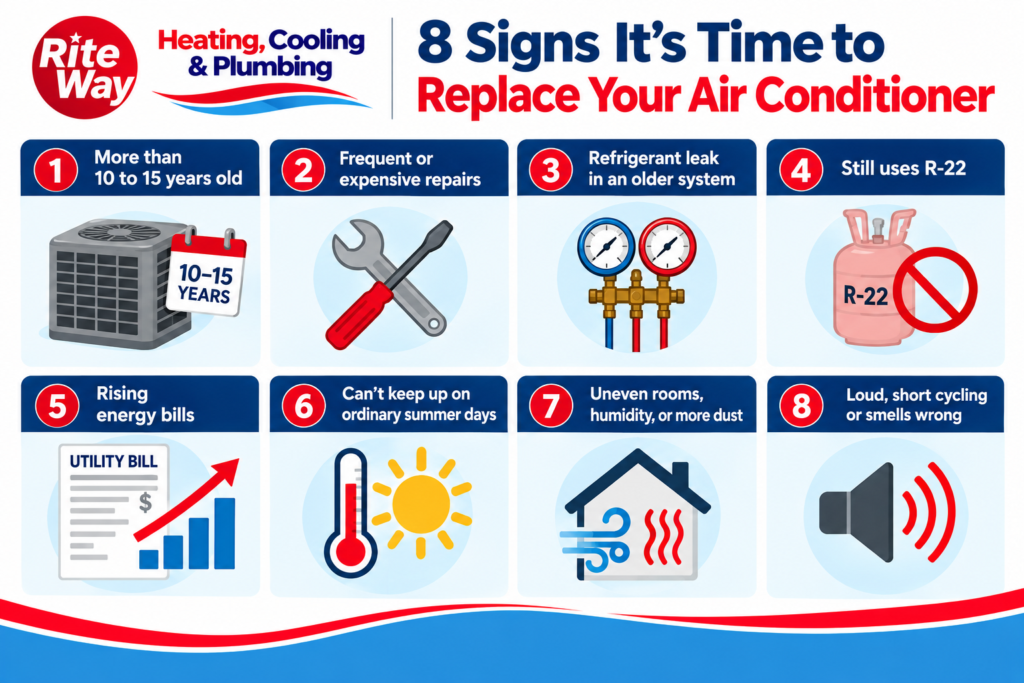
1. It Is More Than 10 to 15 Years Old
Age alone is not a reason to replace, but it changes how you weigh everything else on this list. A 7-year-old system that needs a minor repair is a different situation than a 13-year-old system with the same problem. The older the unit, the more each repair decision should include a conversation about replacement.
2. Repairs Are Getting Frequent or Expensive
Rite Way reviewed 100 completed AC repair calls in the Tucson area during one week in June 2026. That single-week snapshot reflects peak-heat conditions and skews toward heat-related failures, but the pattern it reveals is instructive: 62% of calls involved two or more issues on the same system. Multiple concurrent failures on an older unit are a strong signal to weigh replacement rather than continuing to repair.
3. It Has a Refrigerant Leak in an Older System
The June study found refrigerant or leak issues on 55% of calls, often traced to the evaporator coil. Arizona’s extreme heat accelerates coil degradation, and a refrigerant leak in an older system is one of the most common tipping points where the cost of repair approaches or exceeds the case for a new, more efficient system. On an aging unit, a coil replacement paired with a recharge warrants a serious replacement conversation.
4. It Still Uses R-22
R-22 refrigerant production and import ended in 2020. Recharging an R-22 system has become increasingly impractical and expensive in the years since. If your system uses R-22, replacement is not just a comfort decision — it is a practical one.
5. Your Energy Bills Keep Rising
Compare the same months year over year. Tucson and Phoenix homes run AC from roughly March through October, which means a year of higher-than-expected bills is a significant cost over time. If your bills are climbing while usage habits have stayed the same, a declining system is often the reason. Newer, high-efficiency systems are substantially more economical to run than units from 10 to 15 years ago.
6. It Cannot Keep Up on Ordinary Summer Days
On the hottest afternoons in Tucson and Phoenix, even a perfectly functioning system can hit its design limit and fall short of the set temperature. That is expected behavior, not a failure sign. What matters is whether the system struggles on ordinary days. Consistent inability to cool on a 95-degree afternoon, combined with rising bills and repeated repairs, is a replacement indicator. If you are not sure where your system falls, our post on AC not blowing cold air covers how to tell the difference.
7. Rooms Are Uneven, Humid, or Unusually Dusty
Arizona’s monsoon season brings humidity that a struggling system has difficulty managing. Persistent hot spots, excess humidity, or more dust than usual can indicate the system is losing the ability to manage airflow. It can also point to duct issues or improper sizing — both worth evaluating before replacing, since a new system in a leaky duct system will have the same problems.
8. It Is Loud, Short Cycling, or Smells Wrong
Grinding or banging sounds, a system that turns on and off every few minutes, or burning smells from the vents are all reasons to call for service. Some causes are repairable, but on an older unit they often accompany other failures and signal that the system is working harder than it should.
When Repairing Your AC Still Makes Sense
Not every call ends in a replacement recommendation. In Rite Way’s June 2026 repair study, capacitor failures showed up in 50% of calls and condensate drain shutdowns in 23%. In Arizona’s extreme summer heat, capacitors degrade faster than in most markets, making them one of the most common single-point failures our technicians see. On an otherwise healthy system, these are typically straightforward repairs and the right call.
A useful guideline: if the system is under 10 years old and the repair is a single, minor issue, repair usually makes sense. If a repair on an older system would cost a significant share of what a new one would, the math often favors replacement. Rite Way’s technicians give honest, upfront assessments — and if you want a second perspective, we offer a free second opinion. For AC repair in Tucson, contact Rite Way.
What About Refrigerants? R-22, R-410A, and New Systems
A brief overview as of late 2026. R-22 systems should be replaced — recharging them is no longer practical. R-410A systems can still be fully serviced and recharged; having R-410A is not by itself a reason to replace. New residential systems installed since early 2025 use lower-global-warming-potential refrigerants such as R-454B or R-32.
If your R-410A system is aging and develops a major leak or needs a compressor or coil replaced, that is a reasonable moment to compare repair cost against a new system. An EPA rule effective July 27, 2026 allows R-410A equipment manufactured before 2025 to continue to be installed while supplies last. Note: refrigerant regulations continue to evolve — confirm current rules with your technician at service time.
What to Replace It With
Plan for a matched system — outdoor unit and indoor coil or air handler together. Mismatching an older indoor coil with a new outdoor unit reduces efficiency and can affect the equipment warranty. Your technician should also confirm the new system is sized correctly for your home’s square footage and that your ductwork can support it. Many Tucson homes, with a median year built in the late 1970s, carry original ductwork that benefits from evaluation when a system is replaced.
In Arizona’s mild winters, a heat pump handles both cooling and heating with one system. Rite Way installs heat pumps across Tucson and Phoenix. See our post on heat pumps in Arizona or our heat pump installation page for more.
When to Replace Your AC in Tucson and Phoenix
Generic advice says replace in spring or fall. In Arizona, the practical window is October through April. If your system is aging and needed major repairs during last summer’s heat, get an estimate now rather than waiting for a breakdown when demand peaks, temperatures are extreme, and your home heats up in hours.
Rite Way offers a free estimate on AC replacement in Tucson, and you can get a general sense of system cost through our online HVAC estimate tool. Tucson homeowners should ask about current utility rebates — Rite Way is a TEP participating contractor. Phoenix-area residents can visit our Phoenix AC services page.
When to Replace Your Air Conditioner FAQs
Typically 10 to 15 years. Arizona systems run most of the year under sustained extreme heat, which puts them on the shorter end of the national range. Regular maintenance helps reach the upper end of that window.
Not automatically. If an older system is cooling well, not needing frequent repairs, and your bills are steady, there is no urgent reason to replace. The smart move is to plan ahead: get an inspection, request a replacement estimate during the cooler months, and decide on your own timeline rather than during a summer breakdown.
It depends on the repair. A capacitor failure or a clogged condensate line on an otherwise sound 10-year-old system is usually worth fixing. A refrigerant leak in the evaporator coil or multiple concurrent failures on the same unit is a different conversation.
No. Existing R-410A systems can still be serviced and recharged. The refrigerant transition mainly affects new equipment. Where R-410A matters is if your system is older and needs a major repair — that is a good time to weigh repair cost against a new system.
Often yes. A matched system is more efficient and protects the equipment warranty. If your air handler is also aging, replacing both at once typically makes more sense than doing them separately over the next few years.
October through April. The cooler months mean faster scheduling, and you avoid the risk of going without cooling during a heat wave. If your system is approaching the end of its life, plan the replacement before summer — not during it.
Likely yes, especially if your current unit is more than 10 years old. Efficiency standards have improved significantly, and a system that has spent years running in Arizona’s extreme heat is often performing well below its original rating.
Not necessarily. In Tucson and Phoenix, long run times during extreme heat are normal. The concern is a system that cannot reach the set temperature on ordinary summer days or runs constantly alongside rising bills and repeated repairs.