If your home air conditioner is running but not blowing cold air, the most common causes are an incorrect thermostat setting, a clogged filter, a frozen evaporator coil, or a refrigerant leak. In Tucson and Phoenix, a failed capacitor is an especially frequent culprit in summer. Start with the simple checks below, and call Rite Way if the problem persists.
In a market where summer temperatures regularly push AC systems to their limits and cooling season stretches across most of the year, a unit that stops performing is not something you can wait out. This guide walks through every common cause in order from the simplest homeowner check to the repairs that need a licensed HVAC technician, so you can identify what is happening and decide on the right next step.
Key Takeaways:
- Start with the simplest checks first: thermostat settings, filter condition, and the circuit breaker. These are free to fix and take five minutes.
- In Tucson and Phoenix, capacitor failure is one of the most common reasons an AC stops cooling in summer. Extreme heat degrades these components faster than in cooler climates.
- A frozen evaporator coil, a refrigerant leak, and a dirty condenser coil all reduce cooling output gradually. You may notice the air getting less cold over several days before the system stops cooling entirely.
- On Tucson’s hottest days, even a well-maintained system may struggle to keep up. That is not always a sign something is broken.
- If your outdoor unit is humming but the fan is not spinning, or the system keeps shutting off right after starting, call an HVAC technician. These are not DIY repairs.
Is Your AC Blowing Warm Air or Not Moving Air at All?
The answer changes what to check first.
If the system is running and air is coming through the vents but it feels warm or lukewarm, the problem is with cooling capacity. The causes below cover this scenario.
If the fan is not moving air at all, check the circuit breaker first, confirm the thermostat fan setting is on AUTO rather than ON, and make sure the outdoor unit is running. If the outdoor unit is silent and the breaker is fine, you likely have an electrical or capacitor issue that needs a technician.
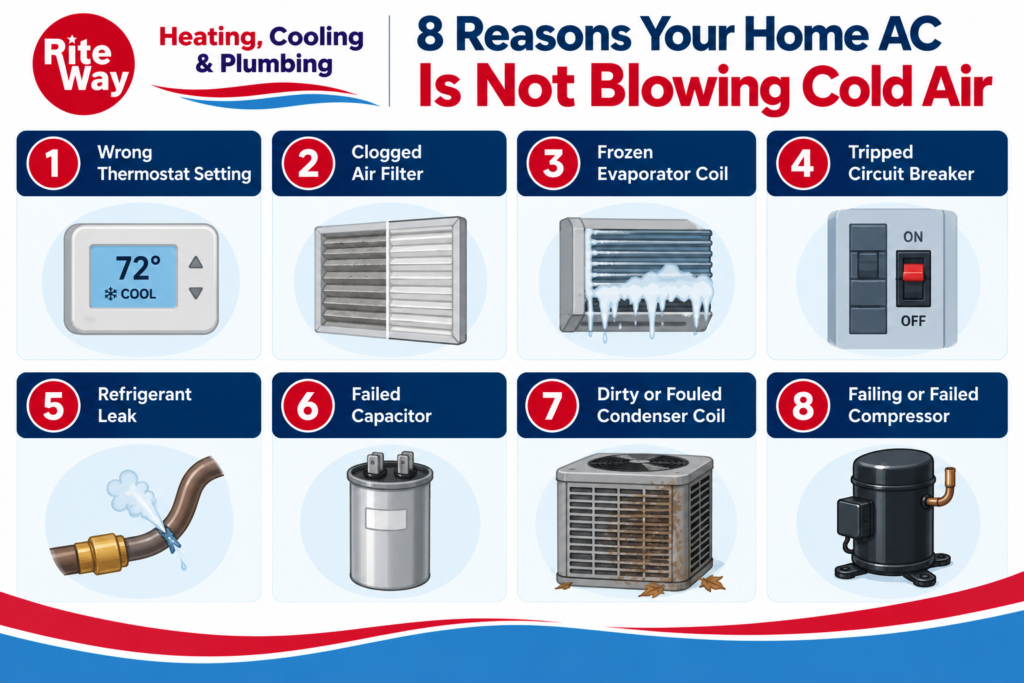
8 Reasons Your Home AC Is Not Blowing Cold Air
1. Wrong Thermostat Setting
Before anything else, check the thermostat. Confirm the system is set to COOL and not HEAT or FAN ONLY. The fan-only setting circulates air without cooling it, which is one of the most common explanations for warm air coming through the vents. Also confirm the set temperature is below the current room temperature.
DIY check: Yes. Verify mode, set temperature, and that the display shows the system is actively running.
2. Clogged Air Filter
A dirty filter restricts airflow through the system. When airflow is significantly reduced, the evaporator coil cannot absorb heat effectively, cooling output drops, and in severe cases the coil can freeze entirely. In Tucson and Phoenix, where systems run 8 to 10 months per year and desert particulate loads filters faster than in most U.S. markets, a filter that might last 90 days elsewhere may need changing every 30 to 45 days in summer.
DIY check: Yes. Pull the filter and hold it up to a light. If you cannot see light through it, replace it before anything else.
3. Frozen Evaporator Coil
The evaporator coil sits inside the air handler and absorbs heat from the air. If airflow is restricted (often from a dirty filter), refrigerant is low, or the system runs in unusually cool conditions, moisture on the coil can freeze and block airflow entirely. A frozen coil typically produces little to no cold air, and you may notice ice forming on the refrigerant lines near the indoor unit.
What to do: Turn the system off and set the fan to ON to let the coil thaw. This typically takes 1 to 3 hours. Once thawed, replace the filter if it was clogged and restart the system. If the coil refreezes, the underlying cause (usually low refrigerant or airflow restriction) needs a technician.
DIY check: Partial. You can thaw the coil and replace the filter yourself. If the problem returns, call Rite Way.
4. Tripped Circuit Breaker
A tripped breaker can cause the outdoor unit to stop running while the indoor fan continues to blow air, which feels warm since there is no active cooling happening. Check your electrical panel for any tripped breakers labeled for the AC, air handler, or HVAC.
Reset a tripped breaker once. If it trips again immediately, do not reset it a second time. A breaker that keeps tripping indicates an electrical problem that needs a licensed technician.
DIY check: Yes, for a single reset. If it trips again, call a technician.
5. Refrigerant Leak
Refrigerant is the substance that absorbs heat from your home’s air and releases it outside. When the refrigerant level drops due to a leak, the system loses its ability to cool effectively. You may notice the air getting progressively less cold over several days, ice on the refrigerant lines or evaporator coil, a hissing or bubbling sound near the indoor or outdoor unit, or higher-than-normal energy bills as the system works harder to compensate.
Refrigerant leaks are one of the most common reasons for AC repairs and require a licensed HVAC technician. Adding refrigerant without locating and repairing the leak is a temporary fix at best. In Arizona, handling refrigerant requires EPA 608 certification and is not a DIY repair.
DIY check: No. Call Rite Way.
6. Failed Capacitor
This is the most common technician-level repair Rite Way performs on summer AC calls in Tucson and Phoenix, and it is the cause that national guides consistently underemphasize.
A capacitor is an electrical component that stores and releases energy to start and run your AC’s compressor and fan motors. Think of it as the charge that kicks the system into gear each time it cycles on. Without a functioning capacitor, the motor cannot start or sustain operation under load.
Capacitors degrade over time in any climate, but they degrade significantly faster in high ambient heat. Tucson and Phoenix summers regularly push outdoor temperatures above 105 degrees Fahrenheit at ground level, and on surfaces like rooftop installations and concrete equipment pads, the temperature at the outdoor unit can run even higher. That sustained thermal stress accelerates the chemical breakdown inside the capacitor, shortening a component that might last 10 years in a moderate climate to 4 or 5 years in ours.
Signs of a failed or failing capacitor:
- The outdoor unit hums but the fan does not spin.
- The system tries to start but shuts off immediately.
- The compressor kicks on but the fan starts slowly or erratically.
- The system cools for a few minutes, then shuts down.
Capacitor replacement is typically a same-day repair and one of the more straightforward fixes in HVAC service. Do not attempt to handle a capacitor yourself. They store an electrical charge and can cause serious injury even when the system is powered off.
DIY check: No. Call Rite Way.
7. Dirty or Fouled Condenser Coil
The outdoor condenser coil releases heat from inside your home to the outside air. When it is coated in dust, dirt, or debris, it cannot transfer heat effectively and the system’s cooling output drops. In Tucson and Phoenix, desert particulate, pollen, cottonwood seeds, and monsoon dust accumulate on condenser coils significantly faster than in most U.S. markets. A coil that might need cleaning annually elsewhere may need attention twice per summer here.
You can rinse a lightly fouled condenser coil with a garden hose (with the system powered off), spraying from the inside out. For heavier fouling or compacted debris between the fins, professional cleaning with the right equipment does a more thorough job without bending the fins.
DIY check: Light rinsing only, with power off. For deep cleaning, call a technician or schedule an AC tune-up.
8. Failing or Failed Compressor
The compressor is the heart of the cooling system. It pressurizes the refrigerant and drives the cooling cycle. A failing compressor typically produces warm air despite the system running, along with unusual sounds such as clicking, rattling, or hard starting. Compressor failure is among the more serious and expensive AC repairs, and in older systems it often makes replacement of the entire unit more cost-effective than repair alone.
Systems that have run with low refrigerant, have never been properly maintained, or are approaching the end of their service life are the most vulnerable. A system showing compressor symptoms near or past the 10 to 15-year mark is worth evaluating for full replacement rather than compressor repair.
DIY check: No. Call Rite Way.
Why AC Problems Hit Harder in Tucson and Phoenix
Most HVAC components are engineered with moderate climates in mind. In Tucson and Phoenix, what holds up for 5 to 7 years in a typical U.S. market can wear out in 3 to 4. Systems run nearly year-round, outdoor units operate for months at a stretch in temperatures that push the upper limits of what residential equipment is rated to handle, and components like capacitors and condenser coils take on a workload that simply has no equivalent in most of the country.
On the hottest summer days, even a fully functioning system may not hit your target indoor temperature. That is not a malfunction. It is a physics limit that every AC system has, and Tucson and Phoenix summers are one of the few places in the country that actually reach it on a regular basis. Knowing the difference between a system that is broken and a system that is at its design ceiling is part of what Rite Way’s technicians help homeowners sort out every summer.
Annual tune-ups that catch worn capacitors, dirty coils, and refrigerant issues before peak season are the most effective way to avoid a breakdown when temperatures are at their worst.
When to Call Rite Way and How Fast We Respond
A broken AC in Tucson or Phoenix in July is not a wait-until-Monday situation. Rite Way’s HVAC technicians are available around the clock and respond to summer AC calls with the urgency the heat demands. If you have worked through the DIY checks and the system is still not cooling, or if your outdoor unit is humming without the fan spinning, call us.
AC Not Blowing Cold Air FAQs
The most common reasons are an incorrect thermostat setting, a clogged air filter, a frozen evaporator coil, or low refrigerant from a leak. In Tucson and Phoenix, a failed capacitor is also among the top causes since extreme summer heat degrades these components faster than in cooler climates.
Signs include warm or lukewarm air from the vents despite the system running, hissing or bubbling sounds near the indoor or outdoor unit, ice forming on the evaporator coil or refrigerant lines, and rising energy bills as the system works harder to compensate. Refrigerant leaks require a licensed technician and are not a DIY repair.
Every residential AC system has a maximum outdoor temperature it is designed to handle, typically up to 110 to 115 degrees. When Tucson’s summer heat pushes past that threshold, even a well-maintained system may not reach your target indoor temperature.
A capacitor stores and releases electrical energy to start and run the AC’s compressor and fan motors. Capacitors degrade faster in high heat, and Tucson and Phoenix summers regularly push outdoor unit temperatures well above what most climates see. Signs of failure include a humming outdoor unit where the fan does not spin, a system that tries to start but cannot, or a unit that shuts off immediately after starting.
You can check the thermostat settings, replace a clogged filter, thaw a frozen evaporator coil, and reset a tripped breaker yourself. Refrigerant leaks, capacitor failure, compressor problems, and deep condenser coil cleaning all require a licensed HVAC technician.
Check it visually once a month during the cooling season and rinse it with a garden hose (power off) when it looks dirty. Plan for professional cleaning at least once per summer, ideally twice during peak season, given our desert conditions and extended runtime.
This is a classic sign of a failed run capacitor. The compressor is trying to start but the fan motor cannot engage without a functioning capacitor. Turn the system off and call a technician. Do not attempt to manually spin the fan or continue running the system.
Central air conditioners in our market typically last 10 to 15 years with proper maintenance, which is at the shorter end of the national range due to near-year-round runtime and extreme heat. A system approaching or past that window with repeated repair needs is worth evaluating for replacement rather than continued repair.