
Aeroseal duct sealing is often worth it if your ducts leak, and in a typical house, about 20 to 30 percent of the air moving through the duct system is lost to leaks, holes, and poor connections, according to ENERGY STAR. That matters even more in Tucson and Phoenix, where AC runs most of the year and ducts often pass through attics that reach extreme temperatures in summer. But it is not the right fix for every home. Here is how Aeroseal works, the signs your ducts are leaking, when it pays off, when another repair makes more sense, and what to expect from the process.
Key Takeaways
- Most homes lose 20 to 30 percent of conditioned air through leaky ducts, according to ENERGY STAR.
- Aeroseal seals leaks from the inside without tearing out walls, and measures results before and after.
- It is not the right fix for large gaps, disconnected ducts, crushed flex duct, or wet in-slab systems.
- In Tucson and Phoenix, hot attics and a long cooling season make duct leaks more costly than in cooler climates.
- Ask for before-and-after leakage numbers so you can see exactly what you paid for.
What Is Aeroseal Duct Sealing?
Aeroseal seals leaks from the inside of the duct system rather than requiring access to every joint from the outside. A technician blocks the supply and return registers, then injects a polymer sealant into the ducts as a fine mist. As air escapes through leaks, sealant particles collect at the edges of each gap and bond there, gradually closing the opening. A computer measures system leakage before and after so the results are verifiable, not estimated.
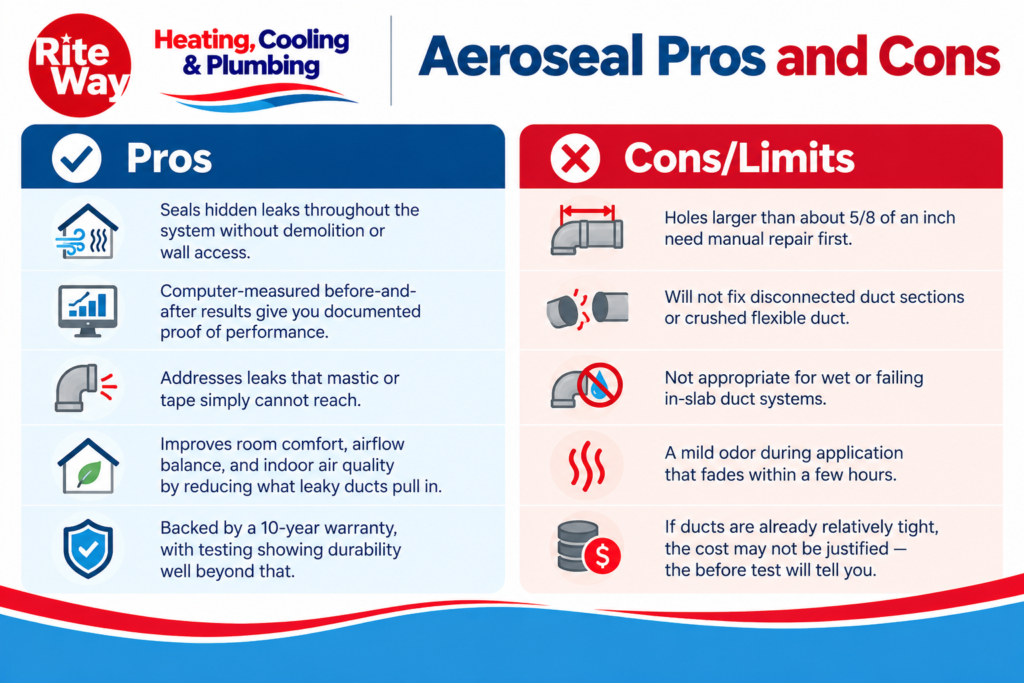
The process is effective on holes up to about 5/8 of an inch. Larger gaps, disconnected duct sections, or crushed flexible duct need manual repair before or instead of Aeroseal.
Rite Way offers Aeroseal duct sealing in Tucson for homeowners whose ducts need this type of treatment.
Signs Your Ducts Are Leaking
You may not be able to see duct leaks, but you can usually feel them. ENERGY STAR lists these warning signs:
- Higher-than-expected energy bills despite normal usage
- Rooms that are difficult to cool or heat evenly
- Stuffy areas that never feel comfortable regardless of the thermostat setting
- Ducts located in the attic, crawlspace, or garage
- Tangled or kinked flexible duct sections in the system
In Arizona, excessive dust throughout the home can also indicate leaky return ducts pulling attic or garage air into the system. If you are unsure whether leaky ducts are contributing to your comfort or efficiency problems, Rite Way’s energy efficiency audit through TEP can help identify where energy is being lost.
Why Duct Leaks Cost More in Arizona Homes
In Tucson and Phoenix, leaky ducts are not just an efficiency problem — they are a particularly expensive one. Here is why:
Hot attics: Many desert homes run ductwork through attics that can get far hotter than outdoor temperatures in summer. When cooled air leaks into that space instead of reaching the living area, it is completely lost, and leaky return ducts can pull that superheated, dusty attic air back into the system.
Long cooling season: AC systems in Tucson and Phoenix run roughly 8 to 10 months a year. Every percentage point of duct leakage is paid for over a much longer stretch than in cooler climates.
Older ductwork: Tucson’s housing stock has a median year built in the late 1970s, and Phoenix metro homes were built mostly in the 1980s and early 1990s. Original duct tape and duct connections from that era have often dried, cracked, or loosened over decades of extreme heat cycling.
In-slab ducts: Some older desert homes have ductwork embedded in the concrete slab. Aeroseal can seal sheet-metal in-slab ducts if they are dry and relatively clean, but wet or deteriorating in-slab duct systems need a different approach entirely. A technician can determine which situation you have.
When Aeroseal Is Worth It and When It Isn’t
Worth it when:
- Your ducts have moderate leakage and the system is otherwise in good condition
- You are pairing it with a new AC installation so the new equipment does not lose efficiency to a leaky duct system. If you are weighing a full replacement, see our guide on when to replace your air conditioner first.
- Comfort problems or uneven cooling have been traced to air distribution rather than equipment capacity
- Your home has ducts in hot attics or unconditioned spaces where losses are amplified
Not worth it when:
- Ducts need full replacement or have major disconnects that require manual repair
- The before-test shows ducts are already reasonably tight
- You are planning a duct system overhaul in the near term
Ask for the before-and-after leakage numbers. If the after reading does not show meaningful improvement, you should not pay for the service.
Is Aeroseal Safe?
Aeroseal reports that the sealant contains ingredients commonly found in hairspray and chewing gum, is UL-tested, and produces a mild odor during application that typically dissipates within a few hours.
Most homeowners stay home during the process, but if anyone in the household has asthma or sensitivity to smells, it is worth running errands during and shortly after the application.
ENERGY STAR also notes that leaky ducts in homes with gas appliances — furnaces, water heaters, dryers — can contribute to backdrafting, where combustion gases are drawn back into the living space instead of being expelled outdoors. Sealing leaks reduces that risk.
How Long Does Aeroseal Last?
Aeroseal backs the process with a 10-year warranty. The company’s accelerated durability testing has shown the sealant holding up well beyond 40 years under laboratory conditions. For everyday purposes, treat the warranty as the documented commitment and the long-term testing as supportive evidence, not a guarantee.
Aeroseal vs. Duct Cleaning
These are two different services that solve two different problems. Duct cleaning removes dust, debris, and buildup from inside the duct walls. Aeroseal seals leaks in the duct structure itself. Aeroseal says cleaning before sealing is usually not required, and a technician can advise based on your system’s condition. Rite Way offers both services, so if you are unsure which one your home actually needs, we can assess and recommend the right path.
What Affects Aeroseal Cost?
No two homes are identical, and Aeroseal cost varies based on the size of the home, the number of systems, how accessible the ductwork is, and how much leakage needs to be addressed. Rite Way offers a free in-home estimate so you know what you are looking at before committing. Ask about current utility rebates when you schedule — incentive programs for duct sealing exist and eligibility can change, so current information is always more reliable than anything published online.
Serving Southern Arizona Since 1959
Rite Way offers Aeroseal duct sealing and air duct repair. Whether you want to know if your ducts are leaking or are ready to schedule a service, we provide an honest assessment and upfront pricing before any work begins. We have been serving Arizona homeowners since 1959 and answer phones 24/7.
Aeroseal Duct Sealing FAQs
Yes, and the results are verifiable. The computer measures leakage before and after the process, so you can see exactly how much improvement was achieved rather than taking anyone’s word for it.
Usually not. The sealant has a mild odor during application, similar to white glue, that fades within a few hours. If anyone in your home has asthma or is sensitive to smells, plan to be out during the process and for a short time afterward.
It can, but only if the in-slab ducts are sheet-metal, dry, and relatively clean. Wet or deteriorating in-slab systems are not candidates. A technician should assess the condition of your specific ducts before recommending Aeroseal.
Aeroseal says cleaning first is usually not required. A technician can advise based on what is actually in your system. Rite Way offers both services and can help you determine which one — or which combination — makes sense for your home.
Often yes. If rooms that are hard to cool or heat trace back to air escaping through leaks before it reaches those spaces, sealing the ducts can make a noticeable difference. If the issue is equipment sizing or duct design, Aeroseal alone may not resolve it — a technician can help determine which is the cause.
It should not. Aeroseal is applied inside the ductwork, not to the equipment itself. That said, confirm with your technician at the time of installation, since warranty terms vary by manufacturer and installer.
