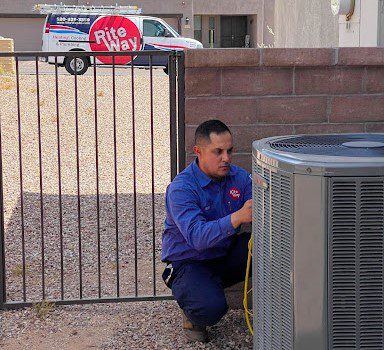
The heating season in Tucson and Phoenix is short, and it has a habit of catching people off guard. After sitting idle from spring through late fall, your furnace or heat pump gets called on to produce heat on the first cold morning of the season, often with a filter still loaded with monsoon dust, a thermostat battery on its last legs, or a flame sensor coated in months of buildup. These are not random failures. They are the predictable result of a heating system that runs hard all summer, then waits.
The good news is that most of the reasons a heater blows cold air are either free to fix yourself or quick for a technician to resolve. This guide covers nine causes, from the simplest homeowner check to repairs that need a licensed professional, so you can identify what is happening and take the right next step.
Rite Way has been serving Tucson, Phoenix, Sierra Vista, and communities across Southern Arizona since 1959. Our HVAC technicians take calls 24/7.
Key Takeaways
- Three free checks resolve most no-heat calls in Arizona: thermostat mode and batteries, a dirty air filter, and a tripped breaker. Run through those before anything else.
- Not all cold air from a heat pump means something is wrong. Brief cool air during defrost mode and lukewarm air at the register are both normal.
- Heating systems in Tucson and Phoenix sit idle most of the year. Most failures surface on the first cold morning of the season when dormancy takes its toll.
- Smell gas? Leave immediately. From a safe place, call 911 and Southwest Gas.
- Flame sensors, igniters, refrigerant issues, and a breaker that keeps tripping all need a licensed technician.
Is Your Heater Blowing Cold Air or Not Blowing Air at All?
Start by figuring out exactly what the system is doing.
If air is moving through the vents but it feels cold or lukewarm, you have a heat production problem. The nine causes below all address this scenario.
If no air is moving at all, start with the breaker, the furnace power switch on the wall near the unit, and the furnace door panel. A safety switch inside the panel shuts the heating system down completely when the door is even slightly ajar.
Furnace or heat pump? If an outdoor unit is running in winter, you have a heat pump. If there is a gas line and a metal exhaust pipe running out of the indoor unit, you have a gas furnace. Knowing which system you have makes troubleshooting much more straightforward.
How to Fix Heater Problems Yourself: 5 Checks to Try First
Run through these before making any calls. They are free, they take less than ten minutes, and they resolve a surprising share of no-heat situations.
- Check the thermostat. Set it to HEAT, not COOL. Raise the setpoint at least 3 to 5 degrees above current room temperature. Switch the fan to AUTO rather than ON. When the fan is set to ON, it circulates air even when the heat is not running, which sends cold air through the vents. Swap in fresh batteries too. In Tucson and Phoenix, where a single day can swing 25 degrees between morning lows and afternoon highs, thermostats get switched between HEAT and COOL more often than most people realize.
- Pull the air filter and hold it up to light. If you cannot see light pass through it, replace it before doing anything else. Arizona desert dust accumulates quickly, and a filter left over from the cooling season is often the first place to look.
- Check the breaker. Gas furnaces depend on electricity to run the blower, controls, and ignition. Heat pumps have two breakers, one for the indoor unit and one for the outdoor. Reset a tripped breaker once. If it trips again, stop and call a technician.
- Check the furnace power switch and the door panel. The power switch is a standard toggle usually mounted on the wall nearby. A loose furnace door panel trips a safety shutoff that cuts the whole system.
- Check the gas valve (gas furnaces) and the outdoor disconnect (heat pumps). The gas valve lever should run parallel to the pipe, meaning gas is flowing. The heat pump outdoor disconnect should be switched to ON.
9 Reasons Your HVAC Is Not Blowing Warm Air
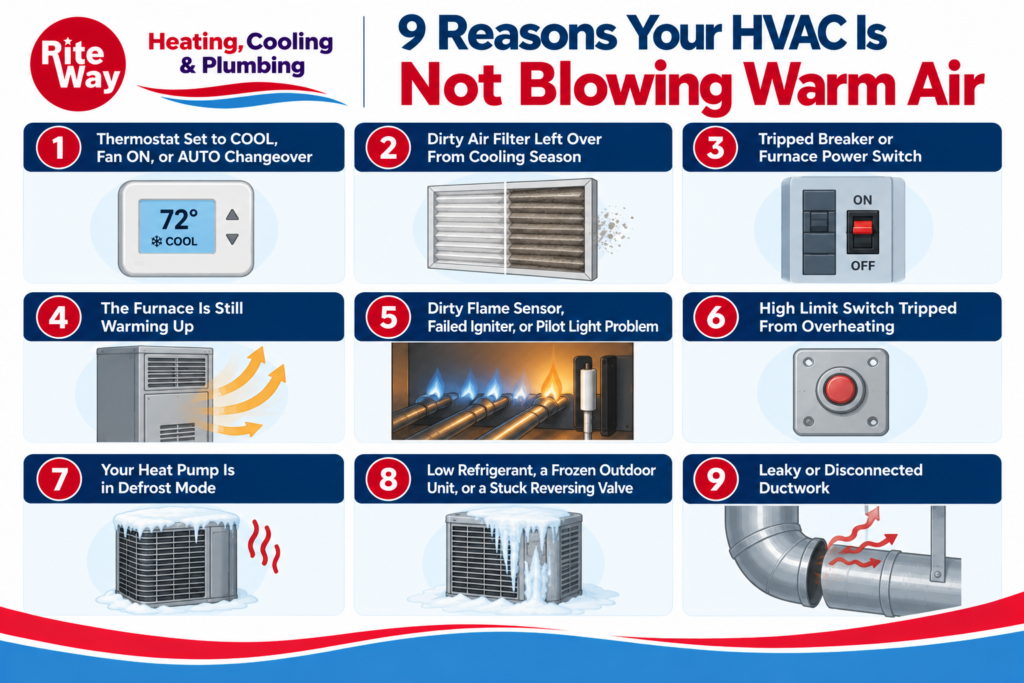
1. Thermostat Set to COOL, Fan ON, or AUTO Changeover
DIY Check: Yes
With 20 to 25 degree temperature swings between Tucson and Phoenix afternoon highs and overnight lows, thermostats get adjusted often and settings get left in the wrong position. A mode left on COOL or a fan left on ON will push unheated air no matter what the rest of the heating system is doing. The checklist above covers this in detail.
2. Dirty Air Filter Left Over From Cooling Season
DIY Check: Yes
Restricted airflow from a clogged filter causes the furnace to overheat. When that happens, the high limit switch cuts power to the burners while the blower keeps running, sending cold air through the vents until the system cools down. Check the filter at the start of every heating season and at least monthly after that.
3. Tripped Breaker or Furnace Power Switch
DIY Check: Yes
Gas furnaces require electricity for the blower motor, ignition, and controls. Heat pumps run on two separate circuits. A tripped breaker or a power switch that got nudged off is a fast fix. Reset it once only. A second trip means an underlying issue a technician needs to evaluate.
4. The Furnace Is Still Warming Up
DIY Check: Yes (wait 60 seconds)
Give the heating system a full minute after startup before assuming anything is wrong. The heat exchanger needs time to reach temperature before warm air reaches the vents. On the first run of the season, you may also notice a faint dusty or burning smell as accumulated buildup on the burners burns off. That is normal as long as it clears within a few minutes.
5. Dirty Flame Sensor, Failed Igniter, or Pilot Light Problem
DIY Check: No
How a furnace ignites depends heavily on when it was built. Modern furnaces, which are more common in Phoenix metro homes from the early 1990s onward, use a hot surface igniter paired with a flame sensor. Older furnaces, more typical of Tucson homes built in the 1970s and 1980s, may have a standing pilot light. The classic sign of a failing flame sensor is burners that light and then shut off within a few seconds, tripped by the sensor failing to detect a stable flame. Long idle periods let dust settle on the sensor, which can cause just this kind of intermittent fault. Pilot relighting should follow the manufacturer label on the furnace door only. Leave igniter and flame sensor work to a professional. For furnace repair in Tucson or furnace repair in Phoenix, Rite Way is ready.
6. High Limit Switch Tripped From Overheating
DIY Check: Partial
When a furnace overheats, the high limit switch interrupts power to the burners as a safety measure. The blower keeps running and pushes cold air until the unit cools. Blocked or closed supply and return vents are common triggers, along with a dirty filter. Clear any obstructions and check the filter. If the furnace keeps overheating, schedule a technician visit.
7. Your Heat Pump Is in Defrost Mode
DIY Check: Yes (just wait)
On cold mornings, frost can build up on the outdoor coil of a heat pump. The system briefly reverses to melt it, a process called defrost mode. During this cycle, the outdoor unit may steam or go quiet and indoor air may run noticeably cooler for a few minutes before normal heating resumes. This is by design and not a malfunction.
Heat pump supply air also runs naturally cooler than furnace air at the register, often around 90 to 95 degrees versus 120 to 140 degrees from a gas furnace. That can feel lukewarm even when the system is running exactly as intended. Learn more about how heat pumps work.
8. Low Refrigerant, a Frozen Outdoor Unit, or a Stuck Reversing Valve
DIY Check: No
When a heat pump runs low on refrigerant, loses the ability to defrost, or has a reversing valve stuck in cooling mode, the result is cold air in heat mode that never warms up. Ice on the outdoor unit that will not clear after a defrost cycle is a clear signal to stop troubleshooting and call for service. Contact Rite Way for heat pump repair.
9. Leaky or Disconnected Ductwork
DIY Check: Partial (visual only)
Gaps or disconnections in ductwork bleed warm air before it ever reaches your rooms, leaving parts of the house cold even when the heating system is running. Tucson homes built in the 1970s and 1980s are more likely to still have original ductwork in place. Check accessible sections in a crawlspace, attic, or utility area for obvious gaps. A technician can trace where conditioned air is being lost.
Why Heater Problems Show Up on the First Cold Morning in Tucson and Phoenix
Arizona winters are mild by almost any national comparison. NWS 1991 to 2020 normals put Tucson’s average January low near 41 degrees Fahrenheit, while NWS data puts Phoenix’s January normal low at 46 degrees. Sierra Vista, at higher elevation near the Huachuca Mountains, sees a January average low of about 34 degrees according to the city’s own climate data, making heat pump defrost cycles and auxiliary heat use more routine there than in either major metro.
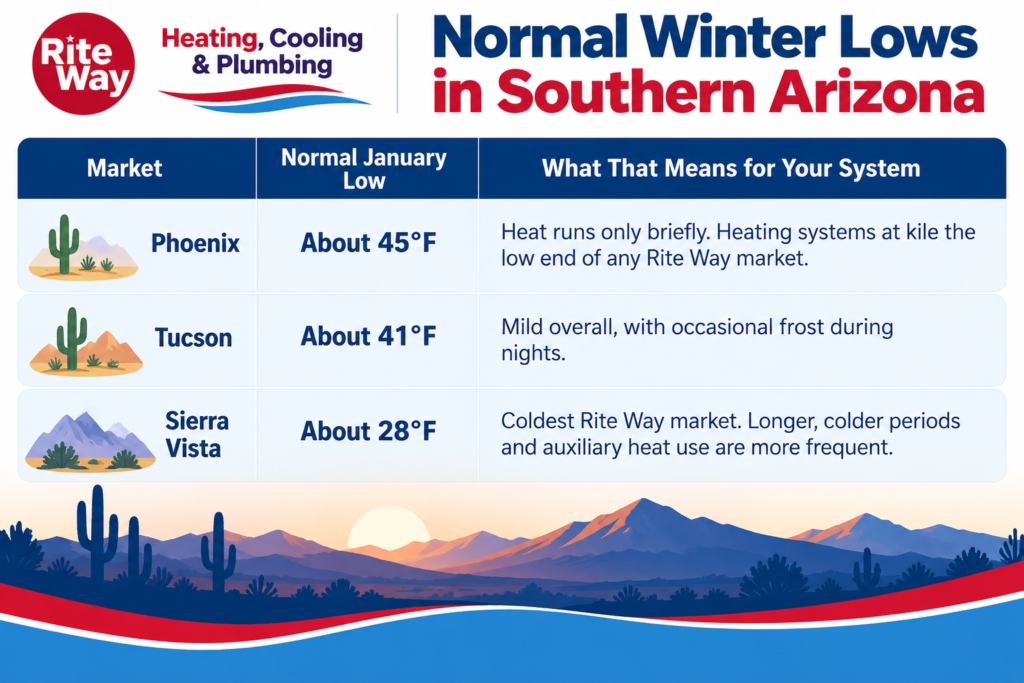
Because heat typically runs only during overnight hours and mornings between November and February, furnaces and heat pumps across these markets go months between uses. That long stretch of dormancy is precisely when small issues pile up unnoticed: batteries die, filters fill with desert dust, flame sensors accumulate grime, and any minor fault that existed at the end of spring sits waiting to show itself on the first cold morning that actually demands heat.
The age of the housing stock matters here too. University of Arizona housing data shows Tucson’s largest share of homes was built in the 1970s, meaning a meaningful portion of the market has older furnaces and original ductwork. Phoenix metro homes are somewhat newer, with NAHB analysis of 2024 Census ACS data putting the Phoenix city median year built at 1984, pointing toward a higher share of modern ignition systems, though the dormancy challenge is the same across both markets.
When to Stop Troubleshooting and Call a Heating Technician
Some heating issues move beyond DIY territory quickly. Call a professional if any of the following apply:
- You smell gas. Leave the home immediately. From a safe place, call 911 and Southwest Gas at 877-860-6020.
- A burning or electrical smell that does not clear within a few minutes.
- A breaker that trips again after one reset.
- Ice on the outdoor heat pump unit that will not clear after a full defrost cycle.
- Burners that light and shut off within seconds.
- Thermostat error codes you cannot clear.
- A carbon monoxide alarm. Leave immediately and call 911.
Rite Way serves Tucson, Marana, Oro Valley, Sahuarita, and communities throughout Southern Arizona, as well as Phoenix, Scottsdale, Mesa, Chandler, and the Greater Phoenix Valley. We handle gas, electric, and oil furnaces as well as central, ductless, and mini-split heat pumps. Every call starts with a full system evaluation, a plain-language explanation of what we find, and upfront pricing before any work begins. ROC-licensed technicians perform all work.
Tucson-area residents can visit our heating repair services in Tucson page. Phoenix-area residents can visit our heating services in Phoenix page.
Prevent a No-Heat Morning With a Fall Tune-Up
The most reliable way to avoid a first-cold-morning surprise is a heating checkup before the season starts. Rite Way offers heater maintenance and heat pump maintenance, along with bi-annual AC and furnace tune-ups. A fall visit lets a technician find dirty flame sensors, weakening igniters, and loaded filters before they leave you without heat on a cold November morning.
HVAC Not Blowing Warm Air FAQs
A few minutes of cool air is often normal during defrost mode, and heat pump supply air naturally runs cooler at the register than furnace air. If the air never warms, ice stays on the outdoor unit, or the system seems stuck in cooling mode, have a technician check the refrigerant, reversing valve, and defrost controls.
Yes, briefly. The heat exchanger needs 30 to 60 seconds to reach temperature before warm air comes through the vents. Wait a full minute before assuming something is wrong.
Dust settles on the burners and heat exchanger during the long idle months Arizona heating systems experience. It burns off on first use and the smell clears in a few minutes. If the odor lingers, smells electrical, or you notice any hint of gas, shut the system off and call for service.
An outdoor unit running in winter points to a heat pump. A gas line and metal exhaust pipe at the indoor unit point to a gas furnace.
Thermostat adjustments, filter replacements, and a single breaker reset are safe DIY repairs. Flame sensors, igniters, refrigerant, reversing valves, and anything involving gas supply lines or the electrical panel should be handled by a licensed technician.
Check it at the start of the heating season and at least once a month through the winter. Arizona desert particulate and monsoon dust load filters faster than in most of the country.
Check the thermostat, filter, and breaker first, then contact your landlord or property manager. Do not open the furnace cabinet or attempt repairs on equipment you do not own.
Not always. A wrong thermostat setting or dirty filter is often a quick fix. If you smell gas, see ice that will not clear, or the breaker keeps tripping, treat it as urgent and call for service.