
Yes, heat pumps work well in most of Arizona. They cool like an air conditioner in summer and move heat into your home in winter, and Arizona’s mild winters let them heat efficiently most of the time. In Tucson, where winter lows average around 41 degrees Fahrenheit, a properly sized heat pump keeps most homes comfortable through the heating season. In colder spots like Sierra Vista, where January lows average around 34 degrees, the system may lean on backup heat on the coldest mornings. Here is how heat pumps compare to gas furnaces, what to expect day to day, how long they last, and how Rite Way can help you decide.
Key Takeaways
- Heat pumps cool like an AC in summer and move heat in from outside in winter. One system handles both seasons.
- Arizona’s mild winters make heat pumps an efficient heating choice for most of the state, including most of Tucson’s heating season.
- On the coldest mornings, heat pumps use backup or auxiliary heat. This is normal, not a sign of a failing system.
- Heat pumps typically last 10 to 15 years in Arizona with regular maintenance, similar to a standard AC.
- Rite Way installs both heat pumps and gas furnaces and can help you compare the right fit for your home and utility setup.
How a Heat Pump Works
A heat pump does not generate heat the way a furnace does. Instead, it moves heat from one place to another using refrigerant. In summer, it moves heat from inside the home to the outdoor air, cooling the living space the same way a central air conditioner does. In winter, it reverses that process using a component called the reversing valve, pulling heat energy from the outdoor air and delivering it inside.
This works even when outdoor air feels cold, because air down to quite low temperatures still contains usable heat energy. The efficiency advantage is that moving heat requires less energy than creating it, which is why heat pumps perform so well in mild climates. Arizona’s winters make this particularly favorable for most of the state most of the time.
Are Heat Pumps Effective in Arizona’s Climate?
Heat pumps perform best when outdoor temperatures stay above freezing, and most of Arizona’s winters qualify. According to NWS 1991 to 2020 climate normals, Tucson’s average January low is around 41 degrees Fahrenheit. Phoenix, at around 46 degrees, rarely sees freezing temperatures at all. Both markets are well within the range where heat pumps operate efficiently throughout most of the heating season.
In cooler Arizona communities such as Sierra Vista, Bisbee, and Sonoita, winter temperatures drop lower. Sierra Vista’s average January low is around 34 degrees, and overnight freezes are more common. Heat pumps still work in these conditions, but they run defrost cycles more frequently on cold mornings, and backup or auxiliary heat activates more often.
Properly sized and installed, a heat pump handles Tucson’s winters comfortably. The key word is properly sized. An undersized system in any climate will struggle on the coldest nights.
Heat Pump vs. Gas Furnace in Arizona
This is one of the most common questions we hear from Tucson homeowners, and the answer is not the same for every household. Arizona’s mild winters and long cooling seasons shift the math compared to most of the country, and your existing utility setup plays a big role too.
Rite Way installs both heat pumps and gas furnaces in Tucson and Southern Arizona. The right choice depends on your home, utility setup, and priorities.
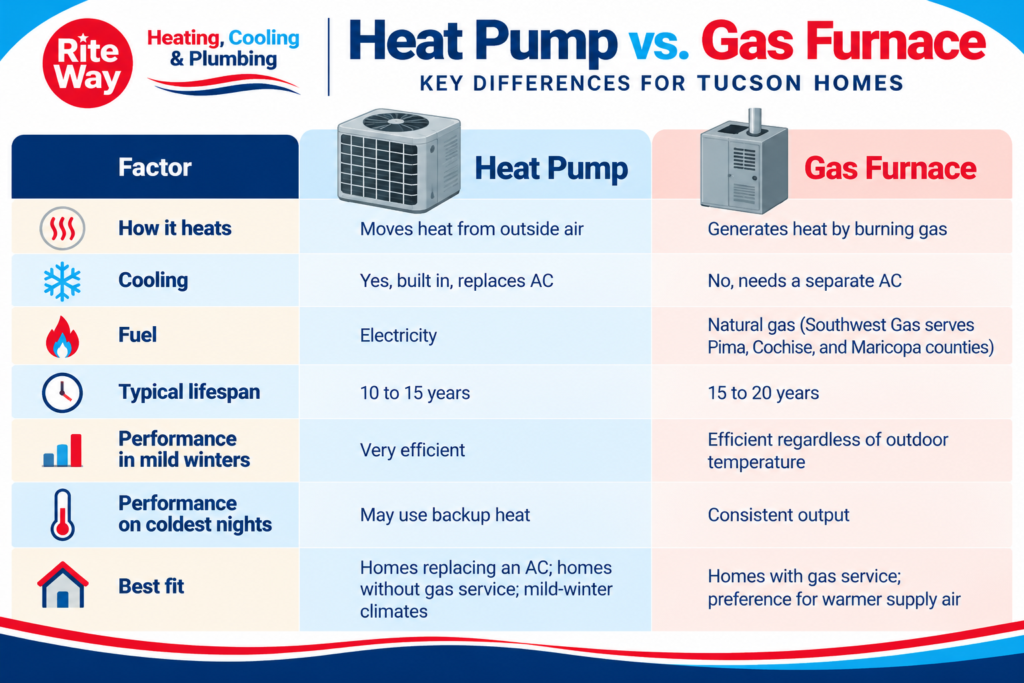
One practical note: heat pump supply air at the vent typically feels cooler than furnace supply air, even when the system is working exactly as it should. The home still reaches the set temperature, but the air from the registers often feels lukewarm rather than hot. This surprises some homeowners who switch from a furnace.
Weighing a heat pump against a furnace? Rite Way installs both and will recommend what fits your home. Get a rough estimate with our online HVAC estimate tool or reach our heat pump installation team to schedule an in-home assessment.
What to Expect From a Heat Pump in Winter
A few day-to-day behaviors of heat pumps are normal but sometimes mistaken for problems.
Supply air feels lukewarm: Heat pump supply air is typically cooler than furnace air at the vent. This is normal. The system is still heating the home, just not with the same blast of hot air a gas furnace produces.
Defrost mode: On cold mornings, frost can form on the outdoor coil. The system periodically reverses briefly to melt it, which may blow slightly cooler air for a short time. This is a normal function, not a malfunction.
Backup heat: Most heat pumps include electric auxiliary or backup heat that activates when outdoor temperatures drop low or when the system needs help recovering after a large setpoint change. You may see an indicator light on the thermostat.
If your heat pump is blowing cold air for extended periods or not reaching the set temperature, see our post on HVAC not blowing warm air for what is normal and what is not, or contact Rite Way for heat pump repair.
Types of Heat Pumps
Air-source heat pumps are the most common residential type. They transfer heat between your home and the outdoor air through a system that looks similar to a standard central AC setup with an outdoor unit and an indoor air handler connected by a refrigerant line.
Ductless mini-split heat pumps work the same way but deliver conditioned air directly to individual rooms or zones without ductwork. They are a practical option for additions, garages converted to living space, casitas, or rooms that an existing duct system does not serve well. Rite Way installs ductless mini-split systems across Tucson and surrounding communities.
Ground-source (geothermal) heat pumps use the earth rather than outdoor air as the heat exchange medium. These are more complex to install and are not a service Rite Way offers. The two types above cover the vast majority of Arizona residential installations.
How Long Do Heat Pumps Last in Arizona?
Rite Way puts the typical lifespan of a heat pump at 10 to 15 years. Because heat pumps in Arizona run nearly year-round, serving as both the AC and the heating system, they accumulate more operating hours than systems in climates with distinct off-seasons. Regular maintenance is the most reliable way to reach the upper end of that range. Rite Way recommends heat pump maintenance twice a year, before the cooling season and before the heating season.
For comparison, gas furnaces typically last 15 to 20 years. The shorter expected lifespan of a heat pump is one factor worth weighing when comparing the two options over time.
Getting the Most From Your Heat Pump
Change the filter regularly. In Tucson, desert dust loads filters quickly and the system runs most of the year. Monthly checks and frequent replacements are more important than in milder climates. Our post on furnace filter schedules covers how often Tucson homes should change filters.
Keep the outdoor unit clear. Desert shrubs, monsoon debris, and settled dust around the condenser reduce airflow and efficiency. Clear at least a couple of feet around the unit and rinse it periodically.
Use steady thermostat settings. Heat pumps are most efficient when maintaining a consistent temperature rather than recovering from large setbacks. Significant temperature swings can cause the backup heat to activate, which uses more energy than the heat pump itself.
Schedule maintenance twice a year. Refrigerant, coil condition, and electrical connections all benefit from regular inspection in a system that runs year-round.
Heat Pump Rebates in Arizona
Several rebate opportunities exist for Arizona homeowners installing qualifying heat pump systems. Efficiency Arizona has offered income-qualified rebates on heat pumps through qualified contractors. Rite Way is a TEP participating contractor, and qualifying systems may be eligible for TEP energy efficiency incentives. Rebate programs and eligibility requirements change, so check current availability directly rather than relying on published amounts, which can be outdated quickly.
When It Makes Sense to Switch to a Heat Pump
A heat pump is worth considering when:
- Your central AC is aging and needs replacement. Upgrading to a heat pump at that point replaces the AC and adds heating in one system.
- Your home does not have natural gas service and relies on electric resistance heat, which is typically less efficient than a heat pump.
- You are adding a room, finishing a garage, or building a casita where extending ductwork is impractical. A ductless mini-split handles both heating and cooling in that space.
- You want one system for both seasons rather than maintaining separate AC and furnace equipment.
For more on timing an AC replacement, see our post on when to replace your air conditioner, and for sizing guidance see our post on what size system your home needs.
Ready to Explore Your Options? Rite Way Can Help.
Rite Way’s licensed HVAC technicians serve Tucson, Marana, Oro Valley, Vail, Sahuarita, Sierra Vista, and communities throughout Southern Arizona. Whether you are deciding between a heat pump and a furnace, replacing an aging AC, or adding a ductless system, we give you honest options and upfront pricing before any work begins. We have been serving Arizona homeowners since 1959 and answer phones 24/7.