
Most homes should change a standard 1-inch furnace filter every one to three months and thicker media filters every six to twelve months. In Tucson and Phoenix, though, the same filter usually serves your AC too, and it works nearly year-round in dusty desert conditions. Monsoon season adds another layer, pushing elevated humidity and particulates through the system during the months when it is already running hardest. That means the national rule of thumb is the minimum here, not the goal. A filter that holds up for 90 days in a moderate climate may need replacing in half that time in a Southern Arizona home. Here is a simple schedule, how to tell when your filter is done, how to change it in five minutes, and what to know before buying the most expensive filter on the shelf.
Key Takeaways
- Standard 1-inch filters should be changed every one to three months. In Tucson, check monthly and change more often during summer and monsoon season.
- Most Tucson and Phoenix homes use one filter for both heating and cooling. It runs nearly year-round and loads up faster than filters in most climates.
- A fresh filter before the first cold night is one of the most important steps at the start of the heating season.
- High-MERV filters are not always better. A filter that restricts too much airflow can cause more problems than a dirty one.
- A dirty filter is one of the most common causes of heating and cooling problems Rite Way sees on service calls across Tucson and Southern Arizona.
How Often Do You Change Furnace Filters?
Here in Tucson, that question has a different answer than it does in most of the country. Between the desert dust, monsoon season particulate, and the fact that our AC systems run hard for most of the year, filters in Southern Arizona homes tend to load up faster than the packaging suggests. A filter that lasts 90 days in a mild climate might need attention in half that time here.
The short answer: it depends. Filter thickness, the number of pets in your home, whether anyone has allergies, and what is happening around your property all affect how quickly your filter gets clogged. A clogged filter does not just hurt your air quality. It forces your system to work harder, raises your energy bills, and shortens the life of your equipment. Staying on top of filter changes is one of the simplest and most effective things you can do to protect your HVAC investment.
Use the chart below as your starting point, and always defer to your filter manufacturer and system specs for the final word.
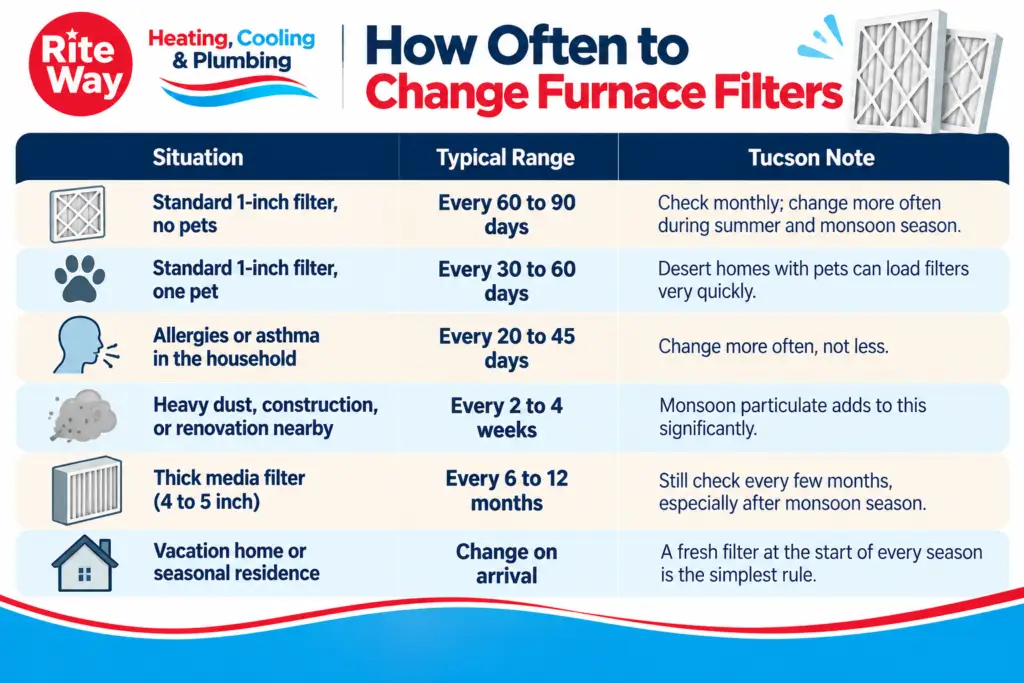
Allergies or asthma in the household: Change the filter more often than the baseline, not less. Every 20 to 45 days for a standard 1-inch filter is a reasonable starting point, and consider a higher-efficiency filter your system can handle. See the MERV section below for guidance on choosing the right one.
Why Tucson Homes Need More Frequent Filter Changes
Most Tucson and Phoenix homes have a single filter serving both the furnace and the air conditioner. Because the AC runs roughly eight to ten months a year in this climate, that filter is working almost constantly. Add desert dust, Saharan dust events that reach Arizona in summer, and the elevated particulate and humidity that monsoon season brings through the Sonoran Desert, and a filter that might last 90 days in a moderate climate can be saturated in half that time or less.
For Rite Way technicians working across Pima County and the surrounding communities, a clogged or nearly clogged filter is one of the most common things found at service calls, particularly when a homeowner follows a seasonal change schedule without accounting for how hard the system is actually running. Check your filter monthly, especially from May through October when the system runs most. If it looks dark gray or you can barely see light through it, it is past due. Start the heating season with a fresh filter regardless of when you last changed it.
What Changes Your Schedule
Filter Thickness
Thicker filters have more surface area to capture particles, so they last longer before restricting airflow. A standard 1-inch filter needs more frequent attention than a 4 or 5-inch media filter. Follow the manufacturer’s guidance for your system and the specific filter product.
Pets
Pet hair and dander add significantly to the dust load in the filter. Homes with one or more dogs or cats typically need to change standard filters every 30 to 60 days. Check every two to three weeks to get a feel for how quickly your specific home loads the filter.
Allergies or Asthma
If anyone in the household has allergies, asthma, or other respiratory sensitivities, change the filter more often than the baseline and consider a filter with a higher MERV rating, as long as your system can handle the added airflow resistance. See the MERV section below.
Dust and Construction
Renovation work, nearby construction, and the heavy particulate that monsoon storms carry into homes all shorten filter life significantly. During or after any of these, check your filter every two weeks and change it as needed. Tucson’s monsoon season runs roughly from late June through September, and many homeowners are surprised by how quickly filters load during that stretch.
Seasonal Homes
Tucson and communities like Green Valley, Saddlebrooke, and Sierra Vista attract a large number of seasonal residents. If your home sits empty for weeks or months, change the filter on arrival regardless of how long it has been installed. A new filter at the start of every season is the simplest policy for seasonal and vacation properties.
Signs Your Filter Needs Changing Now
You do not need to wait for the calendar. Change your filter when you notice:
- The filter looks dark gray or light barely passes through when you hold it up
- Dust accumulates faster than usual on surfaces near vents
- Airflow from supply registers feels noticeably weaker than normal
- The system runs longer than usual to reach the set temperature
- A musty or dusty smell comes from the vents on the first heating cycle of the season
If you notice weak airflow or longer run times alongside a dirty filter, a clean filter often resolves the problem. If it does not, the system may need professional attention.
How to Change Your Furnace Filter
- Turn the system off at the thermostat before starting.
- Find the filter location. In most Tucson homes with central systems, it is at the return air grille on the wall or ceiling, or at the air handler or furnace itself. Some homes have both locations.
- Note the size printed on the filter frame before removing it. Common sizes include 16×20, 20×25, and 16×25, but your home may differ. Take a photo or bring the old filter to the store.
- Slide the old filter out carefully and dispose of it.
- Slide the new filter in with the airflow arrow on the frame pointing toward the unit, not toward the return grille. The arrow indicates the direction air flows through the system.
- Write the installation date on the filter frame with a marker so you know when it was last changed.
- Restore power at the thermostat.
The whole job takes about five minutes. If the filter slot is hard to reach or the system is in an awkward location, Rite Way technicians check and replace the filter as part of every tune up visit.
What Happens If You Do Not Change It
A clogged filter restricts airflow through the system. In heating mode, restricted airflow can cause the heat exchanger to overheat and trip the furnace’s internal limit switch, which shuts the system down as a safety measure. If your heater blows warm air for a while and then switches to cool or shuts off, a dirty filter is one of the first things to check. Our post on HVAC not blowing warm air covers this and other causes.
In cooling mode, restricted airflow can cause the evaporator coil to ice over, reducing or stopping cooling entirely. Our post on frozen AC coils explains what to do if that happens.
Beyond equipment issues, a dirty filter does a poor job cleaning the air and allows dust to accumulate on system components and inside ductwork. For homes with persistently dusty ductwork, Rite Way offers duct cleaning and Aeroseal duct sealing to address leaky return ducts that pull attic dust into the system. If your heating system needs more than a filter, contact Rite Way for a furnace repair.
Choosing the Right Filter: MERV Explained
MERV stands for Minimum Efficiency Reporting Value. It rates how well a filter captures particles: a higher number captures smaller particles more effectively. Most residential systems do well with a filter in the MERV 8 to 11 range. For households with allergies or asthma, a MERV 11 to 13 filter can make a meaningful difference in indoor air quality.
The important caution: a very high MERV filter (14 and above) creates more airflow resistance than most residential HVAC systems were designed to handle. Using one can restrict airflow enough to cause the same heating and cooling problems as a dirty filter. Check your system’s documentation or ask a Rite Way technician what range works for your equipment before upgrading.
For a more comprehensive indoor air quality improvement beyond filtration, Rite Way offers whole-home air purifiers that work alongside the existing system and are well suited to Tucson homes that deal with dust, pollen, and monsoon allergens throughout much of the year.
A Fresh Filter Is Step One. Rite Way Covers the Rest.
A clean filter helps your system run efficiently, but it does not replace a full seasonal inspection. Rite Way’s furnace maintenance covers the components a filter change cannot address, including the heat exchanger, ignition system, and blower. For homes with heat pumps, heat pump maintenance keeps the reversing valve and defrost system ready for Tucson’s cool months. We have been serving Arizona homeowners since 1959 and answer phones 24/7.