
Tankless water heaters have become one of the most common upgrades we install across Tucson, Phoenix, and the wider Southern Arizona area, and the question we hear most before installation is a straightforward one: how does it actually work? It is a fair thing to want to understand before committing, especially in a market like ours where hard water from the CAP supply puts extra wear on these systems year-round, gas line sizing often requires upsizing before installation can even begin, and getting the right unit for your home’s peak demand makes a real difference in what you experience day to day.
Here is a clear breakdown of how a tankless water heater works, what differentiates gas from electric models, and what specifically affects long-term performance for Tucson and Phoenix homeowners.
Key Takeaways:
- Tankless water heaters heat water on demand as it flows through the unit. There is no storage tank, no stored supply to deplete, and no standby heat loss from keeping water warm around the clock.
- The flow sensor is the trigger. Once incoming flow exceeds the unit’s minimum threshold (typically around 0.5 GPM), it activates the burner or heating elements. Fixtures that fall below that threshold may not activate the unit consistently.
- Gas and electric tankless units use the same on-demand process but differ significantly in installation requirements. Gas models typically need gas line upsizing; electric models often require a panel upgrade. Most Tucson and Phoenix homes need one or both before installation can begin.
- Tucson and Phoenix homeowners have a natural advantage: warmer incoming groundwater means less temperature rise required, which supports higher flow rates, especially during our long summers.
- Hard water from the Central Arizona Project is the biggest long-term threat to tankless performance in our market. Mineral scale builds on the heat exchanger over time, reducing efficiency and output. Annual descaling is the minimum standard here; every six months is better.
What Is a Tankless Water Heater?
A tankless water heater, also known as an on-demand or instant water heater, heats water directly as it flows through the unit rather than storing it in a tank. When you open a hot water tap, cold water travels into the unit, gets heated instantly by a gas burner or electric element, and flows out to your fixture. There is no stored supply to deplete and no standby heat loss from keeping a full tank warm around the clock, which matters in a market where energy rates have been climbing steadily and systems run year-round without a seasonal break.
How Tankless Water Heaters Work: Step by Step
- Cold water enters the unit. When you open a hot water tap anywhere in the home, cold water flows into the tankless heater through the inlet pipe.
- The flow sensor activates. A flow sensor detects the incoming water movement. Once flow exceeds the unit’s minimum threshold, typically around 0.5 gallons per minute, it triggers the heating process. Low-flow fixtures that fall below that threshold may not activate the unit consistently, something worth knowing if you have older fixtures in an established Tucson or Phoenix home.
- The burner or heating element fires. In a gas model, the igniter fires the modulating burner. In an electric model, resistance heating coils energize. The unit adjusts its output level in real time based on how much hot water is being demanded at that moment.
- The heat exchanger transfers heat to the water. Water passes through the heat exchanger, where heat from the burner flame or resistance coils raises the water temperature rapidly to your target output level. In Tucson and Phoenix, this is also where mineral scale from our hard water gradually builds up if the unit is not regularly descaled.
- Hot water is delivered to your fixture. The heated water travels through your home’s pipes to the open tap at the temperature your thermostat is set to maintain.
- Heating stops when demand stops. Once you close the tap, the flow sensor detects that water movement has ceased and deactivates the burner or heating elements. The unit uses no energy until the next draw.
Electric vs. Gas Tankless Water Heaters
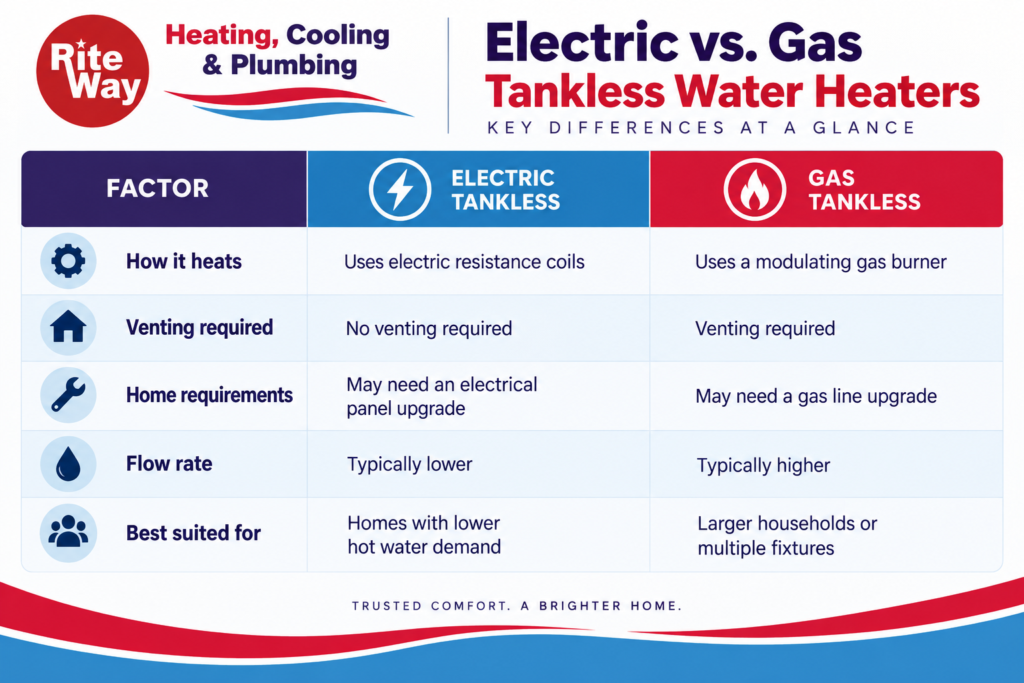
Both fuel types deliver hot water on demand using the same basic process, but the heating mechanism and installation requirements differ in ways that matter depending on your home’s existing setup.
Electric tankless water heaters use resistance heating coils submerged directly in the water path. When electricity passes through the coils, they heat up and transfer that heat to the water flowing around them. Activation is essentially instant since there is no ignition sequence and no combustion, which also means no venting is required. That simplifies placement considerably. The trade-off is that whole-home electric tankless units draw significant electrical load, typically 120 to 160 amps, which often requires a panel upgrade before installation. Many Tucson and Phoenix homes, particularly those built in the 1970s and 1980s, carry older panels that need to be evaluated before electric tankless is a realistic option.
Gas tankless water heaters use a modulating burner that adjusts its BTU output up or down in real time based on how much hot water is being demanded at any given moment. When the flow sensor trips, the igniter fires and the burner heats a copper finned heat exchanger positioned above the flame. Gas models typically achieve higher maximum flow rates than electric units, making them better suited for larger households running multiple fixtures simultaneously. Venting is required, and most homes in the Tucson and Phoenix metros will also need gas line upsizing before installation since tankless units draw gas in high-volume bursts rather than the slow, steady draw of a traditional tank.
The right choice comes down to your home’s existing infrastructure and your household’s peak demand. A licensed plumber can assess both before you commit.
Flow Rate, Temperature Rise, and What They Mean for Tucson and Phoenix Homes
Flow rate, measured in gallons per minute (GPM), determines how much hot water a tankless unit can deliver at any one time. Temperature rise is the difference between your incoming cold water temperature and your desired output. The higher the temperature rise required, the harder the unit has to work, which can reduce effective flow rate at peak demand.
This is one area where Tucson and Phoenix homeowners have a real advantage. Southern Arizona’s incoming groundwater runs warmer than in northern climates, often reaching 65 to 75 degrees Fahrenheit in summer compared to 40 to 50 degrees in colder regions. That smaller temperature rise means your unit modulates to a lower output level during warm months, which can support higher simultaneous flow rates than the unit’s rated capacity might suggest elsewhere. In winter, when incoming water cools, the unit works harder to reach the same output temperature, which is worth factoring into sizing decisions before installation.
What Affects Performance Over Time
Understanding how a tankless unit works is only part of the picture. What happens to that performance over months and years matters just as much, and in the Tucson and Phoenix markets there are two factors that come up more than anywhere else.
Hard water scale on the heat exchanger. Tucson and Phoenix both draw from the Central Arizona Project, a Colorado River diversion that carries significant mineral hardness. Those minerals deposit on the heat exchanger surface over time, creating scale that reduces the unit’s ability to transfer heat efficiently. The unit works harder, uses more energy, and produces lower output temperatures even when nothing else is wrong. Annual descaling is the minimum standard in this market. Every six months is better. A whole-home water softener slows the buildup significantly and extends the life of the unit.
Minimum flow threshold. The flow sensor only activates the unit when incoming flow exceeds its minimum GPM. Low-flow fixtures or fixtures turned only partially open can fall below that threshold, causing the unit to cycle inconsistently or not activate at all. If you are noticing intermittent hot water at a specific fixture in your home, this is worth checking before assuming something more serious is wrong.
For a deeper look at what limits hot water performance and how to recognize a real problem, see: Can You Run Out of Hot Water With a Tankless Water Heater?
Wondering how tankless and traditional tank water heaters compare on cost, lifespan, and efficiency? See the full breakdown: Tankless vs Traditional Water Heaters
Rite Way Installs Tankless Water Heaters Throughout Tucson, Phoenix, and Southern Arizona
If you are considering a tankless water heater, Rite Way can walk you through what your home’s existing setup actually supports, what installation will involve, and which system is the right fit before you commit to anything. We have been installing and servicing tankless water heaters throughout Tucson, Phoenix, Marana, Oro Valley, Green Valley, Sierra Vista, and the wider Southern Arizona area since 1959.
How Tankless Water Heaters Work FAQs
It is the component that transfers heat from the burner or heating elements directly to the water. In Tucson and Phoenix’s hard water environment, mineral scale on the heat exchanger is the most common cause of declining performance over time.
Yes, though electric units typically have lower maximum flow rates and may require a panel upgrade. For larger Tucson or Phoenix homes with multiple bathrooms, gas models are usually the better fit.
It works in your favor, as warmer incoming water means less temperature rise required, so the unit modulates to a lower intensity and can support higher flow rates, especially during our long summers.
Every six months. Both cities draw from the CAP and run hard which builds scale on the heat exchanger faster than the national average.
Most likely a flow rate issue: the unit’s flow sensor only activates above a minimum threshold, typically around 0.5 GPM. Low-flow fixtures or partially open valves can fall below that and prevent the unit from firing.
Gas models require either direct vent or power vent installation, and most Tucson and Phoenix homes will also need gas line upsizing before installation since tankless units draw gas in short, high-volume bursts rather than the steady draw of a traditional tank.
With proper maintenance, 20 or more years. In Tucson and Phoenix’s hard water environment, that lifespan depends heavily on consistent descaling and, ideally, a whole-home water softener to reduce mineral load on the heat exchanger.
Most units require at least 0.5 GPM to trigger the flow sensor and begin heating. If a fixture does not consistently produce hot water, checking whether it meets that threshold is the right first step before calling for a repair.
