Your home’s ductwork carries heated and cooled air from your HVAC system to every room, and when it leaks, sags, or fills with dust, you pay for it in comfort and energy bills. According to ENERGY STAR, a typical home loses about 20 to 30 percent of the air moving through its ducts to leaks and poor connections. In Tucson, where ducts typically run through attics that reach extreme temperatures in summer, that lost air is not just an efficiency problem but it is cooled air disappearing directly into one of the hottest spaces in the house.
Many Tucson homes also have ductwork that is decades old. The city’s median year is in 1979, which means a significant share of homes still have original duct tape, mastic, and flex duct runs installed for equipment that has long since been replaced. Aging connections dry out and pull apart. Flex duct collapses or sags. Layouts designed for older systems do not always perform correctly when a new AC or heat pump is installed. The result is ductwork that quietly undermines the performance of otherwise sound HVAC equipment.
Here is how ductwork works, what simple maintenance you can do yourself, the signs your ductwork needs repair, and what the right professional fix looks like.
Key Takeaways
- ENERGY STAR estimates 20 to 30 percent of conditioned air is typically lost to duct leaks and poor connections, which is a significant efficiency loss in Tucson’s long cooling season.
- Most Tucson ductwork runs through attics, one of the hottest spaces in the house. Leaks there lose cooled air and can draw hot, dusty attic air into the living space.
- Uneven room temperatures, rising energy bills, and excess dust near vents are the most consistent early signs of ductwork problems.
- Duct cleaning, sealing, and repair are three different services that solve three different problems. Knowing which one you need avoids paying for the wrong fix.
- When a system is replaced, ductwork sizing and condition should be evaluated at the same time.
How Ductwork Works
A forced-air HVAC system moves air through two types of ducts: supply ducts and return ducts.
Supply ducts carry conditioned air from the air handler or furnace out to the registers in each room. Return ducts pull air back from the living space and send it through the filter and back to the system to be heated or cooled again. The balance between supply and return is important. Too much air being supplied to a room with an inadequate return path creates pressure problems that reduce efficiency and comfort throughout the house.
Registers and grilles are the visible endpoints of the duct system. Supply registers typically have adjustable louvers; return grilles are larger and fixed. The system as a whole is designed to maintain consistent airflow and temperature throughout the home when it is properly sealed, sized, and unobstructed.
Where Ductwork Runs in Tucson Homes
Most Tucson homes are built on concrete slab foundations, which means there is no basement or crawlspace for ducts to travel through. In most cases, ductwork runs through the attic and connects to a rooftop packaged unit or a ground-level split system. Some homes have ducts in a dropped ceiling or in interior walls.
The attic location creates a significant challenge. Tucson attics can reach temperatures well above outdoor air temperatures in summer, and ductwork running through that space is exposed to extreme heat. Leaks in supply ducts lose cooled air directly into that hot environment instead of delivering it to the living space. Leaks in return ducts can pull hot, dusty attic air and insulation fibers back into the system and into the home.
Tucson’s median home was built in 1979, which means a large share of the housing stock has original or significantly aged ductwork: old tape and mastic that has dried and cracked, sagging flex duct runs, and layouts designed for equipment that has since been replaced. When equipment is upgraded, ductwork condition and sizing should be evaluated at the same time.
Simple Ductwork Maintenance You Can Do
Regular ductwork maintenance does not require a technician for every step. Several basic tasks keep ducts running as efficiently as possible and help you catch problems before they become expensive.
Change air filters regularly. This is the single most important thing a homeowner can do for ductwork and system health. In Tucson, where monsoon season brings dust and particulates into the air, checking filters more frequently than the label suggests is reasonable. A clogged filter restricts airflow through the entire system and causes the equipment to work harder.
Keep supply and return registers clear. Furniture, rugs, and curtains blocking registers reduce airflow to that room and disrupt system balance. Return grilles in particular need unobstructed airflow to function correctly. Note: closing vents in unused rooms does not save energy the way many homeowners expect.
Look for obvious damage if you can safely access the area. Disconnected ductwork sections in an attic or visible kinked or crushed flex duct runs are worth noting. If you can see a clear gap or a run that has come apart from a register boot, contact an HVAC technician.
Schedule regular HVAC maintenance. An AC tune-up includes airflow checks that can surface ductwork issues a homeowner might miss. It is also the most practical time to discuss anything you have noticed about comfort or airflow with a technician.
For dust and debris buildup inside the ductwork, duct cleaning removes what has accumulated over years of use and is worth considering before or after system replacement, or if a major renovation has pushed debris into the ducts.
Signs Your Ductwork Needs Repair
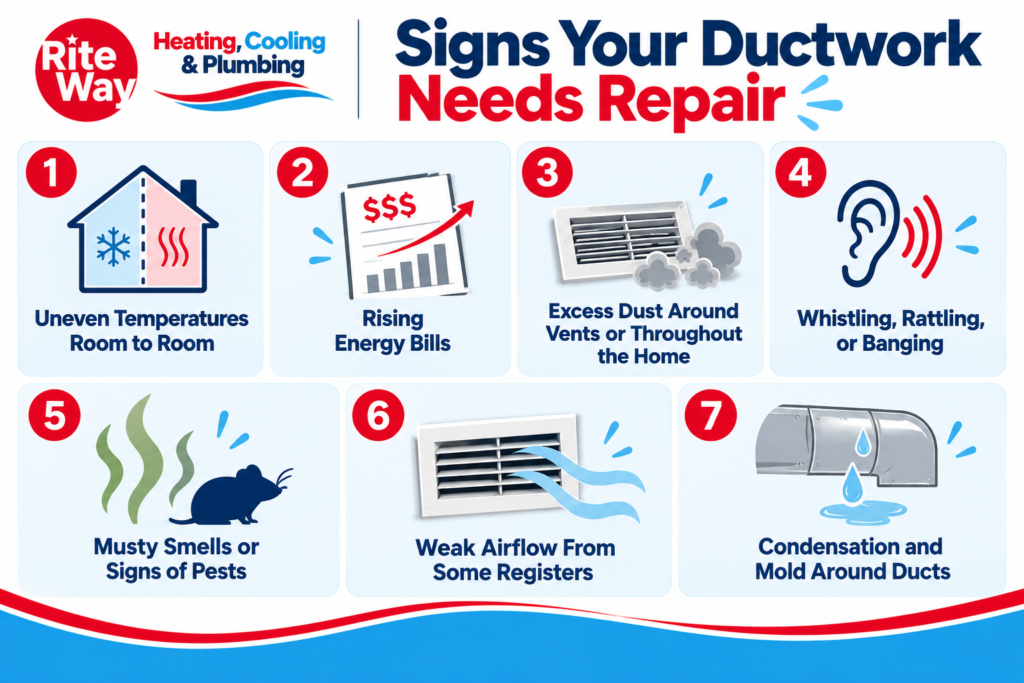
The signs below are the most common indicators that ductwork repair is needed. Some are obvious; others build gradually until a comfort or efficiency problem becomes hard to ignore.
Uneven Temperatures Room to Room
If some rooms are consistently harder to cool or heat than others, the problem is often the ductwork rather than the equipment. A disconnected run, a collapsed section of flex duct, or a poorly balanced system can starve specific rooms of conditioned air while others are comfortable.
Rising Energy Bills
A meaningful increase in energy bills without a change in usage habits often points to a system working harder than it should. In Tucson’s long cooling season, ductwork leaks that continuously lose conditioned air to the attic show up clearly in monthly bills over time.
Excess Dust Around Vents or Throughout the Home
Leaky return ducts can pull dust, debris, and insulation fibers from the attic and distribute them throughout the living space. If surfaces near vents collect dust faster than the rest of the room, or if your filters clog unusually quickly, return ductwork leakage is a likely contributor. This also directly affects indoor air quality. For more on how ductwork leaks connect to pest entry, see our post on bugs in your AC.
Whistling, Rattling, or Banging
Unusual sounds from the ductwork during operation are worth investigating. Whistling often indicates restricted airflow through undersized or blocked ducts. Rattling or banging can point to loose ductwork connections, a section that has come away from a collar or register boot, or debris in the duct.
Musty Smells or Signs of Pests
A musty or stale odor coming from the registers when the system runs can indicate mold growth inside the ductwork. Pest intrusion through gaps in the ductwork or system is another source of odors and debris. Neither issue resolves on its own.
Weak Airflow From Some Registers
A register that delivers notably less airflow than others fed by the same system usually indicates a blockage, a disconnected run, or ductwork that has kinked or crushed closed. Checking whether the register damper is fully open is a quick first step before calling a technician.
Condensation and Mold Around Ducts
In Tucson’s monsoon season, supply ductwork carrying cold air through hot, humid attic spaces can develop condensation on the exterior. If the insulation is inadequate or has deteriorated, moisture can accumulate and reach the ceiling or wall below, creating conditions where mold can develop. If you notice water staining near a register or duct collar, contact an HVAC technician.
Quick Checks Before You Call
Before scheduling service for an airflow or comfort issue, run through a few basics that sometimes resolve the problem without a service call:
- Confirm every supply and return register in the home is fully open and unblocked.
- Check the air filter and replace it if it is visibly dirty.
- Verify the thermostat is set correctly and functioning.
- Check that the system is actually running: confirm the breaker has not tripped and the condensate drain shutoff has not been triggered.
If the checks above do not reveal the issue, the problem warrants a technician visit.
Why Ductwork Size and Design Matter
Ductwork is sized for a specific system capacity and home layout. When equipment is replaced with a larger or smaller unit, which happens often as older systems are upgraded, ductwork sized for the original equipment may not perform correctly with the new one.
Undersized ductwork restricts airflow, causes the system to work harder than it should, and can result in poor comfort despite a properly functioning unit. Poorly planned ductwork layouts create areas of the home that consistently receive inadequate airflow regardless of how the system is adjusted.
Ductwork sizing and design matters most when a new AC or heat pump is being installed. Our guide on when to replace your air conditioner covers what to consider during a system replacement. For rooms that the existing ductwork serves poorly, ductless mini splits deliver conditioned air directly without requiring duct runs.
Duct Cleaning, Sealing, or Repair: What’s the Difference?
These are different services that solve different problems. Choosing the wrong one wastes time and money.
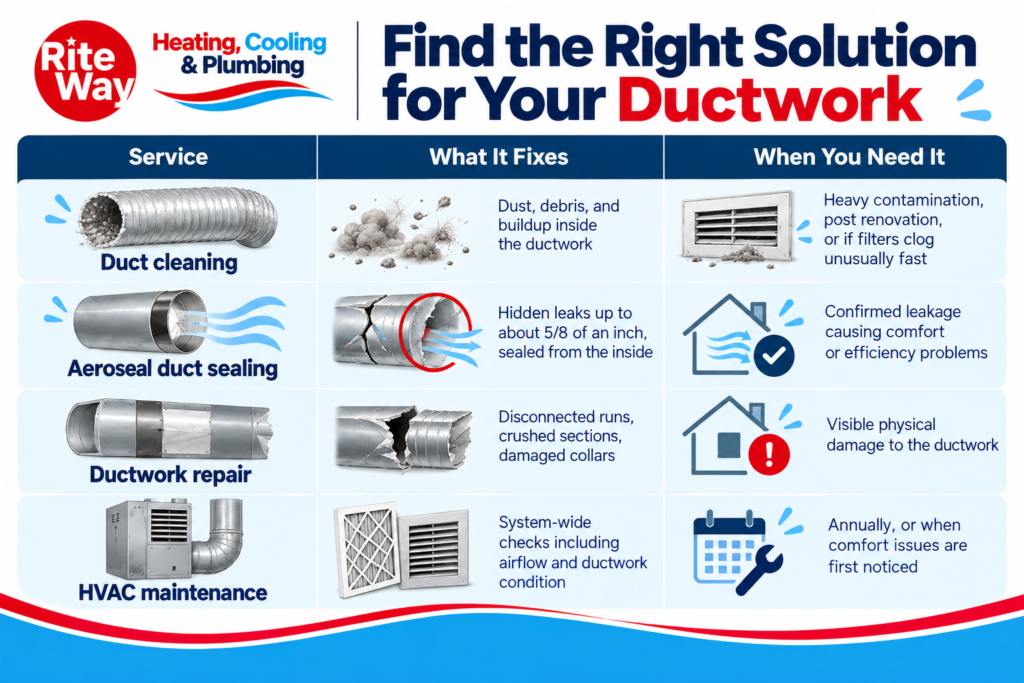
Rite Way offers duct cleaning and Aeroseal ductwork sealing and repair in Tucson. For more on whether Aeroseal makes sense for your home, our post on whether Aeroseal is worth it breaks it down.
Not Sure Where to Start? Rite Way Can Help.
Rite Way’s licensed technicians serve Tucson and communities across Southern Arizona. If you are noticing uneven temperatures, rising bills, or excess dust and are not sure whether the issue is the ductwork or the equipment, we can evaluate both and give you honest options before any work begins. We answer phones 24/7 and have been serving Arizona homeowners since 1959.