
There’s nothing quite like walking into a cool home after being out in the Southern Arizona heat and nothing more frustrating than finding out your air conditioner has shut itself off again. If your AC keeps turning off before your home reaches the set temperature, you’re dealing with a problem that’s not just uncomfortable, it’s likely putting extra wear on your system and driving up your energy bills at the same time.
The good news is that most of the reasons why an air conditioner turns off by itself are well-understood and fixable. Some you may be able to address on your own, while others will need a professional AC technician. Either way, knowing what to look for is the first step toward getting your system running the way it should, especially during Tucson’s brutal summer months when a functioning AC isn’t optional.
Key Takeaways:
- When your AC shuts off repeatedly before cooling your home down, it’s called short cycling and it puts serious wear on your compressor, which is one of the most expensive parts to replace.
- A dirty air filter is the most common and most preventable cause, yet in Southern Arizona’s dusty climate most homeowners wait far too long between changes.
- An oversized AC unit is a counterintuitive but surprisingly common culprit, bigger doesn’t mean better when it comes to cooling efficiency.
- Refrigerant leaks and failing capacitors won’t fix themselves and will only get worse the longer they run unaddressed.
- If you’ve checked the basics and your AC is still short cycling, a professional diagnostic is worth scheduling before the problem becomes a compressor replacement.
First, Understand What’s Actually Happening
When your AC turns off repeatedly without cooling your home to the set temperature, that’s called short cycling. A normal cooling cycle runs for around 15 to 20 minutes before the system shuts off. Short cycling is when your AC runs for just a few minutes, shuts off, and kicks back on again shortly after while never completing a full cycle.
Short cycling puts excessive wear on your compressor, the heart of your AC system. In Tucson and Phoenix, where systems run nearly year-round under extreme heat, catching this problem early matters more than in most parts of the country.
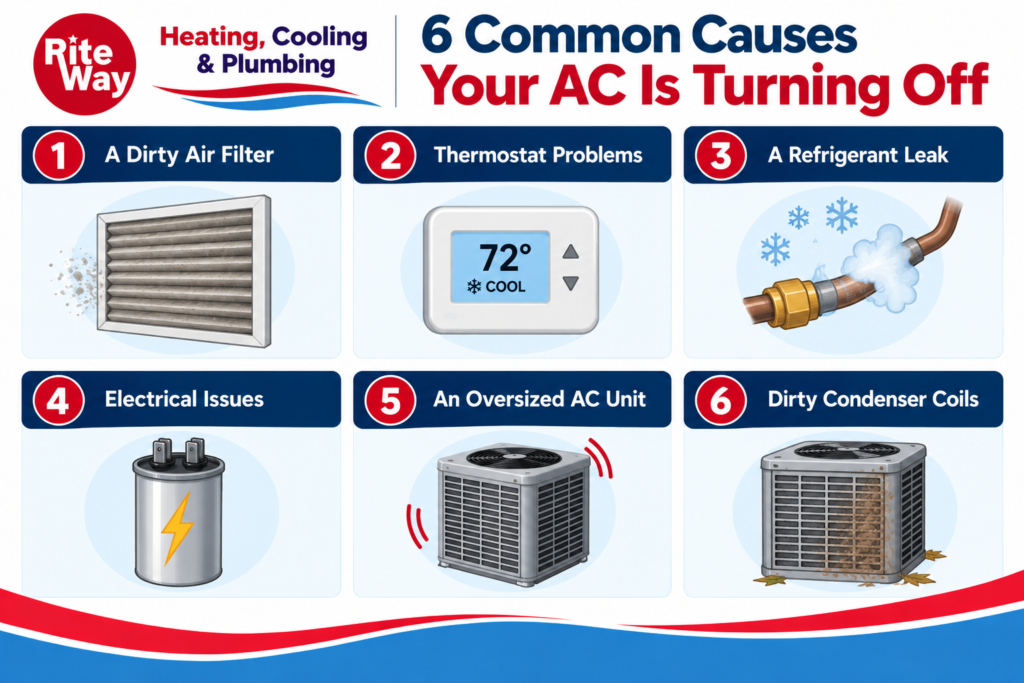
1. A Dirty Air Filter
This is the first thing to check and the easiest fix on the list. When your air filter gets clogged, it restricts airflow through the system which can cause two separate problems:
- Frozen evaporator coils: without adequate airflow, the coils inside your air handler get too cold, ice forms, and the system shuts down to protect itself.
- Overheating the outdoor unit: restricted airflow can also cause the condenser to overheat, triggering another automatic shutdown.
Both are symptoms of the same root problem: not enough air moving through the system. In Southern Arizona, where dust is relentless and systems run nearly year-round, a good rule of thumb is to replace your air filter:
- Every 30 days if you have pets, allergies, or run your AC heavily.
- Every 60 days for most standard Tucson and Phoenix households.
2. Thermostat Problems
Your thermostat is the brain of your cooling system. When it malfunctions or is positioned incorrectly, it sends the wrong signals and shuts your AC off too soon. There are two distinct issues to watch for:
- Malfunctioning thermostat: an electrical issue or worn components cause it to misread the actual room temperature.
- Poor placement: a thermostat installed near a window, vent, or in direct sunlight reads the space as cooler than it is, triggering an early shutdown.
Before calling for service, try something simple first like swapping the thermostat batteries. A low battery can cause erratic behavior that mimics a much more serious problem.
3. A Refrigerant Leak
A refrigerant leak does not just reduce cooling output. As the level drops, pressure inside the system falls out of range and the safety controls shut the unit down before it can finish a full cycle. It restarts, gets partway through another attempt, and shuts off again. The cycles get shorter over time while your home stays warmer.
Watch for these signs:
- The system runs briefly, shuts off, then restarts without reaching your set temperature.
- Ice forming on the refrigerant lines near the indoor unit.
- A faint hissing sound near the indoor or outdoor unit during operation.
Every incomplete cycle puts extra stress on the compressor. This is not a DIY repair, and topping off refrigerant without finding the source of the leak only delays the next episode.
4. Electrical Issues
A failing capacitor, tripped circuit breaker, or faulty wiring can all cause your AC to shut off unexpectedly. The capacitor is what gives the compressor and fan motors the electrical boost they need to start each cycle. When it begins to fail, you may notice:
- The system starts but shuts off within minutes.
- A humming sound when the unit tries to start.
- The outdoor fan not spinning even when the system appears to be running.
Electrical issues are difficult to self-diagnose and carry real safety risks if handled improperly. If you’ve ruled out the filter and thermostat and your system is still shutting off, a failing electrical component is a likely culprit.
5. An Oversized AC Unit
This one surprises most homeowners but an AC unit that’s too large for your home is a very common cause of short cycling. Here’s why: an oversized system cools the air so quickly that it shuts off before finishing a full cycle. The result is a home that never gets properly dehumidified and a compressor that cycles on and off far more than it should.
Signs your unit may be oversized:
- Your home cools down very quickly but humidity still feels high.
- You notice uneven temperatures from room to room.
- The system has been short cycling since it was first installed.
If your system is relatively new and already shutting off frequently, improper sizing is worth investigating. A licensed HVAC technician can perform a load calculation to determine whether your unit is the right fit for your home.
6. Dirty Condenser Coils
The outdoor condenser coil releases heat from inside your home to the outside air. When it is coated in dust, dirt, or debris, heat transfer becomes less efficient, the system has to work harder to complete a cooling cycle, and in some cases overheats and shuts off before finishing. In Tucson and Phoenix, desert dust, pollen, and monsoon particulate accumulate on condenser fins significantly faster than manufacturer cleaning schedules are designed for. A coil that might need attention once a year in a moderate climate may need professional cleaning twice per summer here. If your system is short cycling and the filter is clean, the condenser coil is worth a look.
When to Call a Professional
Some of these issues, like a dirty filter or a thermostat battery, are simple enough to handle on your own. But if you’ve checked the basics and your AC keeps turning off, it’s time to bring in a technician. In Tucson and Phoenix, losing your AC in the middle of summer isn’t just uncomfortable, it’s a genuine health concern. Don’t wait until a manageable repair becomes a compressor replacement.
Keep Your Home Cool With Rite Way
If your air conditioner keeps turning off and you’re not sure why, the team at Rite Way Heating, Cooling & Plumbing is here to help. We serve homeowners throughout Tucson, Phoenix, Sierra Vista, and across Southern Arizona with AC repair, maintenance, and replacement services you can count on.
Contact Rite Way today to schedule a diagnostic and get your system back on track before the next heat wave hits.
AC Turning Off FAQs
This is typically short cycling. Most often caused by a dirty filter, refrigerant leak, electrical issue, or an oversized unit. A professional diagnostic is the most reliable way to pinpoint the exact cause.
Yes, a clogged filter restricts airflow, which can freeze evaporator coils or overheat the outdoor unit, both of which trigger an automatic shutdown. It’s one of the most common and preventable causes of AC problems.
Every 30 to 60 days during peak cooling season is a reasonable target for most Southern Arizona households. Homes with pets or heavy AC use should replace filters closer to every 30 days.
Short cycling is when your AC turns on and off rapidly without completing a full cooling cycle. It prevents your home from reaching the set temperature, increases energy use, and puts excessive wear on the compressor, potentially shortening the life of the entire system.
A newer system that short cycles is often improperly sized for the home. An oversized AC cools too quickly, shuts off before completing a full cycle, and never properly dehumidifies the space.
In most cases no. Continuing to run a short cycling system risks compressor damage, one of the most expensive AC repairs, you should have the system evaluated promptly rather than waiting for the problem to worsen.
When condenser coils are coated in dust and debris, the system cannot release heat efficiently, which forces it to work harder and can cause it to overheat and shut off. In Tucson and Phoenix, desert dust and monsoon particulates make this a more frequent issue than in most markets.
Start by replacing the thermostat batteries and confirming the settings are correct. If the system still short cycles after that, and the filter is clean, the issue is most likely with the unit rather than the thermostat.
A normal cooling cycle runs roughly 15 to 20 minutes, but on Tucson’s hottest days, cycles may run longer as the system works harder to overcome extreme outdoor temperatures. A cycle that consistently ends in under 5 minutes is almost always short cycling and worth having evaluated.