
Most water heaters on a closed plumbing system need an expansion tank. When water heats up, it expands, and if a pressure-regulating valve, backflow preventer, or check valve prevents that extra water from flowing back to the city supply line, pressure builds inside your pipes and water heater. An expansion tank gives that pressure somewhere safe to go. In Pima County, where newly built homes have been required to have pressure-regulating valves since 2005, expansion tanks are a common and practical need. Here is how to tell if your home is one of them, how expansion tanks work, and how Rite Way’s plumbers can assess your water heater setup.
Key Takeaways
- If your plumbing is a closed system due to a PRV, backflow preventer, or check valve, you likely need an expansion tank.
- In Pima County, PRVs have been required on new construction since 2005, making many Tucson homes closed systems.
- A T&P valve that drips frequently is one of the most common signs that pressure is building without a proper release point.
- The expansion tank’s air pre-charge should be set to match your home’s incoming water pressure, not a fixed number.
- Rite Way’s plumbers can assess whether your water heater setup needs an expansion tank.
Do Water Heaters Need Expansion Tanks?
It depends on your plumbing system. There are two types: open and closed.
In an open system, expanded water from heating can flow back into the city supply line, so pressure naturally stays balanced. Older homes without any backflow control device often have open systems.
In a closed system, a device on the supply line, usually a PRV, backflow preventer, or check valve, blocks that backward flow. When water heats and expands, pressure has nowhere to go except into your pipes and water heater. This is where an expansion tank is needed. It absorbs the expanded water volume into a pressurized chamber, keeping system pressure within safe limits.
If you are not sure which type of system you have, a licensed plumber can check your pressure and configuration.
What an Expansion Tank Does
As water heats inside the tank, its volume increases. This is called thermal expansion. An expansion tank is a small pressurized vessel connected to the cold water supply line near the water heater. Inside the tank, a flexible diaphragm or bladder separates a water-side chamber from a dry-side chamber pre-charged with air. When system pressure rises during heating, expanded water pushes into the water-side chamber, compressing the air on the other side. When demand drops and pressure normalizes, the air pushes the water back into the system.
Without an expansion tank on a closed system, repeated pressure spikes stress the water heater tank, fittings, and fixtures throughout the home. Over time, they can also cause the temperature and pressure relief valve (T&P valve) to open and discharge water, which is the system doing its job but signals that something in the pressure setup needs attention.
Why Many Tucson Homes Need One
Two local factors make expansion tanks particularly relevant in Tucson.
First, the 2025 Tucson Water Annual Water Quality Report notes that Pima County has required pressure-regulating valves on all newly constructed homes since 2005. A PRV installed on the supply line creates a closed system, which means expanded water from heating has nowhere to go except into your pipes and water heater. If your home was built after 2005 in Pima County and has a PRV, an expansion tank is likely appropriate if one is not already installed.
Second, Tucson Water recommends a PRV when home pressure exceeds 80 psi, and many homeowners have added one to manage high pressure. If a PRV was added to an older home that did not previously have one, the system became closed at that point.
Tucson’s hard water is a third consideration. Mineral buildup on water heater components adds wear over time, and repeated pressure spikes from thermal expansion without a proper buffer accelerate that wear on an already stressed tank.
Signs You May Need an Expansion Tank
A few indicators suggest your system may be building pressure without adequate relief:
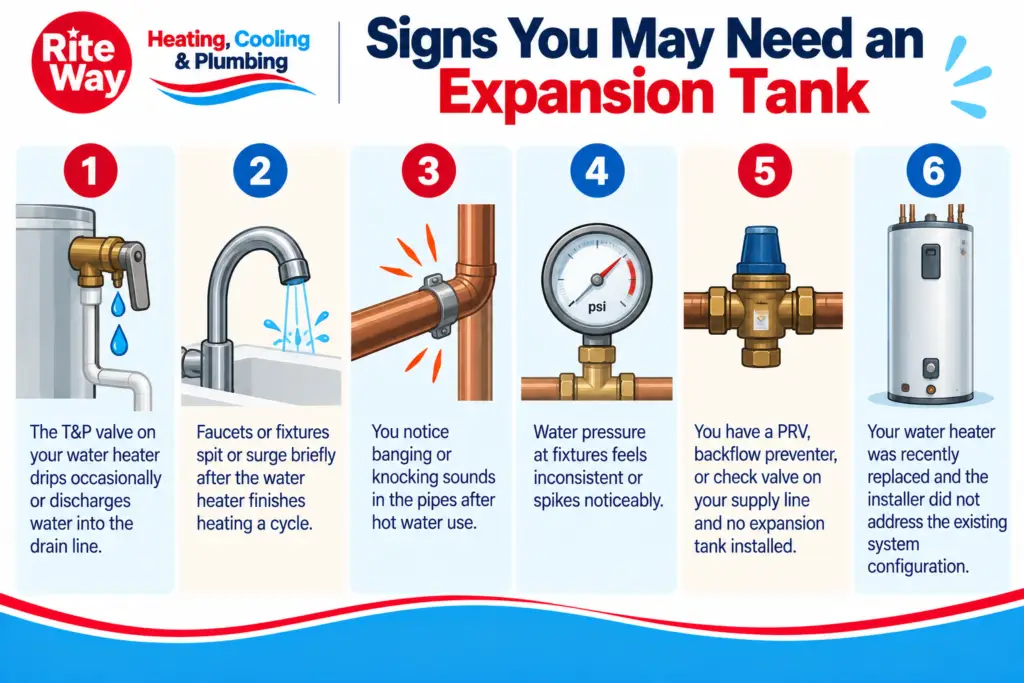
Any of these is worth having a plumber evaluate. Rite Way can assess your pressure and setup and advise on whether an expansion tank is appropriate. For context on water heater maintenance in general, see our post on maintaining your water heater.
Is an Expansion Tank Required by Code?
Plumbing codes generally require thermal expansion control on closed systems, and many jurisdictions also expect it when a water heater is replaced in a closed-system home. Requirements vary by city and county, and they are updated periodically. The safest approach is to check current local requirements with your building department before a water heater installation or replacement. Rite Way’s licensed plumbers are familiar with local requirements in Tucson and Pima County. If you are replacing your water heater, we make sure the new installation meets current code for your specific configuration.
How to Check an Existing Expansion Tank
If your home already has an expansion tank, it is worth checking periodically. Here is what to look for:
Tap test: Tap the expansion tank lightly with your knuckle at different heights. The upper portion should sound hollow (the air chamber). If the tank sounds solid throughout, it has likely waterlogged, meaning the diaphragm has failed and the tank is completely water-filled. A waterlogged expansion tank cannot absorb pressure and needs to be replaced.
Air valve check: Expansion tanks have a Schrader valve (like a tire valve) on the air side. A plumber can check whether the pre-charge pressure matches your home’s incoming water pressure, which is how it should be set. The air pre-charge is not a fixed number but it should equal your home’s supply pressure, typically measured at the PRV or main shutoff. Releasing air without knowing your home’s pressure is not recommended.
Signs of failure: Rust, visible leaks at the tank body or connections, or a T&P valve that resumes dripping after the tank was installed are all reasons to have a plumber evaluate the tank. Expansion tanks do not last indefinitely, and having one checked during a water heater maintenance visit is the simplest way to stay ahead of a failure.
What About Tankless Water Heaters?
Tankless water heaters heat water on demand and store very little water internally. Thermal expansion is less of a concern than with storage tanks, but it is not zero. Check your manufacturer’s instructions for guidance on your specific model, and confirm with your installer whether an expansion tank is recommended or required for your system configuration. Rite Way handles tankless water heater repair, replacement, and maintenance and can advise on the right setup for your home.
Expansion Tank vs. Well Pressure Tank
Homes on private wells have a pressure tank connected to the well pump, which is a different device from a thermal expansion tank. A well pressure tank manages pump operation and maintains consistent household pressure. It does not serve the same function as a thermal expansion tank on a water heater, and having one does not mean you also have thermal expansion control. If your home is on a well and the water heater is on a closed system, a separate expansion tank may still be appropriate. Rite Way serves homeowners in outlying Southern Arizona communities including Marana, Vail, and Green Valley, where private wells are more common.
Ready to Know If Your System Needs One?
Rite Way’s licensed plumbers serve Tucson, Marana, Oro Valley, Vail, Sahuarita, Green Valley, and communities across Southern Arizona. Whether you want your pressure checked, your existing expansion tank evaluated, or a new water heater installed correctly the first time, we give you honest options and upfront pricing before any work begins. We have been serving Arizona homeowners since 1959 and answer phones 24/7.