
A slab leak is a leak in a water or sewer line running beneath your home’s concrete foundation. The signs are often subtle at first: a higher water bill, a warm patch on the floor, a faint sound of running water when nothing is on. In Tucson, where desert soils swell and shrink with the seasons, many homes have pipes that are now decades old, and hard water accelerates pipe wear from the inside. Left unaddressed, a leak beneath your home can quietly cause water damage, mold growth, and structural damage that compounds every week it goes undetected. Here are the warning signs, a simple meter test, and what to do next.
Key Takeaways
- A rising water bill with no obvious cause is often the first sign.
- Warm floors, damp spots, cracks, and a musty smell can all point to a leak under the slab.
- A water meter test can confirm whether water is escaping before you call a plumber.
- Tucson’s shifting soils, aging pipes, and hard water all raise the risk.
- Professional leak detection can pinpoint the source without tearing up your floors.
9 Signs of a Slab Leak
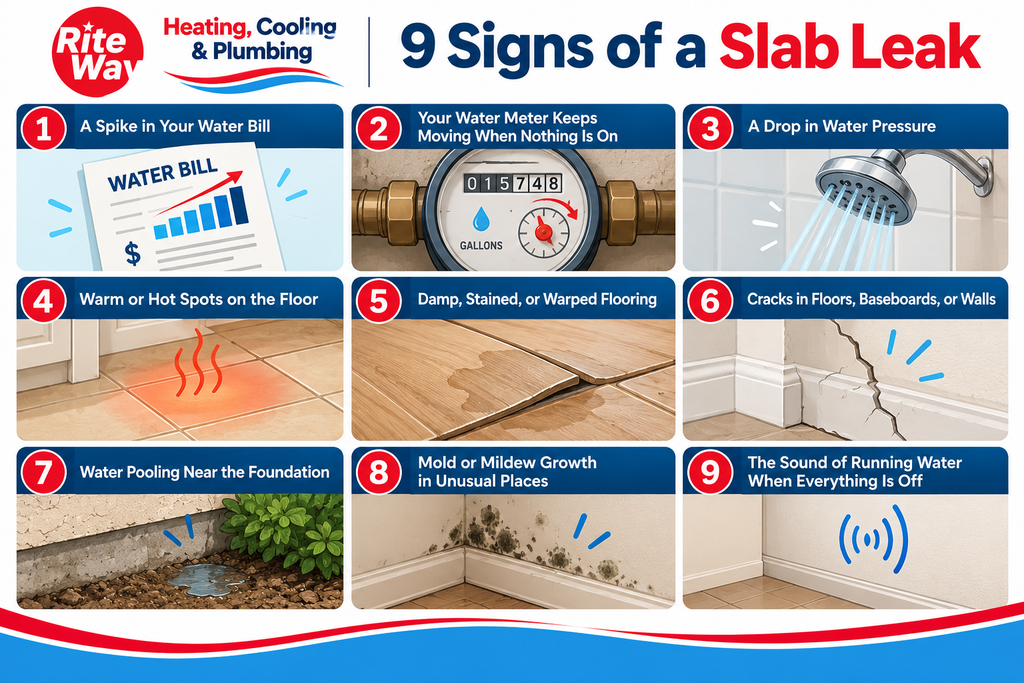
1. A Spike in Your Water Bill
If your usage habits have not changed but your bill keeps climbing, water may be escaping somewhere you cannot see. Compare the same month year over year. A consistent pattern of increases without explanation warrants a closer look.
2. Your Water Meter Keeps Moving When Nothing Is On
Turn off every faucet, appliance, and irrigation zone. Then watch the small leak indicator dial on your water meter. If it is still moving, water is leaving your system somewhere.
3. A Drop in Water Pressure
A house-wide pressure drop, not just at one faucet, can indicate water is escaping through a breach in the supply line. See our post on causes of low water pressure for more.
4. Warm or Hot Spots on the Floor
An escaping hot water line often reveals itself through warm patches on the floor. In Tucson homes with tile or concrete floors, a section that feels noticeably warmer in a fixed spot unrelated to sun or vents is worth noting.
5. Damp, Stained, or Warped Flooring
Water migrating upward through a cracked slab can cause flooring to buckle, stain, or develop an odor. Tile may shift at the grout lines; hardwood or laminate may cup or warp without any visible surface source.
6. Cracks in Floors, Baseboards, or Walls
Water under the slab can cause soil to shift unevenly, transmitting stress upward as cracks in tile, baseboards, drywall, or door frames that no longer sit square.
7. Water Pooling Near the Foundation
In a supply line slab leak, water sometimes finds a path out near the base of a wall or the foundation perimeter. In a desert climate, pooling with no obvious source near the house is meaningful.
8. Mold or Mildew Growth in Unusual Places
In Tucson’s dry climate, mold does not appear without a moisture source. Finding it along baseboards or under flooring with no nearby plumbing fixture is a signal worth investigating.
9. The Sound of Running Water When Everything Is Off
A faint hissing or rushing sound near the floor when no fixtures are running is worth taking seriously. For sewer-line leaks, slow drains throughout the house or a persistent sewage odor are the more common cues. A sewer camera inspection can confirm drain-line involvement.
Noticing two or more of these signs? Rite Way’s leak detection uses non-invasive ultrasonic equipment to find leaks under concrete without unnecessary demolition.
How to Check With Your Water Meter
- Turn off every water source: faucets, appliances, irrigation, and any softener regeneration cycle.
- Watch the small leak indicator dial on your meter. If it is moving, water is actively escaping.
- If the dial is still, wait one to two hours without using water, then check the reading again. If it changes, you have a leak.
- Close the main shutoff at the house and recheck. If the meter stops, the leak is inside the house. If it keeps moving, the leak may be in the service line between the meter and the house, which Tucson Water notes is the homeowner’s responsibility.
A positive test confirms a leak exists. Finding where it is requires professional equipment.
Rule Out These Look-Alikes First
Not every unexplained wet spot or climbing bill points to a slab leak. Before calling for detection, check a few common sources that can produce nearly identical symptoms in Tucson and Phoenix homes: drip irrigation emitters or supply lines leaking near the foundation, pool plumbing or shell leaks, an overflowing AC condensate drain line, a leaking water softener or RO system, and monsoon runoff pooling against the house from improper grading. If you have checked all of these and the meter still shows movement, a slab leak is a strong possibility. Rite Way’s leak detection covers pool lines, outdoor supply lines, and main water lines alongside under-slab detection, so multiple sources can be ruled in or out in a single visit.
Why Slab Leaks Are a Real Risk in Tucson
The Arizona Geological Survey notes that Arizona’s expansive soils swell with monsoon moisture and shrink through the hot dry months, which is a cycle that can rupture pipelines. Tucson’s median home was built in 1979, meaning many homes have copper or galvanized lines approaching or past the 40 to 50-year mark. Hard water adds to the problem: mineral buildup weakens pipes from the inside, and Tucson Water’s 2025 Annual Quality Report recommends a pressure-regulating valve when home pressure exceeds 80 psi. That combination of shifting soil, aging pipes, and mineral-heavy water under sustained pressure is why slab leaks show up regularly in Tucson’s older neighborhoods.
What to Do If You Suspect a Slab Leak
- Shut off the main water valve if water is visible or the meter is moving quickly.
- Move belongings away from wet areas and document everything with photos for your insurance claim but coverage varies, so check your policy directly.
- Do not open the floor yourself without a confirmed leak location.
- Call Rite Way for 24/7 emergency plumbing if the situation cannot wait.
How Professionals Find and Fix a Slab Leak
Rite Way uses non-invasive ultrasonic and acoustic listening equipment to pinpoint leaks beneath concrete before any cutting begins. Pressure testing isolates the affected section. For drain-line leaks, a sewer camera confirms the location.
Repair options depend on what detection finds. A localized leak in an otherwise sound pipe is typically a spot repair, the slab is opened at the confirmed location, the pipe is repaired, and the concrete is patched. If the pipe needs to be rerouted, it runs above the slab through walls or the attic instead. When a home has aging pipes throughout, repiping eliminates the underlying risk rather than addressing one failure at a time. Rite Way can advise on whether plumbing repair or repiping makes more sense after inspection. Phoenix-area homeowners can visit our slab leak repair in Phoenix page for more.
Serving Southern Arizona Since 1959
Rite Way’s licensed plumbers serve Tucson, Marana, Oro Valley, Vail, Sahuarita, Green Valley, and communities throughout Southern Arizona. We use non-invasive technology to find the source and give you honest options before any work begins. We have been serving Arizona homeowners since 1959 and answer phones 24/7. For urgent situations, our emergency plumbing team is available around the clock.
