If you’ve ever had your AC go down in the middle of a Tucson summer, you already know what that feels like. It doesn’t matter if you’re in a newer build in Marana, a mid-century home in Midtown, or a casita in the Barrio. When it’s 108°F outside and your system stops cooling, the inside of your home becomes dangerous fast. Tucson’s heat doesn’t leave much margin for error, and neither does a failed AC. You call for help and hope someone can get there before it gets worse.
What most homeowners don’t get is the full picture. You hear the diagnosis after the fact: “your capacitor failed,” “you had a refrigerant leak,” but rarely why it happened, how often it happens across Tucson specifically, or what the warning signs looked like in the weeks before the system gave out. In a market where your air conditioner runs from April through October and a breakdown isn’t an inconvenience but an emergency, that knowledge gap is costly.
Rite Way Heating, Cooling & Plumbing has been servicing homes across the Tucson area since 1959. Our technicians are in Tucson neighborhoods every day. Not dispatched from a call center, not passing through. This is our market, and these are our neighbors.
We pulled 100 completed AC repair calls from our own data: jobs our technicians finished across Tucson, Marana, Oro Valley, Sahuarita, Green Valley, Vail, and the surrounding communities, all within a single week in June 2026. We reviewed every work order and documented the most common failure patterns across the board.
*Because these calls came from a single week in June, this sample naturally leans toward heat-related failures.
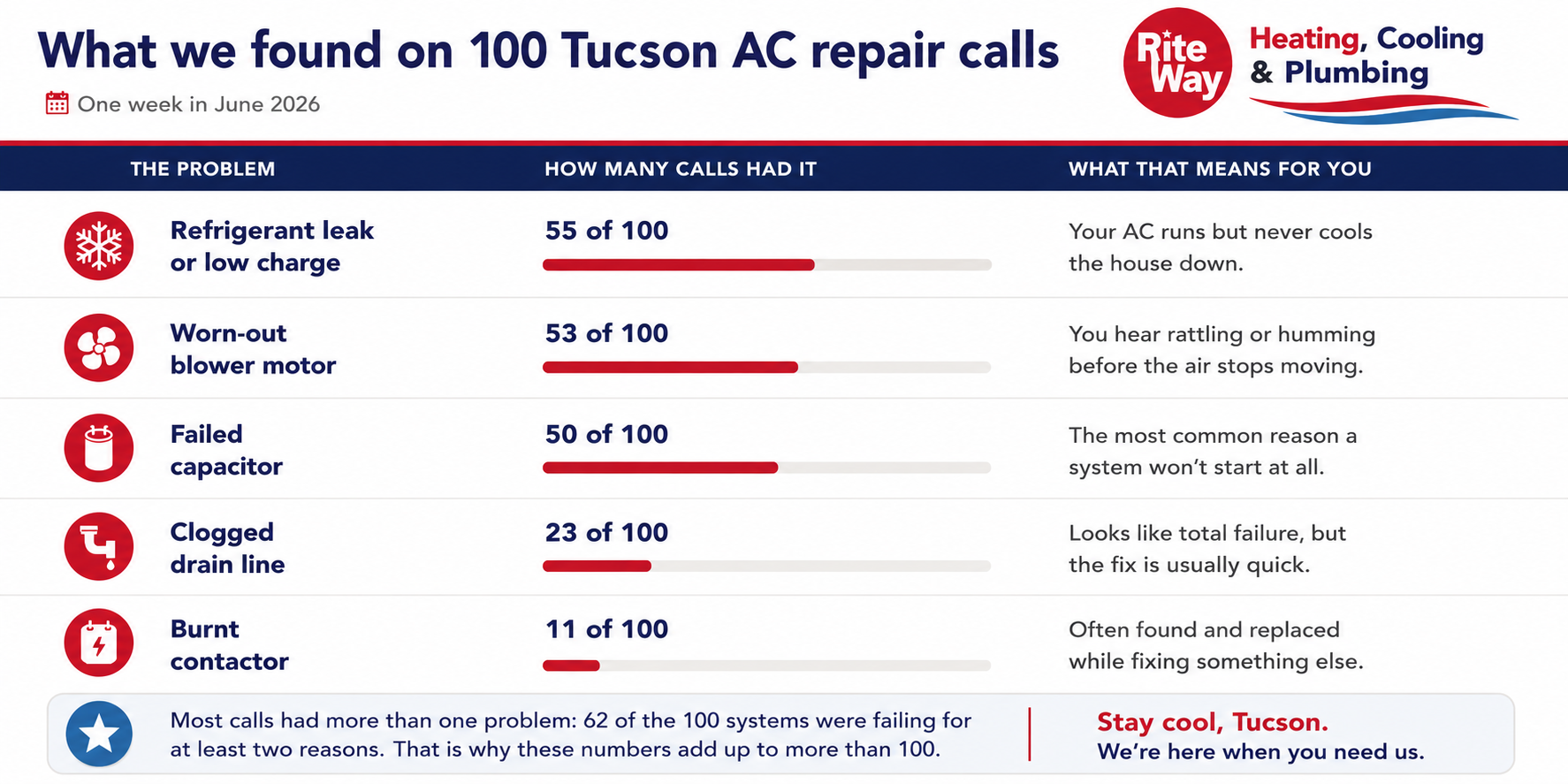
Refrigerant and leak-related issues appeared in 55 of 100 calls, and rarely announced themselves with a sudden shutdown. Low refrigerant is a slow fade: the system runs but never pulls the temperature down, or homeowners start noticing ice forming on the refrigerant lines or coil. By the time a call comes in, the problem has usually been building for a while.
The most common source our technicians found was the evaporator coil. Corrosion, vibration marks at the coil connections, and galvanic corrosion at the copper joints were recurring findings. In several jobs, techs spotted refrigerant staining or oil residue before even attaching an electronic detector.
A few things from this data worth understanding:
One call from Tucson illustrated the worst-case version of this: a 2002 Trane system with a confirmed refrigerant leak in the indoor coil. When our technician called Trane directly, they confirmed the coil was no longer manufactured. There was no repair path, only replacement. The homeowner had no idea the system was that far gone until it stopped cooling entirely.
Blower motor problems appeared in 53 of 100 calls, sometimes as the direct cause of a no-cool call, and often as a serious secondary finding during a full evaluation triggered by a different primary issue. The blower motor moves air across the evaporator coil and through your ductwork. When it starts to go, you often hear it before you feel it: a rattling, humming, or unusually loud noise from inside the air handler. Some systems throw an error code. Others quietly stop moving air altogether.
Signs our technicians found repeatedly:
In Vail, a homeowner who cleaned his own blower wheel inadvertently loosened a low-voltage wiring connection during reassembly. The system threw an error code and stopped. A quick wiring fix resolved it, a reminder that not every HVAC failure has a dramatic origin, and that secondary findings during a full evaluation catch things a quick fix never would.
The capacitor was the most common reason a system wouldn’t start at all. Capacitor failure appeared in 50 of the 100 calls we reviewed, making it one of the most common causes of AC breakdowns across every community we serve. A capacitor stores electrical charge and gives your compressor and fan motors the burst of energy they need to start. Without it, neither one runs.
Tucson’s heat is especially punishing on capacitors. Outdoor units here routinely sit in temperatures that push well past 100°F, sometimes 130°F or more in direct sun. Add in how many times a system cycles on and off during a 105°F day, and you have conditions that wear capacitors down far faster than they would in a milder climate. When one fails, it usually shows up one of two ways:
In most cases, replacing a capacitor restores cooling within the same visit. But our technicians don’t stop there. A failed capacitor rarely fails in isolation. A compressor that has been short-cycling due to a weak capacitor may already have elevated amp draws. A fan motor that has been straining to start may be leaking oil from the bearings.
One call from Oro Valley stood out: a homeowner whose capacitor had been previously replaced by another company with entirely the wrong size. A 70 microfarad capacitor had been installed where the compressor called for 45. The mismatch had been stressing components for an unknown period before we caught it.
If your outdoor unit is humming but not starting, or your system is running with no cooling output, a capacitor is the first thing a technician should test.

Condensate drain issues appeared in 23 of 100 calls, and this one surprises more homeowners than almost anything else on this list. As your AC cools your home, it pulls humidity out of the air, and in Tucson’s monsoon season, that’s a significant amount of moisture. It all drains through a PVC condensate line to the exterior of the home. When that line gets clogged with algae, dust, or debris, water backs up into the drain pan, triggers a float switch, and shuts the entire system down.
From a homeowner’s perspective, it looks like a complete failure. The thermostat is blank. The system is off. Nothing points to a clogged drain line.
Across our calls, the causes varied:
The fix is usually quick: clear the clog, flush the line, confirm proper drainage. The bigger concern is a backed-up drain that goes unnoticed. It can overflow into the furnace cabinet, the ceiling, or the flooring below. Flushing the condensate line once a year before cooling season starts is one of the simplest preventive steps a Tucson homeowner can take.
Contactor failure appeared in 11 of 100 calls, and more often than not, it was found alongside a capacitor issue rather than as a standalone failure. A contactor is a high-voltage relay inside your outdoor unit that controls power to the compressor and fan motor. Every time the system kicks on, the contactor absorbs that electrical load. Over time, and faster in Tucson’s sustained heat, the contact points burn and pit until they can no longer deliver power reliably.
A worn contactor can present in a few different ways:
In several of our calls, a technician replaced a capacitor and restored cooling, then found a visibly pitted contactor that would have caused another breakdown before summer’s end. Replacing it while already on site is a straightforward decision. Waiting until it fails means another no-cool call in the middle of July.
One thing that hasn’t changed across every summer we’ve worked in Tucson: the Sonoran Desert is one of the harshest environments an HVAC system can operate in, and most equipment isn’t rated for what it faces here.
A system that might last 18 or 20 years in a moderate climate gets pushed hard in Southern Arizona. From June through September, outdoor units operate in sustained heat that other markets rarely experience. Monsoon season adds humidity spikes that strain condensate systems and accelerate corrosion. Dust and debris clog blower wheels and coils faster than in nearly any other location. By the time a homeowner calls us, the system has often been fighting those conditions for years without an AC tune-up.
What stood out most in this data wasn’t any single failure mode. It was how rarely a system failed for just one reason. A failed capacitor and an oil-leaking motor. A clogged drain and a dust-caked blower wheel. A low refrigerant charge and galvanic corrosion on the coil connections. These things compound, and in Tucson’s climate, they compound fast. Central AC systems typically last 12–17 years here, and heat pumps 10–15 years, but those ranges assume the system is being maintained. Without it, the timeline shortens, and the failures get more expensive.
Rite Way technicians are available across Tucson and Southern Arizona. When we show up, we evaluate the full system and walk you through everything we find: no pressure, no guesswork. Just honest answers from an air conditioning company that has been doing this work in this community since 1959.

Call Rite Way or schedule online for a same-day air conditioning repair diagnostic.